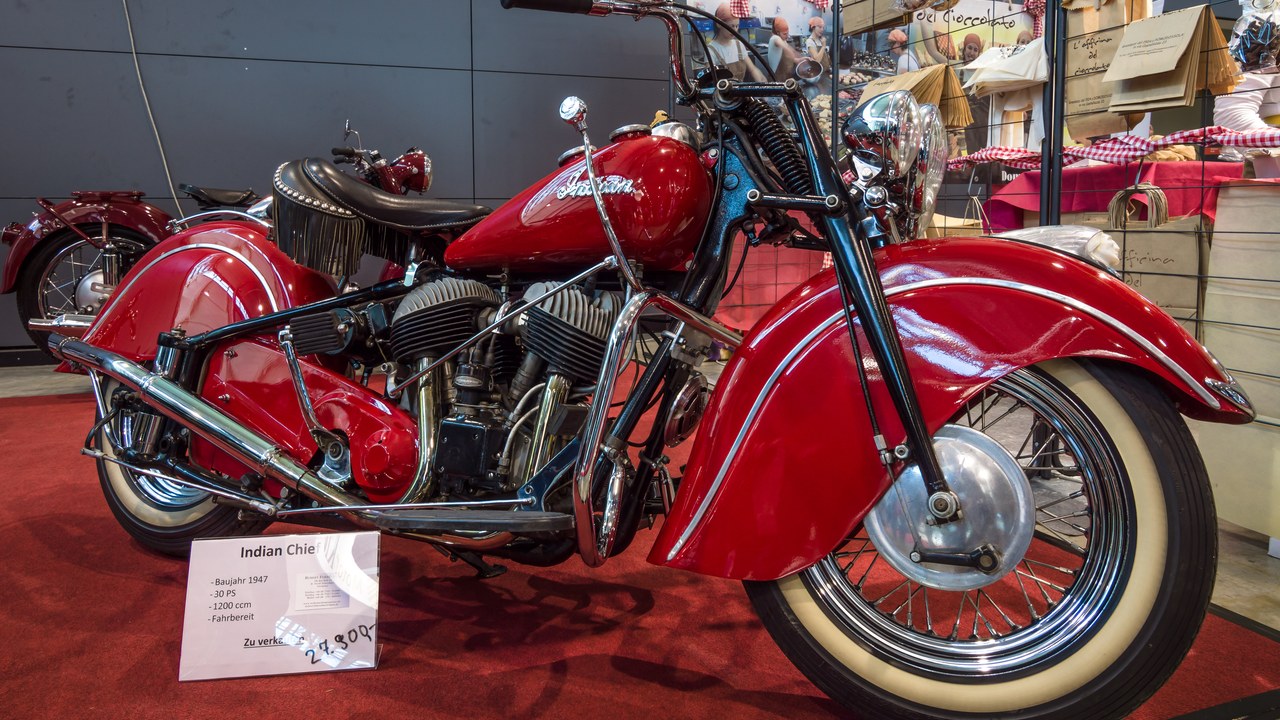
Indian’s factory in Springfield, Massachusetts, stopped building motorcycles in 1953. However, the Indian name itself outlived the plant. Before that date, the Springfield Indian motorcycle lineup ranged widely. It ran from early V-twins to an inline four and a shaft-drive design for the U.S. Army.
Below are seven Springfield models, in the order Indian introduced them.
1. 1916 Indian Powerplus
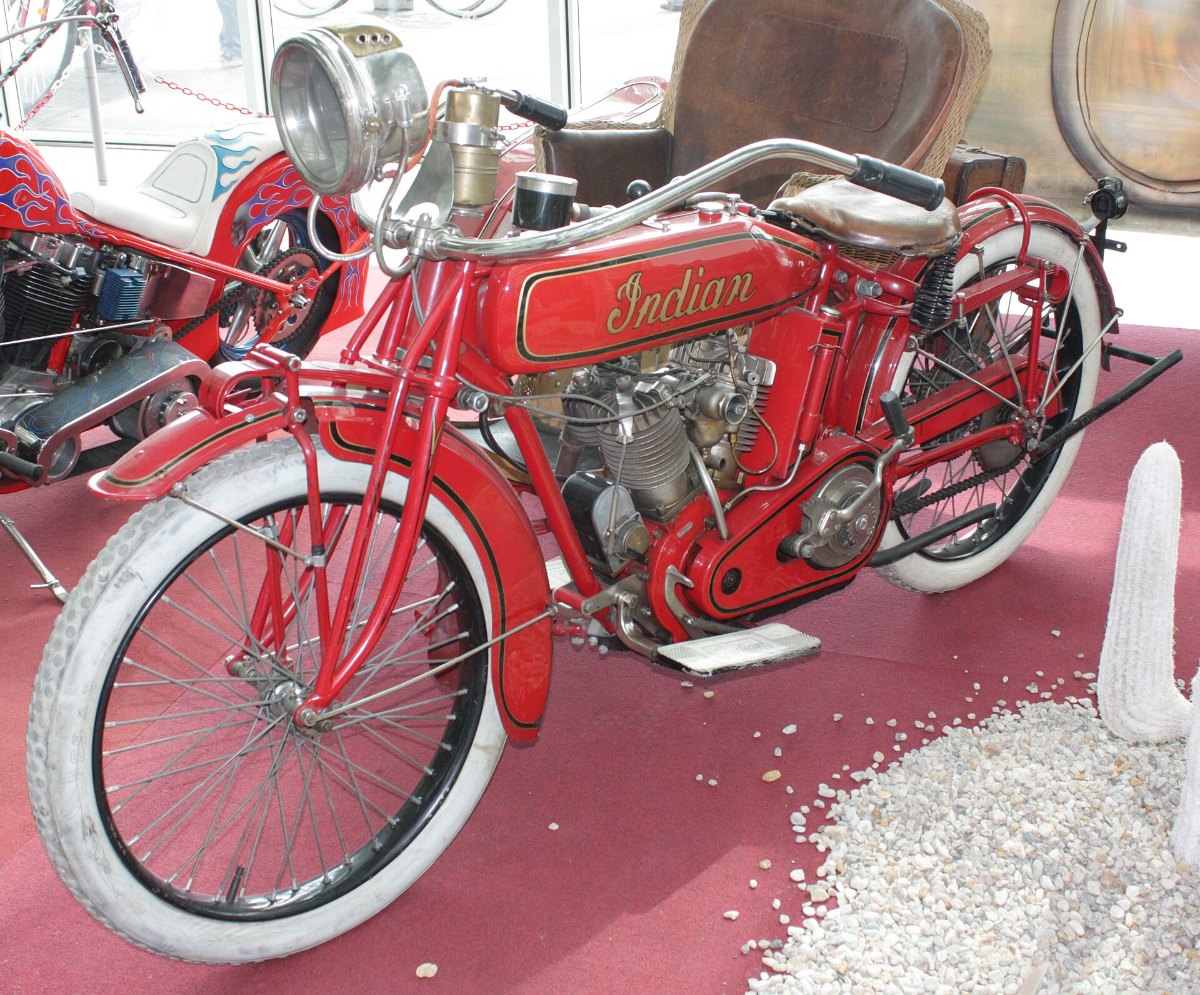
Charles Gustafson, Indian’s chief designer from 1915, created the Powerplus. At the time, the Springfield business that built it still went by the name Hendee Manufacturing Company.
Museums Victoria in Australia holds a sectioned factory display engine from the Powerplus. Its records list the Powerplus as a 986cc two-cylinder V-type with an aluminum crankcase. They also rate it at 15 to 18 horsepower and date its launch to 1916. In addition, the museum notes Indian sent works rider Erwin “Cannonball” Baker to Australia that year to set records. Later, according to the museum, Indian renamed the design the Standard in 1922 and built it until 1924.
2. 1920 Indian Scout

The Scout arrived four years after the Powerplus. The 1920 version is the starting point for the later Springfield models that carried the same name.
Indian Motorcycle’s own heritage page dates the first Scout to 1920. It says the bike drew many people into riding and racing because it was fast, dependable and easy to maneuver. Afterward, the Scout name covered several more models. Two of them appear further down this list.
3. 1922–1953 Indian Chief, the Springfield Indian Motorcycle Built to the End
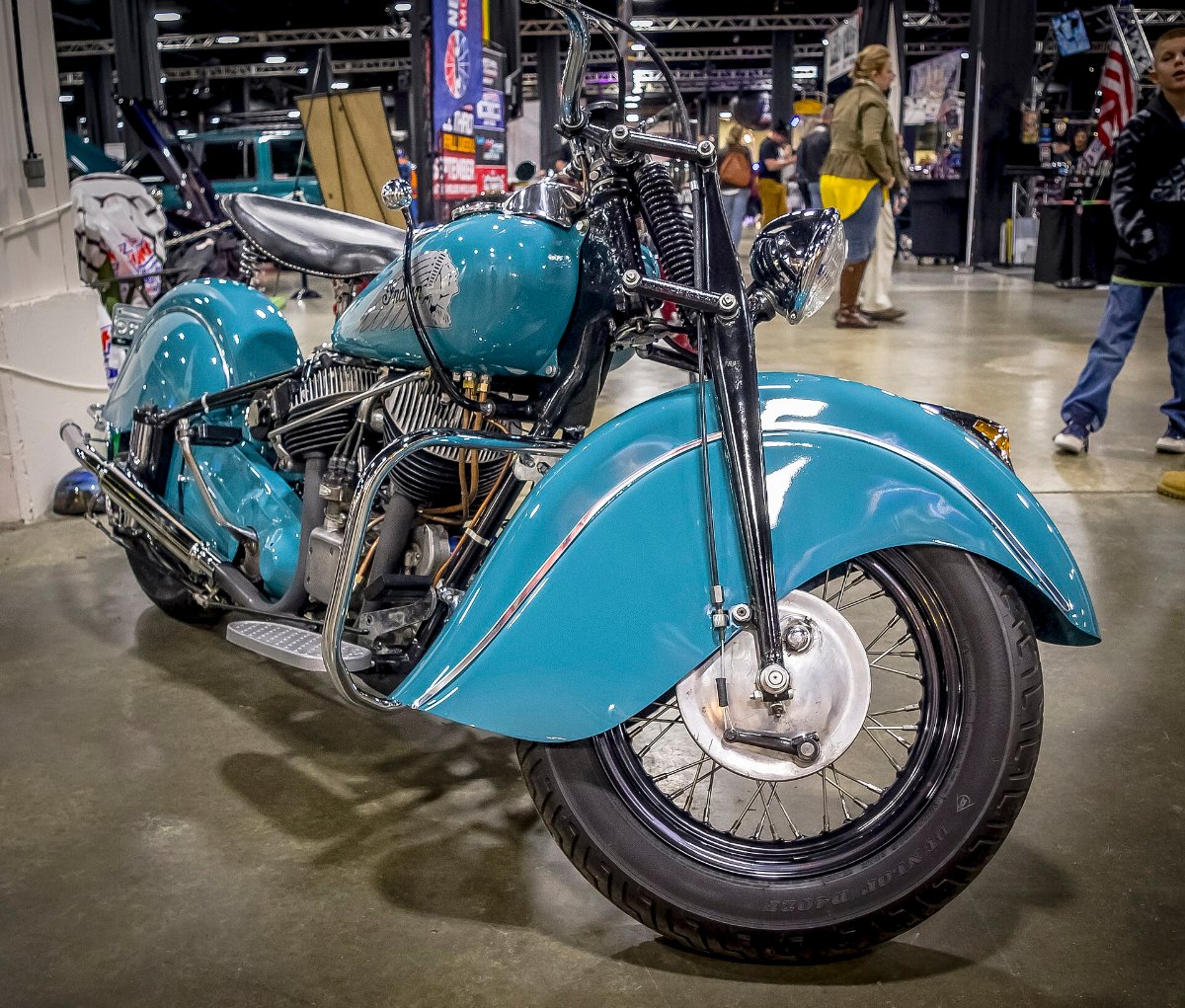
Charles Franklin designed the Chief, which arrived in 1922 as Indian’s large V-twin. It used the 61-cubic-inch engine size carried over from the Powerplus. A year later, the Big Chief added a 74-cubic-inch version, first aimed at sidecar work.
The deep skirted fenders most people associate with the Chief came in 1940, according to Visordown’s history of the model. The Chief was also the model Springfield was building at the very end. Motorcycle Classics reports that Indian built about 350 1953 Chiefs before the factory closed. Those bikes used an 80-cubic-inch (1,300cc) engine, which Indian had created in 1950 by lengthening the stroke.
4. 1928–1941 Indian Four

Indian built an inline four-cylinder motorcycle after taking over Ace in 1927, as Hagerty’s history of the brand notes. The engine design came with that purchase.
The National Motorcycle Museum says the original 1928 Indian Four used an engine designed by Arthur Lemon and Bill Henderson. Indian acquired it from the Schwinn-owned Ace company, and it displaced 77.21 cubic inches (1,265cc). Meanwhile, the museum lists its 1941 spring-frame example at 40 horsepower and 568 pounds. It also notes Four production effectively ended once the United States entered World War II in December 1941.
5. 1928 Indian 101 Scout

Eight years after the first Scout, Indian reworked the model into the 101 Scout. The changes focused on how the bike steered and how it fit its rider.
According to Indian Motorcycle’s heritage page, the 1928 101 Scout got a new frame. It brought more fork rake, a longer wheelbase and a lower seat, along with a stronger 45-cubic-inch engine. That 45-cubic-inch figure put it in the same displacement class as the Sport Scout that followed.
6. 1934–1942 Indian Sport Scout
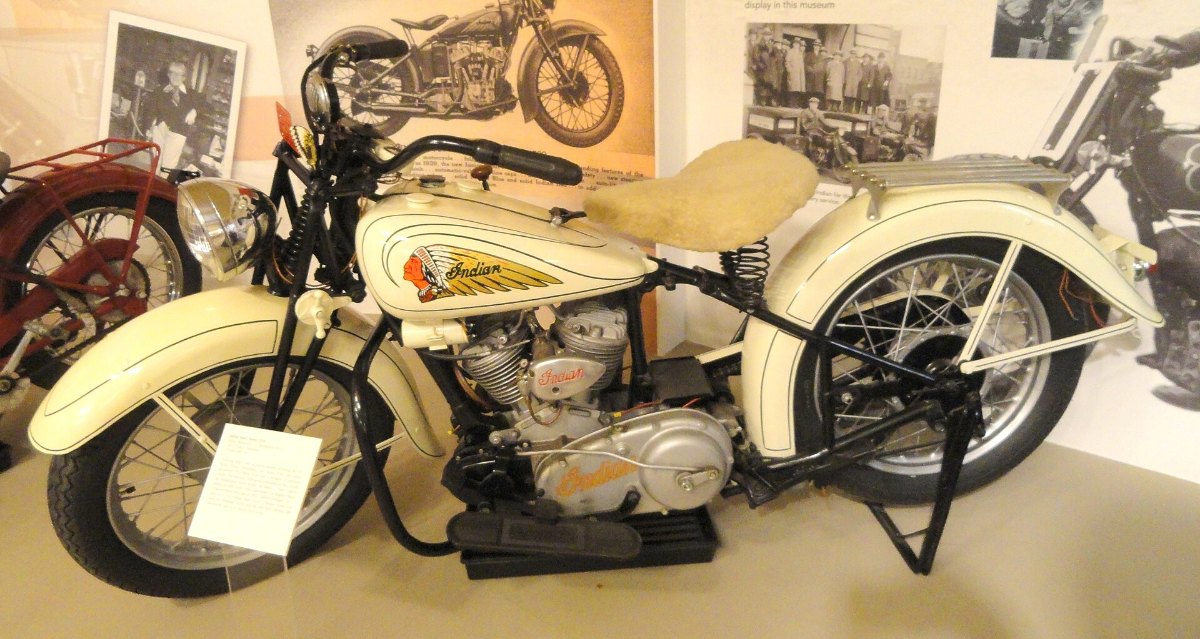
The Sport Scout became Indian’s racing middleweight. In fact, the museum that owns one credits it with many wins over roughly two decades of competition. It used a 42-degree, side-valve V-twin of 45 cubic inches (745cc).
The National Motorcycle Museum’s entry on a 1940 Sport Scout racer dates the model from 1934 to 1942. Meanwhile, Indian Motorcycle’s heritage page records that Ed Kretz won the first Daytona 200, in 1937, riding a Sport Scout.
7. 1941–1942 Indian Model 841
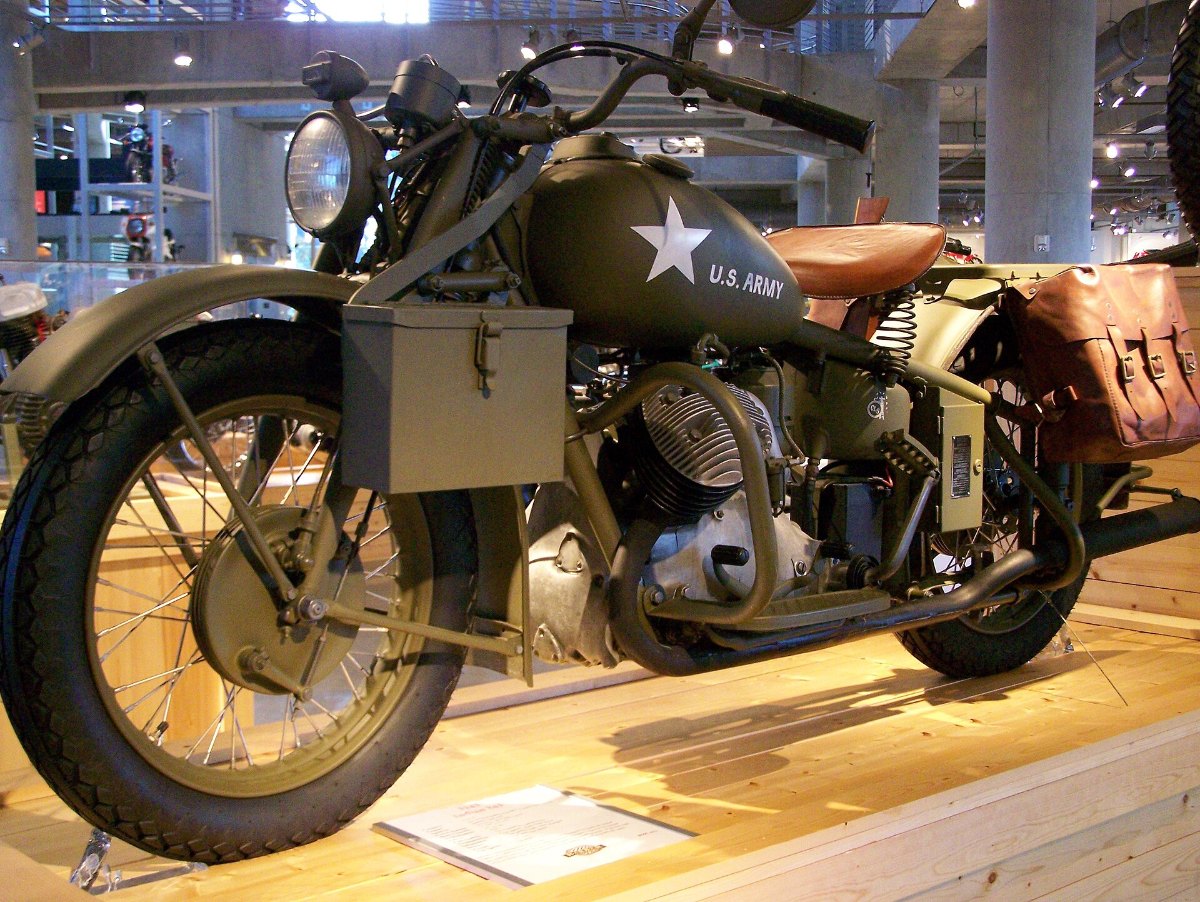
In autumn 1941, the U.S. Army asked Harley-Davidson and Indian to each build 1,000 shaft-drive, side-valve twins for testing. The Army offered $350,000 to each company, according to Motorcycle Classics. Indian’s answer was the 841. Its V-twin sat sideways in the frame, with the cylinders set at 90 degrees.
The lot description from RM Sotheby’s lists a 45.44-cubic-inch, 24-horsepower engine, a four-speed foot-shift gearbox and shaft drive. It also says Indian built a little over 1,000 of the 841s by 1942. Finally, the 1941 example in that sale sold for $35,500. It was part of the National Military History Center auction.
More from Fast Lane Only
- Unboxing the WWII Jeep in a Crate
- 15 rare Chevys collectors are quietly buying
- 10 underrated V8s still worth hunting down
- Police notice this before you even roll window down
This article was created with the help of AI and was reviewed and edited by Fast Lane Only editors before publication.