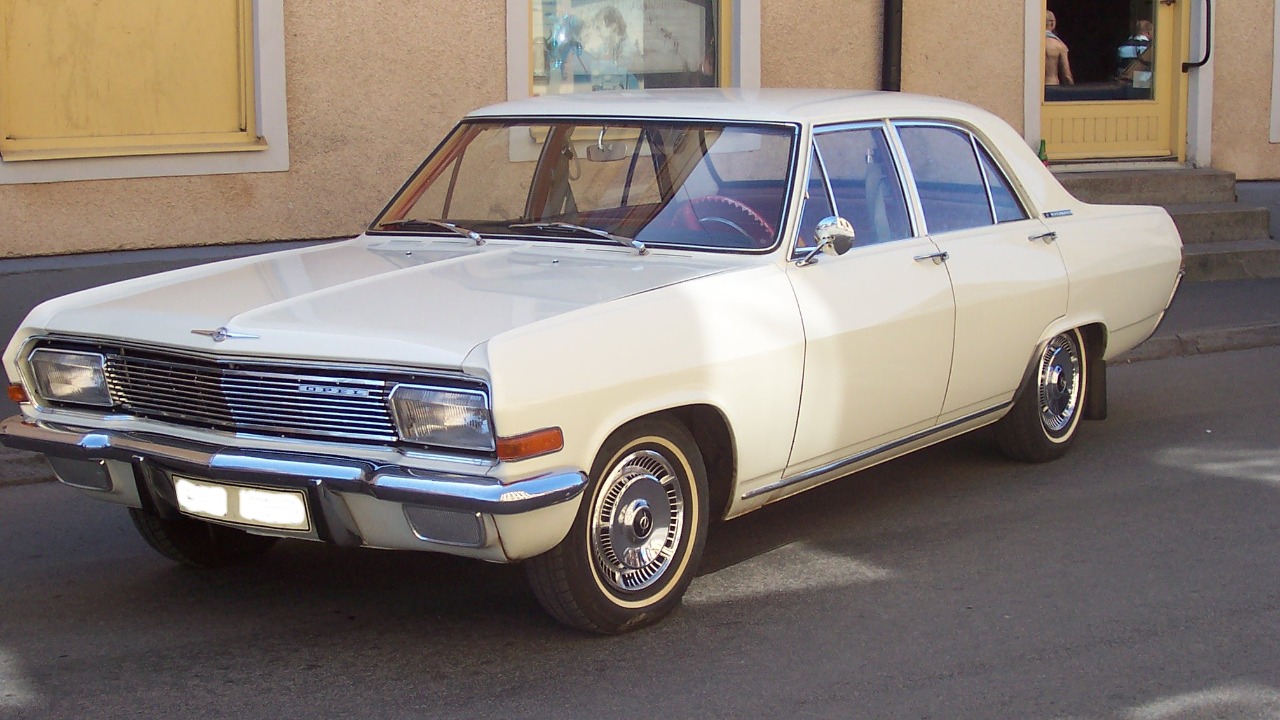
The 1964 Opel Kapitän rarely tops wish lists for European classics, yet it quietly delivered the kind of comfort and restrained glamour that defined an entire era of family luxury. Sitting at the base of Opel’s flagship range, it wrapped American inspired lines around German engineering and a genuinely relaxing driving experience. In a market obsessed with badges, the Kapitän A became the comfortable, stylish alternative that did its best work out of the spotlight.
The long road to the 1964 flagship
By the time the 1964 Opel Kapitän A arrived, the name already carried decades of history. According to period histories, the Kapitän line had been in production since 1938, giving Opel a continuous presence in the large saloon segment that few European rivals could match. The model that appeared just before the 1964 car, often called the P2, had already established a reputation as a big, soft riding sedan for drivers who wanted space more than sport. Contemporary accounts of the early 1960s note that if a buyer in Germany wanted a large car with bench seats that could carry six people in comfort with a substantial six cylinder engine, the Opel Kapitän was more or less the only realistic choice.
That lineage stretched back to the original prewar Kapitän, which enthusiasts describe as a unitary construction car similar in concept to the smaller Olympia, powered by a 2.5-litre overhead valve six cylinder engine. Surviving descriptions of the 1952 Opel Kapitän saloon stress that the American influence was already evident, with a smooth straight six and generous cabin space that set it apart as a classic German luxury car. The Kapitän name therefore arrived in the 1960s already associated with modern engineering, solid comfort and a hint of transatlantic style.
The corporate backdrop also mattered. General Motors had taken a majority stake in Opel and then full control in 1931, creating a long period of American ownership of the German automaker. That relationship shaped everything from styling to drivetrain choices. By the early 1960s, Opel and its parent were using that connection to position the Kapitän as a European answer to American full size sedans, but tuned for narrower roads and higher fuel prices. The 1964 car would become the clearest expression of that strategy.
KAD: a three tier flagship family
In 1964 Opel introduced a completely new trio of large saloons known collectively as the KAD range, an acronym built from Kapitän, Admiral and Diplomat. The Kapitän served as the base model in this three tier structure, with the Admiral and Diplomat sitting above it in price and prestige. As contemporary descriptions of the Opel Kapitän explain, this KAD family shared a common body and mechanical layout, with detail differences in trim, engines and equipment to justify the hierarchy.
Within that structure, the Kapitän A had a clear mission. It was meant to be the accessible flagship, the car that delivered most of the size and comfort of the Admiral and Diplomat without their price tags. Later commentary on the KAD range notes that the hierarchy was simple: Kapitän at the base, Admiral in the middle and Diplomat at the top, with the Diplomat often associated with the most powerful engines and the most lavish appointments. The Kapitän A, by contrast, focused on giving company car drivers and private buyers a big car experience without the excess.
Under the skin, the Kapitän A shared its engines with the contemporary Opel Admiral. Enthusiast references list a 2.6 litre inline six and a 2.8 litre six, with output figures around 110 hp in 1966 and 1967. Those numbers, quoted as 2.6, 2.8 and 110 with the later years abbreviated as 67, placed the Kapitän squarely in the middle of the European power spectrum for executive cars. The shared powertrain strategy allowed Opel to spread development costs across the KAD range while still giving the Kapitän enough performance to cruise comfortably at autobahn speeds.
Higher up the ladder, the Diplomat was the car that carried the most overt American hardware. Period technical summaries describe how the Diplomat V8 used a Chevrolet small block engine labeled 283, with a displacement of 4.6 litre. That V8 Chevrolet unit gave the top model effortless performance and a distinct character, but it also highlighted the Kapitän’s more understated role. With its inline six cylinder gasoline engines, the base car aimed at quiet, steady progress rather than raw speed.
American lines, German manners
Visually, the 1964 Opel Kapitän A made no attempt to hide its American inspiration. Contemporary descriptions of the KAD body note its clear styling similarity with the Vauxhall Cresta PC, another General Motors product that drew heavily on Detroit themes. Long horizontal lines, a wide grille and a formal roofline gave the Kapitän a presence that looked more at home on a boulevard than in a cramped city street. Photographs of a 1964 OPEL Kapitän A 2600 Limousine show a car with substantial chrome, broad shoulders and a dignified stance, very much in line with full size American sedans of the period.
Beneath that styling, however, the Kapitän A behaved like a German car. Detailed reviews of the Opel Kapitan, Admiral and Diplomat from the mid 1960s describe an impressive combination of United States inspired style and power with German engineering. Commentators praised a ride and handling balance that could be mentioned in the same breath as the Mercedes Benz S Class, which set the benchmark for refinement at the time. The KAD cars, including the Kapitän, managed to feel soft and comfortable on rough surfaces while still maintaining control at higher speeds, a balance that many American sedans of the era struggled to match.
One retrospective assessment of the Opel Kapitan, Admiral range highlights that this ride and handling compromise was among the best in its class. The same evaluation notes, however, that despite being so good to drive, the KAD models were often considered over priced and over sized for European tastes. That judgment explains much of the Kapitän A’s later obscurity. It was engineered to a high standard, yet it sat slightly out of step with a continent that was rapidly embracing smaller, more efficient cars.
The connection between American and German influences ran deeper than looks and suspension tuning. Enthusiast videos dedicated to the Kapitän A describe how the car was produced from 1964 to 1968 and combined American inspired design with German engineering to offer a premium driving experience. That positioning helped Opel market the KAD range as aspirational without directly copying domestic rivals. The Kapitän A in particular became the understated choice for buyers who liked the idea of a big car but did not necessarily want the flashiest badge.
A cabin built for six and for comfort
Inside, the 1964 Opel Kapitän A leaned even harder into comfort. Contemporary descriptions emphasize that the interior was spacious, with enough width to accommodate up to six passengers. The front bench seat, a feature more commonly associated with United States sedans, allowed three abreast seating in front and three in the rear. A detailed video overview of the model notes that this layout made the Kapitän A the last Opel passenger car with this feature, which underlines how quickly European manufacturers moved toward individual front seats in the late 1960s.
The same source explains that the interior of the Opel Kapitän A was designed around relaxed long distance travel. Buyers got generous legroom, large windows and a relatively low beltline that improved visibility. Materials were not as lavish as those in the Diplomat, but the Kapitän still offered bright trim, clear instruments and a dashboard that blended American horizontality with German clarity. The overall effect was more lounge than cockpit, which suited the car’s role as a family and business cruiser.
Under the bonnet, the inline six cylinder engines contributed to the sense of ease. Period technical notes on the KAD range describe these sixes as smooth and durable, with enough torque to move the big saloon without strain. The 2.6 and 2.8 litre units shared with the Opel Admiral gave the Kapitän respectable performance while avoiding the thirst of the Chevrolet 283 V8 used in the Diplomat. For drivers who spent long hours on the autobahn, that combination of refinement and relative efficiency made more sense than outright power.
One enthusiast video about the Opel Captain A stresses that the car was more affordable than many rivals in its size class, which further explains its appeal to fleet buyers and middle managers. They could enjoy a large, comfortable saloon with a front bench seat and space for colleagues or family, all without stepping up to the more expensive Admiral or Diplomat. The Kapitän’s quiet competence in this role is part of why it faded into the background of automotive history: it did its job so well that few people felt the need to talk about it.
Driving character and the comfort equation
On the road, contemporary and retrospective accounts agree that the 1964 Opel Kapitän A was tuned for comfort first. The suspension soaked up poor surfaces, and the steering, while not especially sharp, was light enough to make the large saloon manageable in town. Reviews that compare the KAD range to the Mercedes Benz S Class highlight how the Opel cars managed to deliver a similar sense of isolation from bumps at a lower price point. For drivers who valued a relaxed ride more than cornering precision, the Kapitän made a strong case for itself.
At the same time, the car’s size and soft setup meant it was never going to convince enthusiasts who preferred smaller sports saloons. Later evaluations of the ride and handling note that while the Kapitän and its KAD siblings were impressive compared with many large cars, they still felt over sized on European streets. That perception limited their appeal in markets where parking spaces and fuel budgets were both tight.
Engine choice reinforced the Kapitän’s character. The inline sixes delivered a smooth, unhurried surge of power rather than an urgent rush. In a period when some rivals were embracing smaller four cylinder engines to save fuel, Opel’s decision to stick with six cylinders in its big saloon signaled a commitment to refinement. The availability of the Chevrolet 283 V8 in the Diplomat created a clear performance halo at the top of the KAD family, but the Kapitän’s more modest output suited its role as a comfortable daily companion rather than a status symbol.
Braking and transmission technology reflected mid 1960s norms. Many KAD cars used drum brakes at the rear with discs at the front and offered both manual and automatic gearboxes. While specific performance figures vary by engine and year, the consensus among enthusiasts is that the Kapitän A felt composed at typical cruising speeds, with predictable if unspectacular stopping power. The focus remained on making long journeys as effortless as possible, not on setting lap times.
Why the Kapitän slipped into the shadows
Given its strengths, the relative obscurity of the 1964 Opel Kapitän A can seem surprising. Several factors help explain why it receives so little attention today compared with some contemporaries. The first is simple branding. Within its own family, the Kapitän sat below the Admiral and Diplomat, which inevitably drew more prestige focused buyers and more publicity. The Diplomat in particular, with its Chevrolet 4.6 litre V8 and luxury positioning, became the face of the KAD range in many markets, leaving the Kapitän as the quiet workhorse.
The European market was also changing rapidly in the mid 1960s. As incomes grew, many buyers who could afford a large car preferred to spend their money on established luxury badges such as Mercedes Benz or on sportier offerings from brands like BMW. Later analyses of the KAD range point out that the cars were often seen as over sized and over priced for typical European needs. A buyer who wanted a big Opel might also have considered a smaller, more efficient model like the Rekord, which offered enough space for most families without the bulk of a full size saloon.
The Kapitän name itself would not survive the decade. The Opel Kapitän B, produced from March 1969 to May 1970, was the final model in the line and the first of the KAD trio to be discontinued. Enthusiast coverage of the The Opel Kapit B notes that it was built for only about eleven months, which underlines how quickly Opel’s product strategy shifted away from the traditional big saloon formula. With the Kapitän name gone, later generations of buyers had little reason to remember the earlier A model.
Finally, the car’s quiet competence worked against it in the long term. The 1964 Kapitän A did not dominate motorsport, nor did it introduce radical new technology. It simply provided a comfortable, stylish way to travel for families, executives and taxi drivers. When the time came to scrap or sell these cars, few owners felt they were parting with a future collectible. As a result, surviving examples are relatively rare today, and the model has not benefited from the nostalgia that surrounds more iconic nameplates.
A forgotten flagship with enduring appeal
For those who seek it out, the 1964 Opel Kapitän A offers a distinctive blend of qualities that feel surprisingly modern. Its combination of American influenced styling, German engineering and a focus on comfort aligns closely with what many drivers still want from a long distance car. The spacious six passenger interior, complete with front bench seat, anticipates current interest in versatile cabins, even if the layout itself has disappeared from mainstream production.
Enthusiast communities that celebrate the KAD range often describe the Kapitän as the most approachable way into this world. The car shares its basic structure and many components with the more expensive Admiral and Diplomat, yet it carries less of a price premium in the classic market. References to the KAD trio as Germany’s forgotten flagships underline how the entire range has been overshadowed by better known rivals, but they also hint at an opportunity for collectors who value comfort and character over badge prestige.
More from Fast Lane Only