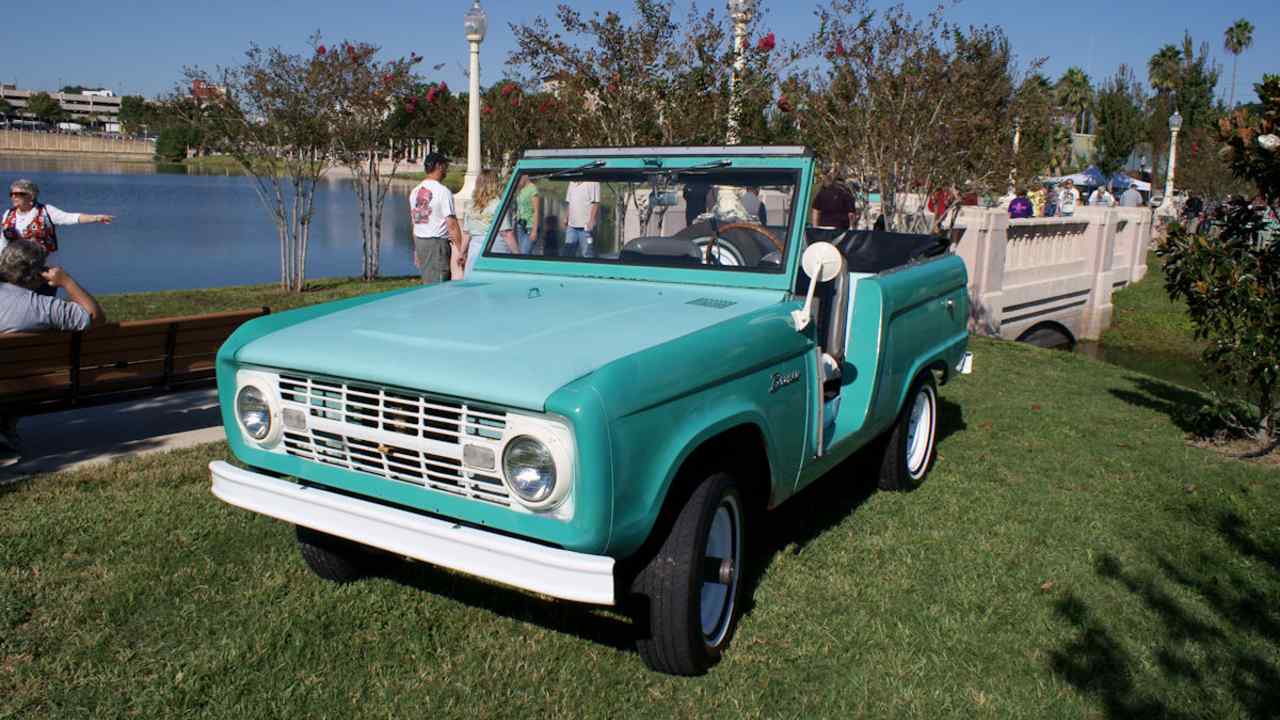
Today, SUVs dominate the automotive landscape.
They serve as family vehicles, luxury transportation, commuter cars, road-trip machines, and status symbols. Modern SUVs are packed with technology, designed for comfort, and often spend their entire lives on paved roads. Many buyers never take them off-road, despite the rugged imagery frequently used in advertising.
When Ford introduced the Bronco in 1966, however, the mission was entirely different.
The original Bronco wasn’t designed to shuttle families between soccer practice and grocery stores. It wasn’t intended to compete with luxury vehicles or provide a commanding view of traffic. Instead, Ford created the Bronco as a compact, capable utility vehicle aimed at buyers who genuinely needed off-road performance and versatility.
In many ways, the first Bronco was closer to a tool than a lifestyle accessory.
It was built to work.
It was built to explore.
And it was built to compete in a growing market for rugged four-wheel-drive vehicles that prioritized capability over comfort.
More than half a century later, the contrast between the original Bronco and today’s SUVs reveals just how dramatically the automotive industry has changed.
Ford Saw an Opportunity in a Growing Market
During the early 1960s, Ford noticed an important trend.
A small but steadily growing number of buyers were purchasing compact four-wheel-drive vehicles designed for off-road use. Models such as the Jeep CJ-5 and International Harvester Scout had established loyal followings among farmers, ranchers, outdoorsmen, and recreational users.
These vehicles were practical and capable, but Ford believed there was room for improvement.
The company saw an opportunity to create something that combined rugged off-road ability with better everyday usability. Rather than simply copying existing competitors, Ford wanted to develop a vehicle specifically designed to meet the needs of this growing market.
The result became the Bronco.
From the beginning, it was conceived as a purpose-built utility vehicle rather than a traditional passenger car.
The Bronco Was Designed From Scratch
Unlike many modern SUVs that share platforms with existing cars or trucks, the original Bronco received its own dedicated architecture.
Ford engineers didn’t simply modify another vehicle and add four-wheel drive. Instead, they created a unique platform specifically tailored to the Bronco’s intended mission.
This approach allowed the company to optimize dimensions, suspension design, and overall packaging for off-road performance.
The resulting vehicle was compact, maneuverable, and surprisingly capable in difficult terrain. Its relatively short wheelbase helped improve agility, while its straightforward engineering emphasized durability and ease of maintenance.
The Bronco wasn’t trying to be everything to everyone.
It was designed to excel at a specific job.
Comfort Was Not the Priority
One of the biggest differences between the original Bronco and modern SUVs involves comfort.
Today’s SUVs often emphasize quiet cabins, premium materials, advanced infotainment systems, and sophisticated ride quality. Manufacturers understand that most buyers use these vehicles primarily as daily transportation.
The 1966 Bronco came from a very different world.
Ford focused on utility first. The interior was simple, durable, and functional. Materials were chosen for practicality rather than luxury. Features that modern buyers consider essential either didn’t exist or were available only as optional equipment.
The emphasis remained firmly on capability.
Owners were expected to value ruggedness more than refinement.
That philosophy shaped every aspect of the vehicle.
Multiple Body Styles Expanded Its Utility
Ford recognized that utility buyers had diverse needs.
As a result, the Bronco launched with several body configurations, including a traditional wagon, a pickup-style version, and an open-roadster model. Each variant targeted different customers while maintaining the same core mechanical foundation.
The wagon appealed to buyers seeking enclosed cargo space and greater weather protection. The pickup version offered increased utility for work-related tasks. The roadster emphasized open-air recreation and simplicity.
This flexibility reflected the Bronco’s mission.
Ford wasn’t creating a lifestyle vehicle.
The company was creating a versatile platform capable of serving multiple roles.
The different body styles reinforced that practical focus.
Four-Wheel Drive Was Standard
Another important distinction involved drivetrain philosophy.
Today, many SUVs are sold with front-wheel drive and rarely leave paved roads. Four-wheel drive or all-wheel drive often serves primarily as a convenience feature for adverse weather conditions.
The original Bronco took a different approach.
Four-wheel drive was standard equipment.
Ford assumed that Bronco buyers intended to use their vehicles in challenging environments. Off-road capability wasn’t a secondary consideration or optional extra.
It was fundamental to the vehicle’s identity.
Everything from the suspension design to the drivetrain configuration reflected this commitment.
The Bronco’s capabilities were genuine, not merely advertised.
Ford Targeted Outdoor Enthusiasts
The Bronco’s marketing reflected its intended audience.
Ford promoted the vehicle as a tool for outdoor recreation, exploration, and work. Advertisements frequently depicted the Bronco in natural settings rather than urban environments.
The imagery emphasized fishing, camping, hunting, ranching, and other outdoor activities.
This approach made sense.
The company understood that many prospective buyers needed a vehicle capable of reaching locations inaccessible to ordinary passenger cars. The Bronco promised freedom and capability rather than luxury or prestige.
Its appeal came from what it could do.
Not from what it said about the owner’s social status.
Simplicity Was a Strength
One reason the original Bronco earned such a loyal following was its mechanical simplicity.
The vehicle featured straightforward engineering that owners could understand and maintain. Components were robust, durable, and designed with practicality in mind.
This simplicity proved especially valuable in remote areas where reliability mattered tremendously.
Owners appreciated the fact that the Bronco could withstand demanding conditions without requiring excessive complexity. The vehicle developed a reputation for toughness that helped establish its credibility among serious off-road users.
In many ways, the Bronco’s simplicity became one of its greatest assets.
The vehicle did exactly what it was designed to do.
It Helped Define a New Category
Although SUVs are commonplace today, the market looked very different in 1966.
The Bronco entered a segment that was still evolving and helped establish many of the characteristics that would eventually define sport utility vehicles.
However, the vehicle’s original interpretation of the category differed substantially from what followed.
The Bronco emphasized utility, durability, and capability above all else. It was designed for people who genuinely needed those attributes.
As the SUV market expanded over subsequent decades, manufacturers increasingly shifted toward comfort, convenience, and family-oriented features.
The original Bronco represented an earlier vision of what the category could be.
The Market Eventually Changed
Ironically, the Bronco’s long-term influence contributed to the transformation of the segment.
As SUVs became more popular, manufacturers discovered that many buyers appreciated the image of ruggedness even if they rarely ventured off-road.
This realization led to a gradual shift.
Vehicles became larger, more comfortable, and more car-like. Luxury features expanded. Ride quality improved. Technology became increasingly important.
The modern SUV emerged from this evolution.
The original Bronco, meanwhile, remains a reminder of where the segment began.
Its priorities reflected a very different era.
Enthusiasts Still Appreciate the Original Mission
Today, early Broncos enjoy tremendous popularity among collectors and enthusiasts.
Part of that appeal comes from nostalgia. Part stems from the vehicle’s classic styling and historical significance.
Many enthusiasts also appreciate the original Bronco because it feels authentic.
The vehicle wasn’t designed around marketing trends or lifestyle aspirations. It was created to perform a specific task and perform it well.
That clarity of purpose remains attractive.
The Bronco’s honesty resonates with people who value capability and simplicity.
The SUV Before SUVs Changed
Looking back, the 1966 Ford Bronco occupies a fascinating place in automotive history.
It helped establish one of the industry’s most important vehicle categories while embodying values that differ dramatically from many modern SUVs.
The vehicle prioritized utility over luxury, capability over convenience, and durability over sophistication.
Those priorities reflected the realities of its time.
A Different Kind of Sport Utility Vehicle
The 1966 Ford Bronco launched with a very different mission than today’s SUV because it was designed primarily as a rugged tool rather than a versatile family vehicle.
Ford built it to compete with compact four-wheel-drive machines, serve outdoor enthusiasts, and tackle demanding terrain. Comfort, luxury, and status were secondary considerations at best.
More than fifty years later, the automotive world has changed dramatically.
SUVs have become mainstream transportation for millions of families.
Yet the original Bronco remains important because it reminds us what the category was originally intended to be.
Not a suburban commuter.
Not a luxury statement.
But a genuinely capable machine built to go where ordinary vehicles could not.
And that’s exactly what made it special.
More from Fast Lane Only