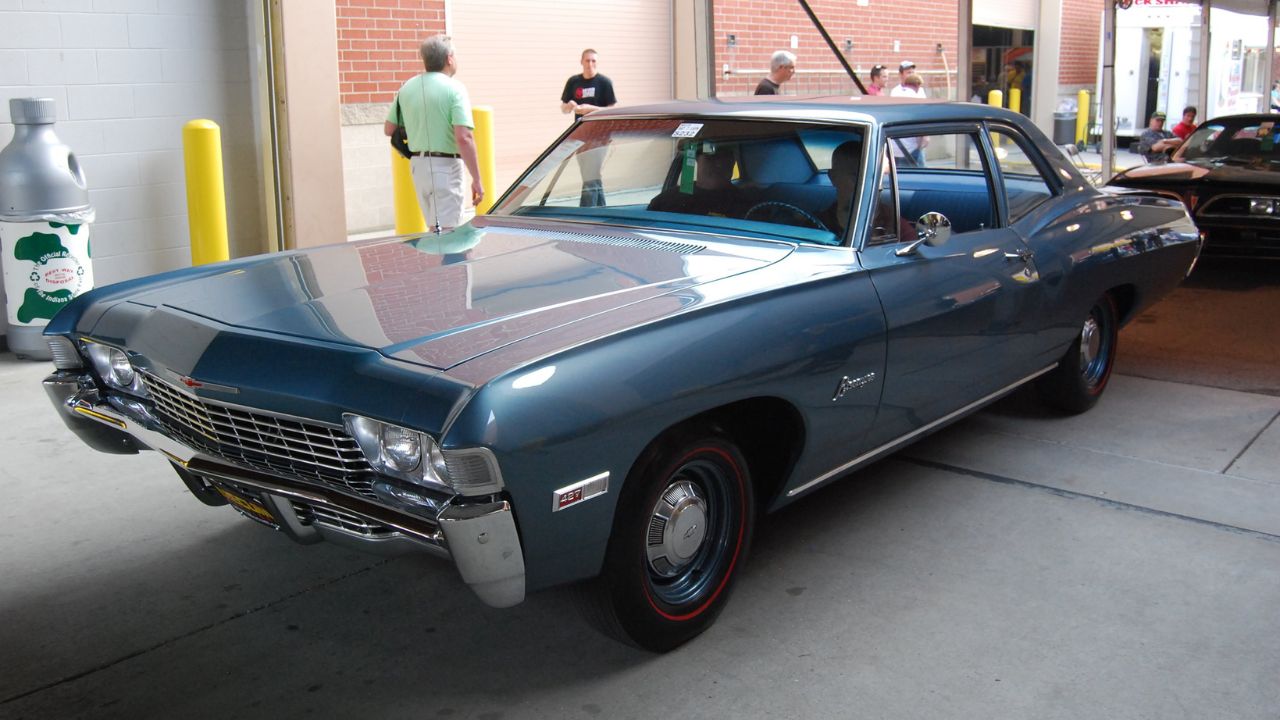
The 1968 Chevrolet Biscayne was never designed to be a muscle car icon, yet it ended up becoming one of the most surprising performance bargains of its era. Built as a no-frills full-size sedan, it quietly transformed into a straight-line powerhouse when equipped with the right factory options, earning a reputation that still fascinates enthusiasts today.
A Plain-Jane Sedan With Hidden Intent
At first glance, the 1968 Biscayne looked like the definition of automotive simplicity. It was a full-size Chevrolet built for fleets, taxi services, and budget-conscious buyers who wanted basic transportation without luxury extras or flashy styling.
The Chevrolet Biscayne (1968) was intentionally stripped down compared to its more upscale siblings. Minimal chrome, basic interior trim, and a focus on durability over comfort defined its personality. It was never meant to attract attention—it was meant to be practical and affordable.
But that simplicity became its secret advantage. By avoiding heavy luxury equipment and styling additions, the Biscayne kept its weight down, creating a platform that could be transformed into something far more serious.
Big-Block Power in an Unlikely Package
What turned the Biscayne into a performance bargain was its access to Chevrolet’s big-block engine lineup. While most buyers chose modest six-cylinder or small V8 engines, Chevrolet also offered high-performance options that completely changed the car’s character.
When equipped with large-displacement V8 engines, the Biscayne shed its image as a basic sedan and became a formidable straight-line performer. The combination of a lightweight interior, minimal trim, and serious horsepower created an unexpected power-to-weight advantage.
This meant that in real-world acceleration, a properly equipped Biscayne could compete with—and sometimes outperform—more expensive and better-known muscle cars. It was not marketed as a performance vehicle, but it could behave like one when ordered correctly.
That contrast between price and capability is what built its reputation as a bargain performance sleeper.
The Sleeper Identity That Defined Its Legacy
Unlike flashy muscle cars with aggressive stripes and bold styling, the Biscayne maintained a completely ordinary appearance even in its high-performance configurations. This made it one of the most effective sleeper cars of the late 1960s.
Drivers often underestimated it at first glance, assuming it was just another full-size family sedan. That perception changed quickly when the throttle was applied and the big-block power delivered immediate, overwhelming acceleration.
This sleeper effect became central to its identity in street culture. The Biscayne did not rely on image—it relied on surprise. And in an era where reputation on the street mattered as much as specification sheets, that surprise factor was priceless.
Weight Reduction Without Compromise
One of the key reasons the Biscayne performed so well in performance configurations was its naturally lightweight approach to full-size design. By stripping away unnecessary trim and luxury features, Chevrolet created a platform that prioritized function over comfort.
This weight savings had a direct impact on performance. Less mass meant better acceleration, improved responsiveness, and a more direct connection between engine output and real-world speed.
In contrast to heavier, more luxurious full-size cars, the Biscayne felt more urgent when equipped with performance engines. It was not refined in the traditional sense, but it was effective in the way that mattered most in straight-line performance.
The Economics of Performance
Part of what made the Biscayne so attractive to enthusiasts was its price positioning. It offered access to serious Chevrolet performance hardware without the premium cost associated with more visually appealing or feature-rich models.
This created a unique value proposition: buyers could invest in engine performance rather than luxury trim. For many, this was the ideal formula, especially in a period when horsepower per dollar was a major consideration.
The result was a car that delivered disproportionate performance for its cost. In hindsight, it represents one of the clearest examples of “factory bargain horsepower” from the muscle car era.
Straight-Line Focus and Real-World Behavior
The Biscayne’s performance identity was heavily focused on straight-line speed. It was not engineered to be a corner-carving machine or a refined touring sedan. Instead, it excelled in acceleration and highway performance when properly equipped.
The chassis was robust enough to handle big-block torque, and the suspension tuning favored stability over agility. This made it especially effective in drag racing scenarios, where consistency and traction mattered more than handling finesse.
In everyday driving, it felt simple and direct. There was little complexity in its behavior, which made it predictable and easy to control even under hard acceleration.
Why It Was Overlooked in Its Own Time
Despite its capabilities, the Biscayne rarely received the same attention as more famous Chevrolet performance models. Its understated styling and fleet-oriented image meant it was often dismissed as just a basic sedan.
This lack of attention actually contributed to its sleeper reputation. Because it did not carry the visual identity of a performance car, many drivers never considered it a serious threat on the street.
As a result, the Biscayne developed a quiet but loyal following among those who understood its potential. It was never the star of Chevrolet’s lineup, but it was one of the most effective hidden performers.
Collector Interest and Modern Reassessment
Today, the 1968 Biscayne is increasingly recognized by collectors who appreciate factory sleeper cars and underrated performance platforms. Clean examples, especially those with documented big-block configurations, are becoming more desirable as enthusiasts seek out unique interpretations of the muscle era.
Its appeal lies in its honesty. It does not pretend to be anything other than what it is—a simple car with the potential for serious performance when properly equipped.
The Chevrolet Biscayne (1968) now represents a different kind of muscle car story: one built not on marketing or styling, but on the raw idea that performance could be hidden in the most ordinary places.
Why Its Legacy Still Resonates
The Biscayne’s legacy endures because it challenges assumptions about what a performance car needs to look like. It proves that speed and capability do not require aggressive styling, luxury features, or expensive branding.
In today’s automotive world, where performance sedans and sleeper builds remain popular, the Biscayne’s philosophy feels especially relevant. It was an early example of a concept that still resonates: true performance does not always announce itself.
That is why the 1968 Chevrolet Biscayne continues to earn respect decades later. It was not famous, but it was effective—and in the world of sleeper performance cars, that is often what matters most.
More from Fast Lane Only
- Unboxing the WWII Jeep in a Crate
- 15 rare Chevys collectors are quietly buying
- 10 underrated V8s still worth hunting down
- Police notice this before you even roll window down
*Research for this article included AI assistance, with all final content reviewed by human editors