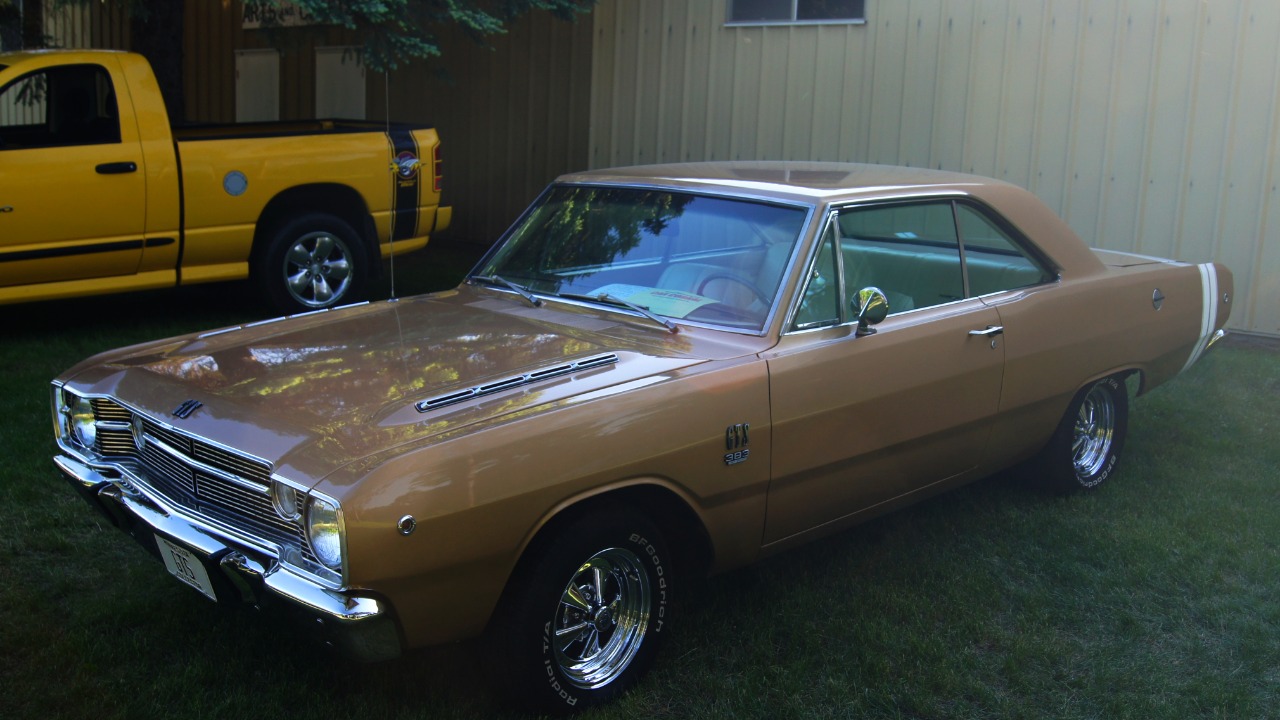
In the late 1960s, muscle car buyers often followed a simple formula.
If you wanted serious performance, you usually looked at a midsize car. Models like the Pontiac GTO, Chevrolet Chevelle SS, and Plymouth Road Runner dominated the conversation because they paired large-displacement V8 engines with platforms specifically designed to handle substantial power. Compact cars, meanwhile, were generally viewed as practical transportation intended for commuters, young families, and budget-conscious buyers.
The 1968 Dodge Dart GTS challenged that assumption in dramatic fashion.
At first glance, the Dart looked relatively ordinary. It lacked the imposing size of many muscle cars and didn’t immediately project the same level of intimidation as some of Detroit’s larger performance machines. Yet beneath its compact dimensions was a combination of power and performance that surprised both buyers and competitors.
Dodge had discovered something important.
A lightweight car with a powerful engine could be every bit as exciting as a larger muscle car—and sometimes even more so. The Dart GTS became one of the clearest examples of that philosophy, offering acceleration and street performance that exceeded what many people expected from a compact coupe.
More than fifty years later, it remains one of the most underrated performance cars of the era.
The Dart Began Life as Practical Transportation
The Dart was not originally designed to be a muscle car.
Introduced years earlier as part of Dodge’s compact lineup, the model built its reputation on affordability, reliability, and everyday usefulness. It appealed to buyers who wanted sensible transportation rather than high-performance excitement.
By the mid-1960s, however, the automotive landscape was changing rapidly.
Young buyers increasingly wanted cars that combined practicality with performance. The success of the muscle car movement demonstrated that consumers were willing to pay for speed, even if they still needed a vehicle capable of daily use.
Dodge recognized an opportunity.
Instead of abandoning the Dart’s practical roots, the company decided to inject serious performance into the existing platform.
The result would surprise a lot of people.
The GTS Package Elevated the Dart
Introduced in 1967 and refined for 1968, the GTS package transformed the Dart from a compact economy car into a legitimate performance machine.
Dodge upgraded the suspension, enhanced the car’s appearance, and most importantly, offered powerful V8 engines that dramatically altered its character. The GTS designation immediately signaled that this was not an ordinary Dart.
The package gave buyers access to a level of performance that few would have associated with a compact Dodge only a few years earlier.
At a time when many manufacturers were creating specialized muscle car models, the GTS stood out because it retained much of the Dart’s basic practicality while adding substantial horsepower.
That balance became one of its greatest strengths.
The Standard 340 Was Already Impressive
Even before buyers reached the top engine options, the Dart GTS offered serious performance.
The available 340-cubic-inch V8 had already developed a strong reputation throughout Chrysler’s performance lineup. Known for its willingness to rev and its impressive real-world output, the engine was perfectly suited to the relatively lightweight Dart platform.
The combination created a lively and responsive driving experience.
Unlike some larger muscle cars that relied primarily on massive displacement, the 340-powered Dart felt agile and eager. Its power-to-weight ratio allowed it to accelerate quickly while maintaining the nimble character expected from a smaller vehicle.
For many enthusiasts, the 340 represented the ideal balance of performance and practicality.
But Dodge wasn’t finished.
Then Came the 383 Big-Block
The most shocking option available in the 1968 Dart GTS was the 383-cubic-inch big-block V8.
Installing such a large engine into a compact platform was an audacious move. Most buyers simply did not expect a car the size of a Dart to contain that much displacement under the hood.
Yet Dodge made it happen.
The result was one of the most outrageous factory combinations available at the time. The big-block transformed the Dart into a genuine street monster capable of startling acceleration.
The engine bay was packed tightly, and fitting the 383 required creative engineering solutions. But Dodge understood the value of creating a car that would generate attention.
The 383-powered Dart certainly accomplished that.
Lightweight and Powerful Was a Winning Formula
One reason the Dart GTS surprised so many people was simple physics.
A lighter vehicle requires less power to achieve impressive acceleration. While larger muscle cars often carried additional weight, the Dart benefited from compact dimensions and a relatively light structure.
When combined with powerful V8 engines, the results could be dramatic.
The car accelerated with a sense of urgency that many competitors found difficult to match. Owners quickly discovered that the Dart could embarrass larger and more expensive vehicles in stoplight contests and drag-strip encounters.
The formula wasn’t complicated.
Take a compact car.
Add a large engine.
Enjoy the results.
Sometimes the simplest ideas work best.
It Looked More Subtle Than Many Rivals
Another factor that contributed to the Dart GTS’s reputation was its appearance.
Compared with some muscle cars of the era, the Dart remained relatively understated. It featured performance-oriented styling cues and distinctive trim, but it generally avoided excessive graphics or dramatic body modifications.
This subtlety created an advantage.
Many people underestimated the car.
Competitors often expected an ordinary compact coupe and instead encountered a surprisingly capable performance machine. The Dart became what enthusiasts often describe as a sleeper—a vehicle whose appearance failed to reveal its true potential.
That element of surprise only enhanced its appeal.
Buyers Got Real Value
Performance wasn’t the only reason the Dart GTS attracted attention.
It also represented strong value.
Many larger muscle cars became increasingly expensive as buyers added bigger engines and desirable options. The Dart offered a more accessible entry point into the performance market while still delivering impressive results.
For younger enthusiasts, this affordability mattered.
The GTS provided genuine muscle car excitement without requiring the budget associated with some premium performance models. Dodge successfully expanded the audience for high-performance automobiles by making speed more attainable.
That value-oriented approach resonated strongly with buyers.
The GTS Reflected Chrysler’s Performance Culture
The Dart GTS also benefited from Chrysler’s broader commitment to performance during the late 1960s.
The company was producing some of the most respected engines in Detroit, and its engineers were willing to experiment with combinations that other manufacturers might have considered too unconventional.
The Dart embodied that spirit.
It demonstrated a willingness to challenge traditional assumptions about what a compact car could be. Rather than accepting established categories, Dodge blurred the lines between economy car and muscle car.
The result felt distinctly Mopar.
Bold, unconventional, and unapologetically fast.
It Helped Create the Compact Muscle Car Segment
Although the Dart GTS wasn’t the only high-performance compact of its era, it played an important role in popularizing the concept.
The car showed that muscle car performance didn’t have to be limited to midsize platforms. Compact vehicles could deliver excitement as well, often with fewer compromises than buyers expected.
This idea would influence future generations of performance cars.
Manufacturers increasingly recognized that power-to-weight ratio could be just as important as raw displacement. The Dart helped demonstrate the effectiveness of that approach.
Its influence extended beyond its production years.
Collectors Appreciate Its Originality
Today, the Dart GTS enjoys growing respect among collectors and enthusiasts.
Part of that appreciation comes from rarity. Another part comes from performance. Most importantly, however, collectors recognize that the car offered something genuinely different.
The combination of compact dimensions and available big-block power remains fascinating.
Few production vehicles of the era embraced such an aggressive formula. The Dart stood apart from the crowd, and that uniqueness has only become more appealing over time.
Enthusiasts increasingly view it as one of Dodge’s most interesting performance creations.
The Compact Car Nobody Expected
Looking back, the 1968 Dodge Dart GTS succeeded because it challenged expectations at every opportunity.
It started with a platform known primarily for practicality and transformed it into a legitimate performance machine. Whether equipped with the respected 340 or the outrageous 383 big-block, the car delivered far more capability than most buyers anticipated.
The GTS proved that appearances can be deceiving.
It also proved that muscle car excitement could come in smaller packages.
Big Performance in a Small Package
The 1968 Dodge Dart GTS packed more performance than buyers expected because it combined lightweight construction, powerful engine options, and clever engineering into a surprisingly effective package.
What looked like a compact coupe often performed like a much larger muscle car. The available 383 big-block, in particular, transformed the Dart into one of the most unexpected performance machines of its era.
More than fifty years later, the car remains a reminder that some of Detroit’s smartest ideas came from challenging conventional wisdom.
The Dart GTS wasn’t supposed to be one of the quickest cars on the street.
That’s exactly what made it so memorable.
More from Fast Lane Only