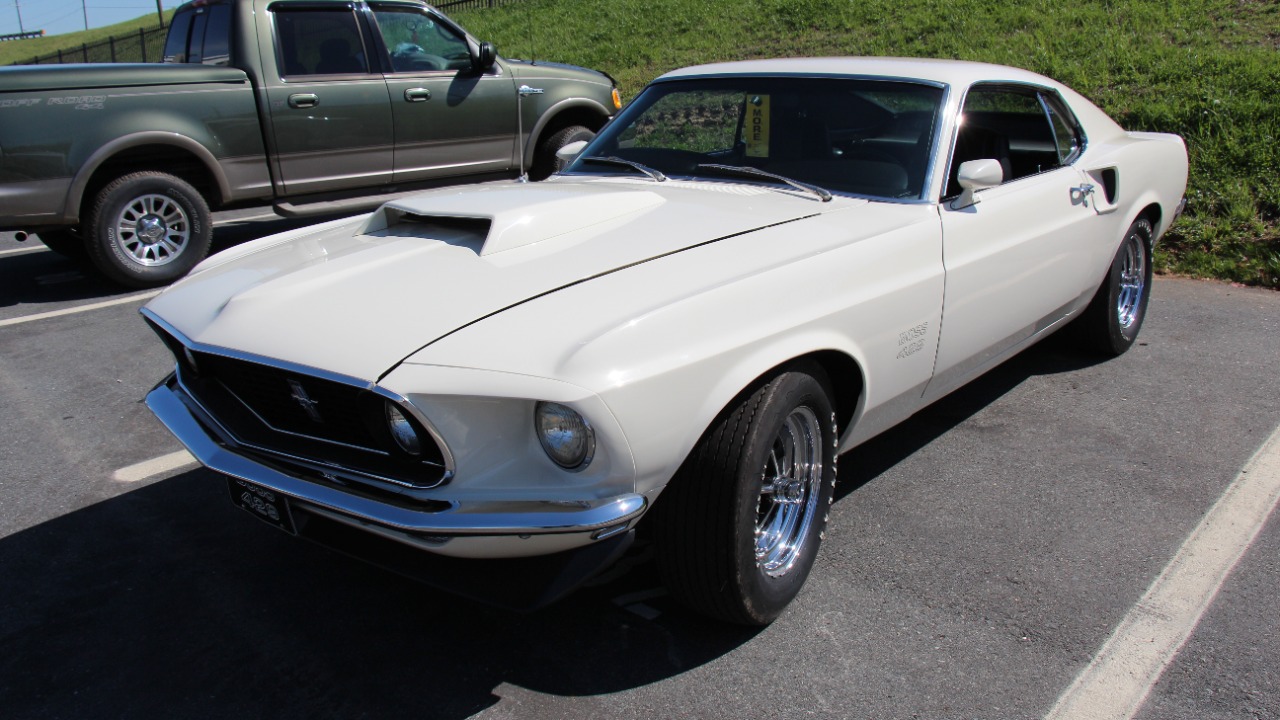
The 1969 Ford Mustang Boss 429 was born from racing rules, not marketing whim, and the result pushed Ford’s pony car far beyond a simple engine swap. To make room for a massive semi‑hemi V8, engineers had to rework the front structure, suspension, and even the way the car was built on the assembly line. Those changes turned a showroom Mustang into a hand‑finished homologation special that still fascinates collectors and racers today.
Examining how the Boss 429 came together reveals a rare moment when a mainstream American automaker let competition needs override production convenience. The car’s existence depended on NASCAR regulations, a specialist contractor, and structural surgery that reshaped the Mustang’s character.
NASCAR Pressure and the Birth of the Boss 429
The Boss 429 story starts with Ford’s desire to dominate NASCAR’s high‑banked ovals. Sanctioning rules required that a race engine be installed in a minimum number of street cars, so Ford needed a road‑legal home for its new 429 cubic inch semi‑hemi V8. The Mustang, already a sales star and a performance icon after the success of the GT and Shelby variants, became the chosen host for this big‑block experiment.
Unlike the small‑block 289 and 302 engines that fit the Mustang’s engine bay with relative ease, the 429 was physically huge. Its wide cylinder heads, tall deck height, and heavy rotating assembly were designed for sustained high‑rpm use on superspeedways, not for easy packaging in a compact pony car. Ford engineers quickly realized that simply dropping the engine into a standard Mustang shell was impossible without major surgery to the front structure.
Ford’s own plants were geared for high‑volume, repeatable processes, not custom metalwork. To solve the problem, the company turned to Kar Kraft, a specialty contractor already involved in racing projects. Completed Mustang bodies were shipped to Kar Kraft, where technicians cut, modified, and reinforced them to accept the 429. Only after this extensive rework did the cars return to Ford for final assembly and sale as Boss 429s.
Reworking the Mustang’s Front Structure
The most dramatic changes occurred in the engine bay. To clear the wide 429 heads, Kar Kraft repositioned the shock towers, effectively widening the space between them. This was not a simple trim job. The towers were cut, moved, and re‑welded, and the surrounding metal received additional bracing to restore rigidity. Without this work, the engine would have interfered with the suspension mounting points and the inner fenders.
The front crossmember and engine mounts were also redesigned. The 429 sat lower and farther back than a typical big‑block installation, a decision that helped both hood clearance and weight distribution. This placement required custom mounts and revised brackets that were unique to the Boss 429, which meant Ford had to track a separate set of parts and assembly steps for a relatively small production run.
Changes extended to the inner fenders and radiator support as well. Enlarged openings and revised sheetmetal allowed better airflow and extra clearance around the exhaust manifolds and accessory drives. The result was a front structure that looked broadly like a standard Mustang but shared surprisingly few untouched panels with it once the modifications were complete.
Suspension, Steering, and Stance
Accommodating the 429’s size and weight forced engineers to rethink the Mustang’s front suspension. The car received unique front coil springs and heavy‑duty components to support the big‑block while still delivering acceptable ride quality. The lower control arms and spindles were selected to work with a lower ride height, which gave the Boss 429 a more aggressive stance than a typical 1969 Mustang fastback.
Steering geometry also changed. With the shock towers moved and the engine sitting lower in the bay, the steering linkage had to be adjusted to avoid interference and maintain proper alignment through the suspension’s travel. This tuning aimed to keep the car predictable at high speeds, a priority given the engine’s racing intent.
At the rear, the Boss 429 used heavy‑duty leaf springs and a stout rear axle to cope with the torque of the 429. While the basic layout matched other performance Mustangs of the era, the calibration leaned toward stability and traction rather than drag strip launches alone. The car’s wide tires and staggered shocks helped control wheel hop and contributed to the planted look that enthusiasts now associate with late‑1960s big‑block Mustangs.
Hood, Cooling, and Exterior Tweaks
Externally, the Boss 429 looked more restrained than its mechanical changes might suggest. The most visible cue was the large, functional hood scoop that rose above the centerline of the car. This scoop sat on a relatively flat hood, a departure from the shaker setups found on some other performance Mustangs, and fed cooler air to the semi‑hemi engine’s hungry carburetor.
The front valance and grille area received subtle tweaks to improve airflow to the radiator and engine bay. Given the heat generated by a high‑compression 429, cooling capacity was a constant concern. Larger radiators and carefully directed airflow helped keep temperatures under control during extended high‑rpm use.
Beyond the hood and stance, the Boss 429 carried modest badging and unique wheels that signaled its status to those who knew what to look for. Compared with the flashier stripes and scoops of some contemporaries, the car’s appearance was almost understated, which only adds to its appeal among collectors today.
Hand‑Finished Homologation Special
The involvement of Kar Kraft turned each Boss 429 into a semi‑hand‑built machine. Unlike mass‑produced Mustangs that flowed straight from body shop to paint to final assembly, Boss 429 shells left the regular path, underwent structural surgery, then reentered Ford’s system. This detour added time and cost, and it limited how many cars could be produced for a given model year.
That process also introduced subtle variations from car to car. Welds, seam sealer patterns, and panel fit in the engine bay often show the human touch of Kar Kraft technicians. Collectors now study these details to authenticate surviving Boss 429s and to distinguish original cars from later clones or restomods.
The homologation requirement meant Ford had to build a specific number of street cars to qualify the 429 engine for NASCAR use. The company met that target, but the total production remained small compared with mainstream Mustang variants. This scarcity, combined with the engineering complexity, has helped drive values for original cars to impressive heights.
How the Boss 429 Compared to Other 1969 Mustangs
In the broader 1969 Mustang lineup, the Boss 429 sat alongside performance versions like the Mach 1 and the Boss 302. The Mach 1, often equipped from the factory with big‑block 428 engines, delivered strong straight‑line performance with fewer structural changes. A period example of a 1969 Mach 1 upgraded with a modern Kaase V8 shows how the standard engine bay could accept large displacement powerplants without the extensive surgery that the 429 required, highlighting just how unusual the Boss’s structural work was compared with a more conventional Mach 1 build.
The Boss 302, by contrast, focused on road racing and used a high‑revving small‑block that fit neatly in the existing bay. It relied more on suspension tuning and lightweight components than on radical structural changes. Against that backdrop, the Boss 429 stands out as the car that forced Ford to reshape the Mustang’s very bones to meet racing goals.
Performance on the street did not always match the expectations created by the engine’s size. Factory‑rated output was conservative, and the car’s weight and gearing sometimes muted its potential in stock form. Tuners quickly discovered that with freer‑flowing exhausts and more aggressive carburetion, the 429 responded dramatically, revealing the race‑bred character that its structural changes had been designed to support.
Legacy in Later Mustang Generations
The Boss 429’s influence can be traced through later Mustang generations, even when the specific engine and structural layout disappeared. When Ford revived the Mustang in the mid‑2000s with a retro‑inspired design, engineers once again had to balance styling, packaging, and performance targets. The architecture that underpinned the 2005, 2006, and 2007 models was created to accommodate modern safety standards and larger powertrains, a reminder of how packaging decisions shape every performance Mustang from the firewall forward, as detailed in coverage of the 2005 to 2007.
Those mid‑2000s cars did not require Kar Kraft‑style surgery, but they carried forward the idea that a Mustang could be engineered from the outset to handle serious power. Later high‑output variants, including modern supercharged models, benefited from this more robust baseline structure, which reduced the need for one‑off modifications.
The Boss 429 also helped cement the Mustang’s image as a car that could serve as a canvas for extreme factory experiments. That reputation paved the way for later limited‑run specials that pushed boundaries in their own ways, from track‑focused packages to drag‑strip‑oriented editions.
Modern Restomods and Reinterpretations
Today, the Boss 429’s combination of rarity and engineering drama has made it a prime candidate for high‑end restomods and licensed recreations. Some builders create new cars that visually echo the 1969 original but use updated chassis components, brakes, and drivetrains. One such modern interpretation pairs classic Boss 429 styling with contemporary construction and performance hardware, showing how the original concept can be reimagined for current expectations of speed, comfort, and reliability in a modern Boss 429.
These projects often sidestep the packaging nightmares that Ford and Kar Kraft faced in 1969. Modern aftermarket front suspensions, rack‑and‑pinion steering, and compact high‑output engines allow builders to achieve or exceed original performance targets without cutting and moving shock towers in the same way. Yet most of these cars still pay tribute to the visual cues and stance that the structural changes of 1969 created.
At the same time, preservation‑minded owners of original Boss 429s tend to focus on maintaining factory‑correct details. The unique front structure, engine mounts, and underhood bracing are part of what make these cars historically significant. Restorers invest considerable effort in replicating original weld patterns and finishes, since knowledgeable buyers scrutinize those elements when evaluating authenticity.
Inside the Semi‑Hemi: Engine and Chassis Partnership
The heart of the Boss 429 was its semi‑hemispherical cylinder head design, which used large valves and a high‑flow combustion chamber to support high‑rpm power. This architecture was aimed squarely at NASCAR competition, where sustained speed and durability mattered more than low‑rpm drivability. The engine’s physical dimensions were a direct consequence of that design, which in turn forced the Mustang’s structural rework.
Ford’s engineers and Kar Kraft’s fabricators had to treat the engine and chassis as a partnership. The lowered engine position helped hood clearance and center of gravity, but it also affected oil pan design and steering linkage routing. Exhaust manifolds had to snake through tight spaces without cooking nearby components. Every decision about the engine’s placement rippled outward into the structure, suspension, and even serviceability for mechanics.
More from Fast Lane Only
- Unboxing the WWII Jeep in a Crate
- 15 rare Chevys collectors are quietly buying
- 10 underrated V8s still worth hunting down
- Police notice this before you even roll window down
*Research for this article included AI assistance, with all final content reviewed by human editors.