The muscle car era produced no shortage of bold automobiles.
Bright colors, oversized engines, racing stripes, hood scoops, and aggressive graphics became common sights on American roads during the late 1960s and early 1970s. Manufacturers competed fiercely for attention, and buyers often embraced vehicles that made powerful visual statements.
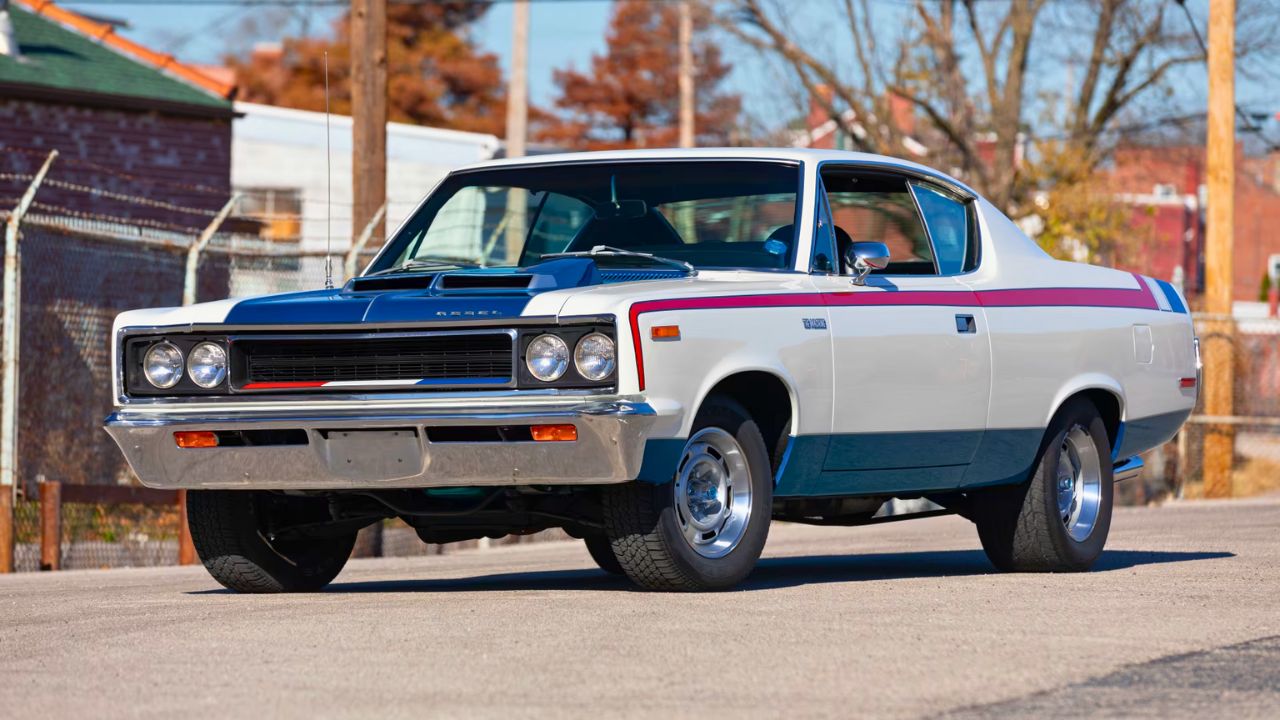
Even in that environment, the 1970 AMC Rebel Machine stood out.
It wasn’t built by one of Detroit’s traditional giants. It didn’t come from General Motors, Ford, or Chrysler. Instead, it emerged from American Motors Corporation, a smaller manufacturer that frequently relied on creativity and unconventional thinking to compete against companies with far greater resources.
The Rebel Machine embodied that spirit perfectly.
Its red, white, and blue paint scheme was impossible to ignore. Its name sounded more like a political slogan than a production automobile. Under the hood sat one of the most powerful engines AMC had ever offered, while the car’s overall personality seemed designed specifically to challenge convention.
The Rebel Machine wasn’t interested in fitting in.
It was built to be noticed.
More than fifty years later, it remains one of the most distinctive and unapologetic muscle cars of its generation.
AMC Needed a Performance Flagship
During the late 1960s, American Motors faced a difficult challenge.
The company lacked the enormous budgets and production capacity enjoyed by the Big Three automakers. Competing directly with Chevrolet, Ford, and Dodge on volume alone was nearly impossible.
AMC needed another strategy.
One approach involved creating vehicles that generated attention disproportionate to their sales numbers.
Performance cars offered that opportunity.
By building exciting automobiles capable of competing with the industry’s best, AMC could strengthen its image and attract enthusiasts to showrooms.
The company had already experimented with performance-oriented models, but executives wanted something even more dramatic.
The result became the Rebel Machine.
The Name Was Impossible to Ignore
One of the first things people noticed about the car was its name.
Most manufacturers used combinations of letters, numbers, or traditional model designations.
AMC chose something different.
“The Machine.”
The name immediately communicated purpose.
It sounded powerful.
It sounded aggressive.
Most importantly, it sounded memorable.
AMC’s marketing embraced the title enthusiastically, portraying the car as something more than ordinary transportation.
The company wanted buyers to view it as a statement.
The name helped accomplish exactly that.
Even today, few muscle car names generate as much curiosity.
The Paint Scheme Guaranteed Attention
If the name wasn’t enough to attract notice, the paint certainly was.
Early Rebel Machines arrived wearing a striking red, white, and blue color scheme unlike anything else in the marketplace.
The roof, body, and hood graphics combined patriotic colors in a way that ensured the car would never disappear into traffic.
Some buyers loved it.
Others found it excessive.
Almost nobody ignored it.
The paint reflected AMC’s understanding of its position in the market.
The company couldn’t afford to be subtle.
It needed products that people would remember.
The Rebel Machine delivered that kind of visibility immediately.
It looked bold even by muscle car standards.
Underneath Was a Serious Performance Car
The dramatic appearance sometimes overshadowed an important fact.
The Rebel Machine wasn’t merely a styling exercise.
It was genuinely fast.
AMC equipped the car with a high-performance 390-cubic-inch V8 that produced impressive horsepower and substantial torque. Officially rated at 340 horsepower, the engine placed the Rebel Machine firmly among the serious muscle cars of its era.
Performance wasn’t optional.
It was central to the vehicle’s mission.
The powerful V8 ensured the car could back up its appearance with real capability.
This combination of visual drama and genuine performance helped establish credibility among enthusiasts.
The Machine looked fast because it was fast.
AMC Focused on Straight-Line Performance
Like many muscle cars of the period, the Rebel Machine emphasized acceleration.
The company understood that quarter-mile performance mattered enormously to enthusiasts.
To maximize effectiveness, AMC equipped the car with performance-oriented drivetrain components and suspension upgrades designed to handle the engine’s output.
The result was a machine capable of competing with far more famous rivals.
Road tests frequently demonstrated that the Rebel Machine possessed enough speed to earn respect.
Its performance credentials weren’t theoretical.
They were measurable.
That fact surprised many observers who underestimated AMC’s capabilities.
It Challenged Bigger Manufacturers Directly
One reason the Rebel Machine remains fascinating is the confidence it represented.
AMC wasn’t merely building a sporty intermediate.
The company was openly challenging manufacturers many times its size.
The Rebel Machine competed against cars such as the Chevrolet Chevelle SS, Plymouth Road Runner, Ford Torino Cobra, and Pontiac GTO.
Those were some of the most respected performance cars in America.
AMC entered the fight anyway.
That willingness to compete enhanced the Rebel Machine’s appeal.
The car became an underdog with genuine capability.
Enthusiasts appreciated that story.
Marketing Matched the Personality
AMC’s advertising reflected the car’s bold nature.
The company promoted the Rebel Machine with enthusiasm, emphasizing its performance credentials and distinctive character.
Unlike some manufacturers that relied heavily on heritage or prestige, AMC focused on attitude.
The marketing reinforced the idea that the Machine was different.
It wasn’t trying to imitate competitors.
It was trying to challenge them.
This approach aligned perfectly with the car’s appearance and performance.
Everything worked together to create a strong identity.
Timing Worked Against It
Despite its strengths, the Rebel Machine faced significant challenges.
The muscle car market was becoming increasingly crowded by 1970. Buyers had more choices than ever before, and many competitors possessed stronger dealer networks and larger advertising budgets.
At the same time, broader market forces were beginning to shift.
Insurance premiums for high-performance cars were rising. Emissions regulations were becoming more restrictive. Consumer priorities would soon change dramatically.
The Rebel Machine arrived near the peak of the muscle car era.
Its moment in the spotlight proved relatively brief.
Yet its impact lasted far longer.
Production Numbers Stayed Low
Because the Rebel Machine was produced in limited quantities, it never became a common sight.
The relatively low production figures contributed to the car’s mystique.
Owners knew they possessed something unusual.
The rarity also enhanced the model’s long-term collectibility.
Many muscle cars were built in substantial numbers.
The Rebel Machine remained far less common.
That exclusivity has become one of its defining characteristics.
Collectors value rarity, especially when combined with historical significance and strong performance.
The Machine offers all three.
It Refused to Follow the Rules
Perhaps the most interesting aspect of the Rebel Machine is how completely it embraced individuality.
AMC could have built a conventional muscle car and hoped to blend into the marketplace.
Instead, the company chose a dramatically different path.
The bold name.
The unforgettable paint scheme.
The aggressive marketing.
The serious performance.
Everything about the vehicle suggested a refusal to compromise.
That attitude resonates strongly with enthusiasts today.
The Machine wasn’t trying to be safe.
It was trying to be memorable.
Collectors Appreciate Its Uniqueness
Over time, appreciation for the Rebel Machine has grown significantly.
Collectors increasingly recognize the car as one of the most distinctive products of the muscle car era.
Its combination of rarity, performance, and personality makes it unlike virtually anything else produced during the period.
The qualities that once seemed excessive have become major strengths.
Enthusiasts admire the confidence behind the design.
They appreciate the willingness to stand apart.
The Rebel Machine’s individuality has aged remarkably well.
The Ultimate AMC Statement
Looking back, the 1970 AMC Rebel Machine represented far more than a performance model.
It was a declaration.
AMC was telling the automotive world that it belonged in the muscle car conversation.
The company wasn’t interested in playing a supporting role.
It wanted attention.
It wanted respect.
And it wanted enthusiasts to remember its name.
The Rebel Machine accomplished all three.
The Muscle Car That Refused to Blend In
The 1970 AMC Rebel Machine refused to blend into its era because blending in was never part of the plan.
From its patriotic paint scheme and unforgettable name to its powerful 390 V8 and aggressive attitude, every aspect of the car was designed to stand apart from the crowd.
At a time when the muscle car market was overflowing with competition, AMC understood that being different could be an advantage.
The company embraced that philosophy completely.
More than fifty years later, the Rebel Machine remains one of the boldest, rarest, and most memorable muscle cars of its generation.
And that’s precisely why enthusiasts continue talking about it today.
More from Fast Lane Only