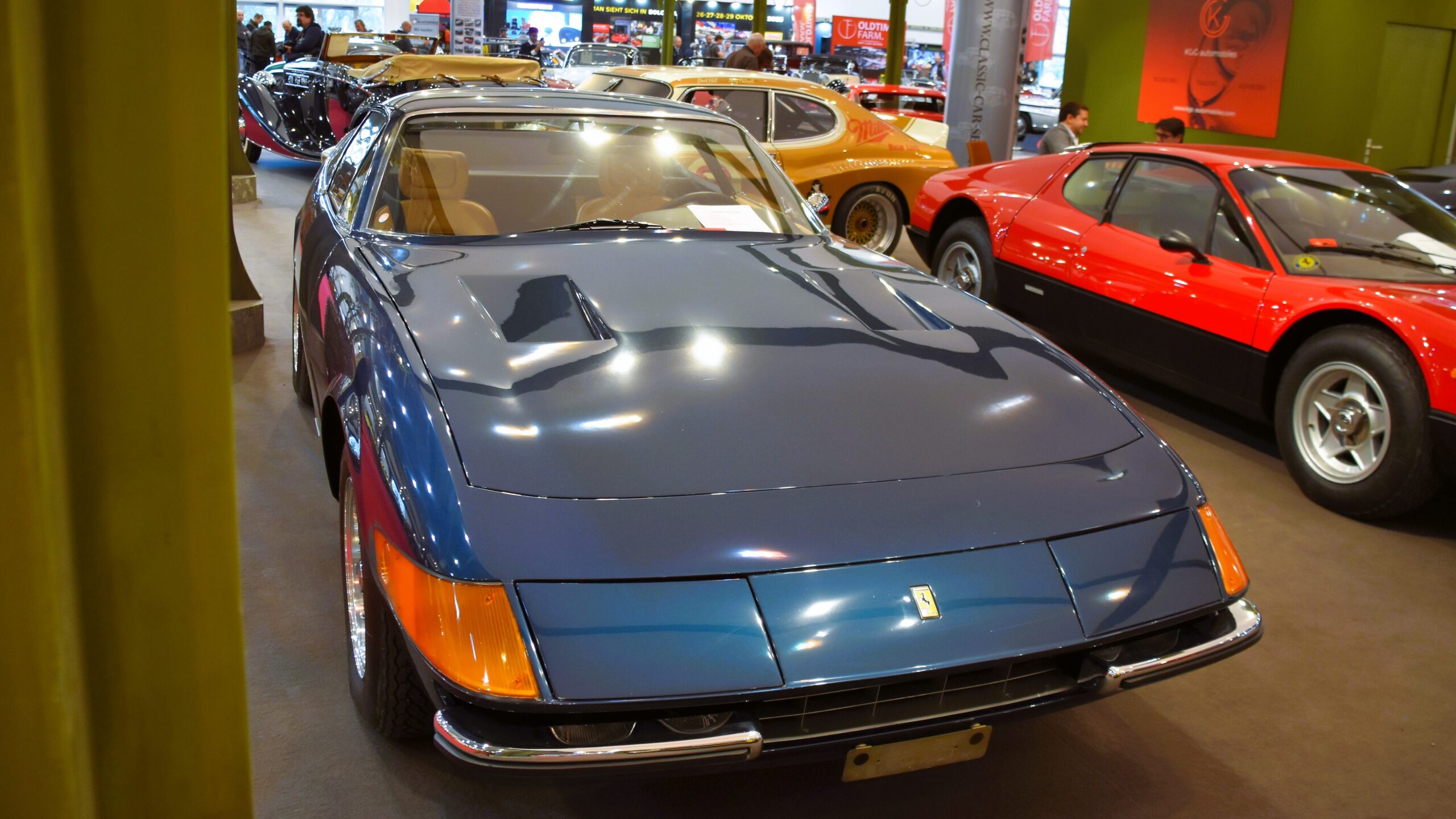
The Ferrari 365 GTB/4, better known as the Daytona, arrived at the dawn of the 1970s as a blunt rebuttal to doubts about front‑engined supercars. With a racing‑bred V12, a top speed that brushed 174 miles per hour, and styling that looked fast even when parked, it captured the restless, high‑speed mood of its era. More than half a century later, it still stands as the car that turned Ferrari’s 1971 road‑car lineup into a rolling manifesto about power, prestige, and the limits of analog engineering.
What happened
By the late 1960s, Ferrari faced a crossroads. Mid‑engined designs were reshaping Formula 1 and endurance racing, and rivals were beginning to sell mid‑engined road cars. Many expected Ferrari to follow that template for its next flagship. Instead, the company doubled down on a traditional layout and developed the 365 GTB/4 with a long‑nose, front‑mounted V12 and a transaxle at the rear. The model entered production around 1969, and by 1971 it had become the definitive expression of Ferrari’s grand touring philosophy.
The car’s unofficial “Daytona” nickname came from Ferrari’s dominant performance at the 24 Hours of Daytona in 1967, where the marque finished first, second, and third with its racing prototypes. The 365 GTB/4 was not a direct derivative of those race cars, yet the association stuck, and buyers saw it as a road‑legal echo of that endurance victory. The name never appeared on official badging, but the market embraced it so completely that “Daytona” became the shorthand for Ferrari’s most potent front‑engined coupe of the period.
Under its sharply creased bodywork, the Daytona carried a 4.4‑liter V12 with six Weber carburetors. Output figures varied slightly depending on market and testing standard, but period data consistently placed power well above 340 horsepower. That engine sat far back in the chassis, almost in a front‑mid position, and sent power through a five‑speed gearbox mounted at the rear with the differential. The layout helped balance weight over the axles and gave the car a level of stability at speed that drivers of the time described as both demanding and rewarding.
Performance numbers told the same story. Contemporary tests recorded 0 to 60 miles per hour in roughly 5.4 seconds and a top speed close to 174 miles per hour, figures that put the Daytona at the very top of the road‑car hierarchy. Those numbers were not theoretical. Owners and testers routinely took the car to triple‑digit speeds on European motorways, where it settled into a long‑legged stride that matched its grand touring brief.
The styling, credited primarily to Leonardo Fioravanti at Pininfarina, marked a shift from the rounded forms of the 1960s to a cleaner, more geometric language. Early cars used a distinctive plexiglass strip over the headlights, later replaced by pop‑up lamps to meet regulations. A razor‑sharp beltline ran from the nose to the tail, and the long hood visually emphasized the engine’s presence. The cabin sat relatively far back, giving the car a cab‑rearward stance that telegraphed speed even at rest.
Inside, the Daytona mixed luxury with race‑inspired cues. Deeply bolstered leather seats, a gated shifter, and a bank of auxiliary gauges gave the driver a sense of operating a machine rather than simply occupying a lounge. Air conditioning and power windows were available, reflecting the car’s dual role as both high‑speed tool and status symbol for long‑distance travel across Europe and North America.
The broader performance context around 1970 amplified the Daytona’s impact. That period has been described as one of the wildest years for road‑car performance, with muscle cars, homologation specials, and European exotics all chasing higher speeds and more power. Coverage of 1970 performance cars highlights how manufacturers pushed displacement, compression ratios, and aerodynamics to extremes before emissions rules and insurance costs began to bite. The Daytona sat at the apex of that wave, a European counterpart to the most aggressive American and German offerings of the time.
Production remained relatively limited. Ferrari built only a few hundred coupes and a smaller number of open‑top variants, known as the 365 GTS/4. Each car required significant hand labor, from bodywork to interior trimming, which kept volumes low and exclusivity high. That scarcity later became a key factor in the model’s collectability, but in 1971 it simply reinforced the idea that the Daytona was a rarefied object, reserved for a small circle of affluent enthusiasts.
Why it matters
The 1971 Daytona mattered first as a raw performance benchmark. In an era when many sports cars still struggled to break 140 miles per hour, a front‑engined grand tourer capable of approaching 174 miles per hour redefined expectations. It proved that a conventional layout could still compete with, and often surpass, newer mid‑engined designs in outright speed. That achievement helped prolong the life of the front‑engined V12 as a credible flagship configuration.
It also crystallized Ferrari’s identity at a moment of rapid change. The company was navigating shifting regulations, rising safety and emissions standards, and evolving customer expectations. By committing to a large‑capacity, naturally aspirated V12 with carburetors, Ferrari signaled that it would not abandon the emotional core of its brand in pursuit of easier compliance or lower costs. The Daytona’s success in the market validated that stance and gave the company confidence to continue building uncompromising performance cars even as the regulatory environment tightened.
From a design perspective, the Daytona helped set the tone for 1970s sports cars. Its sharp lines, low nose, and muscular haunches influenced not only subsequent Ferraris but also competing grand tourers from Italy, Britain, and Germany. The transition from soft curves to more angular profiles can be traced through several high‑end models of the decade, and the Daytona stands near the beginning of that shift. It bridged the aesthetic gap between the organic forms of the 1960s and the wedge‑shaped experiments that followed.
The car’s cultural resonance extended beyond spec sheets. In period, it appeared in magazines, films, and later in television, where its silhouette became shorthand for wealth, speed, and a certain kind of cosmopolitan excess. Even viewers who never learned the 365 GTB/4 designation recognized the long red Ferrari with pop‑up headlights as a symbol of aspiration. That visibility helped cement Ferrari’s public image as the maker of the world’s most glamorous sports cars.
The Daytona also marked a high‑water line for analog driving. With no electronic aids, no power steering on many examples, and a heavy clutch, it demanded real effort. Drivers had to manage the weight transfer, the long gearing, and the carbureted throttle response with skill. For those who could, the reward was a feeling of mechanical connection that modern systems often filter out. Enthusiasts later came to see the Daytona as one of the last great Ferraris built entirely around that raw, unfiltered experience.
Economically, the model signaled how performance and exclusivity could reinforce each other. High purchase prices limited the buyer pool, but they also allowed Ferrari to invest in complex engineering and hand‑built craftsmanship. The car’s later rise in the collector market, where pristine examples command significant sums, reflects how scarcity and historical importance interact. Investors and enthusiasts alike point to the Daytona as a case study in how a car can move from expensive commodity to cultural artifact.
The 1971 context matters as well. That year sat near the peak of pre‑oil‑crisis optimism, when highway speeds were rising and governments had not yet imposed strict speed limits or fuel‑consumption rules in many markets. The Daytona thrived in that environment, where an owner could plausibly use its performance on long, lightly patrolled stretches of road. Within a few years, the combination of fuel shortages, safety campaigns, and emissions regulations would make such carefree use less common. The car therefore captures a specific moment when unrestrained speed still seemed like a reasonable goal for a road‑going machine.
Technically, the Daytona’s transaxle layout and weight distribution influenced later engineering choices. By separating the engine and gearbox, Ferrari improved balance and handling, a concept that became standard practice in many high‑performance front‑engined cars. The use of independent suspension at all four corners and disc brakes on each wheel also reflected a commitment to matching braking and cornering capability to straight‑line speed. Those decisions helped push the industry toward more holistic performance packages rather than simple horsepower races.
The car’s legacy within Ferrari’s own lineup further shows its importance. When the company eventually returned to a front‑engined V12 flagship decades later, designers and engineers repeatedly referenced the Daytona’s proportions and character. Modern grand tourers from the brand often echo its long hood, set‑back cabin, and emphasis on cross‑continent pace. Collectors and historians frequently draw a line from the 365 GTB/4 to later front‑engined icons, treating it as the template that proved such cars could coexist with mid‑engined supercars in the same portfolio.
For enthusiasts, the Daytona has become a benchmark against which later cars are measured. Discussions about steering feel, engine sound, and high‑speed stability often circle back to how the 1971 car behaved on real roads. Its combination of high speed, mechanical honesty, and visual drama created a standard that many believe modern cars, with their layers of electronics and turbocharging, rarely match. That perception, grounded in period testing and owner testimony, keeps the Daytona relevant in conversations about what makes a sports car genuinely engaging.
What to watch next
The Daytona’s story continues to shape how manufacturers and buyers think about high‑performance grand tourers. As modern brands navigate electrification, emissions targets, and shifting customer expectations, the 1971 Ferrari offers both inspiration and a point of contrast. It represents a world where a naturally aspirated V12 could be the centerpiece of a flagship, unencumbered by hybrid systems or particulate filters, and where the primary selling points were sound, speed, and style.
One area to watch is how contemporary Ferraris and rival exotics reinterpret the front‑engined formula. Current models that pair internal combustion engines with electric assistance often cite heritage cars like the Daytona when explaining their proportions and driving goals. Designers borrow cues such as the extended hood and compact cabin, while engineers attempt to recreate the sense of linear throttle response and high‑rev drama that defined the 4.4‑liter V12. The tension between honoring that legacy and meeting modern regulations will continue to shape product planning.
The collector market is another ongoing storyline. As surviving Daytonas age, questions about originality, restoration standards, and usage patterns become more pressing. Owners must decide whether to preserve patina or pursue concours‑level perfection, and those choices influence values as well as historical authenticity. The small production run, combined with the car’s status as a performance icon, suggests that debates over correct finishes, mechanical updates, and sympathetic upgrades will only intensify as the cars move further from their production years.
There is also a broader cultural conversation about analog experiences in an increasingly digital car world. Enthusiasts who grew up with modern driver aids often seek out cars like the Daytona to experience a different kind of engagement. Track events, touring rallies, and curated driving experiences that feature classic V12 Ferraris cater to that demand. How regulators, insurers, and event organizers handle the risks associated with running 1970s supercars at speed will influence how visible and accessible these machines remain.
More From Fast Lane Only: