The 1988 Cizeta-Moroder V16T was born from a brief moment when Italian supercar engineering seemed willing to try anything. Conceived by engineer Claudio Zampolli with financial backing from music producer Giorgio Moroder, it paired a radical transverse V16 engine with a shape that looked more extreme than the Lamborghini flagships of its era. Decades later, the car’s audacious mechanical layout and tiny production run make it one of the clearest examples of how far a small team can push conventional supercar thinking.
It never became a volume success, but the Cizeta-Moroder V16T has gained a second life as a cult object. Collectors and engineers now study it as a rare case where the usual compromises of packaging, cost and manufacturability were largely ignored in favor of pure technical theater.
What happened
The Cizeta-Moroder V16T emerged from the ambitions of Claudio Zampolli, an Italian engineer and former Lamborghini test driver who wanted his own supercar brand. He teamed with producer Giorgio Moroder, whose disco and film work had already made him a global figure, to fund a car that would eclipse the V12 exotics of the late 1980s. The result was the Cizeta-Moroder V16T, first shown in 1988 and built in extremely limited numbers in Italy.
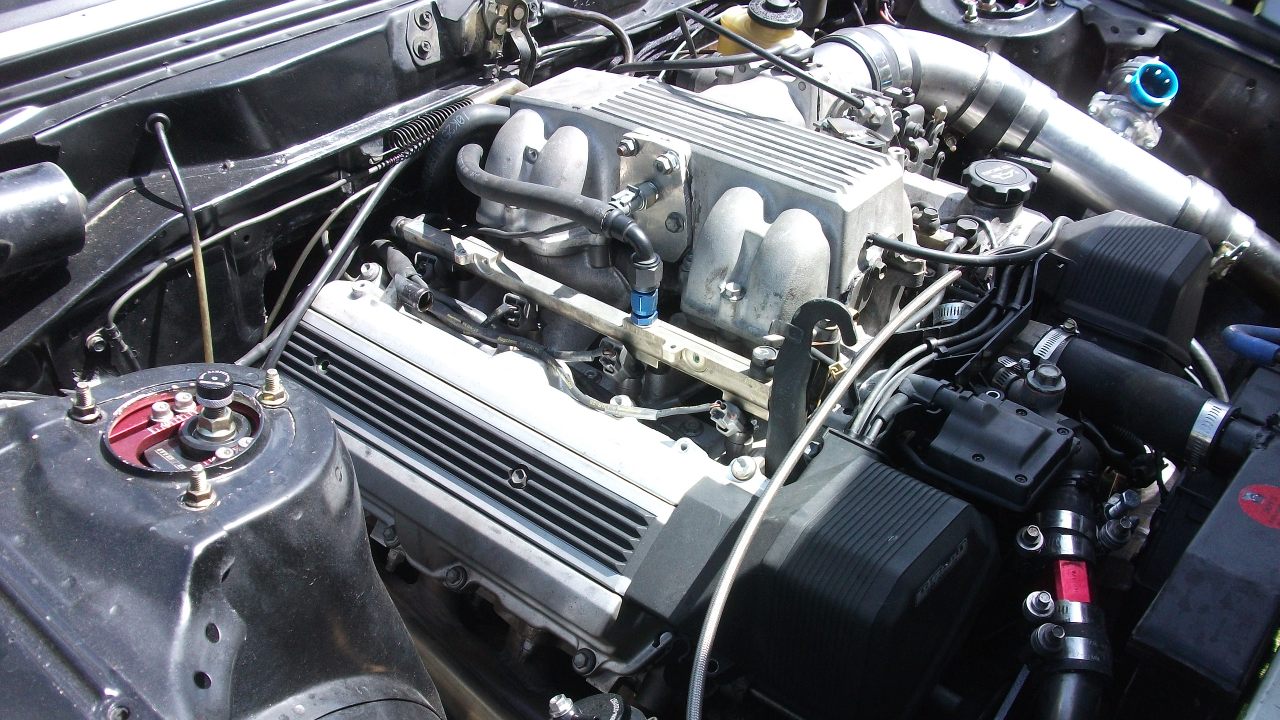
At the heart of the project was a 6.0-liter V16 engine arranged transversely behind the cabin. Instead of a single long crankshaft, the powerplant essentially joined two flat-plane V8s in one block, with a shared crankcase and common accessories. Contemporary reports quote output at about 540 horsepower and 400 lb-ft of torque, figures that placed the car comfortably among the quickest supercars of its day. The transverse layout, combined with a longitudinal gearbox, created the “T” in the model name and gave the car its distinctive, very wide rear section.
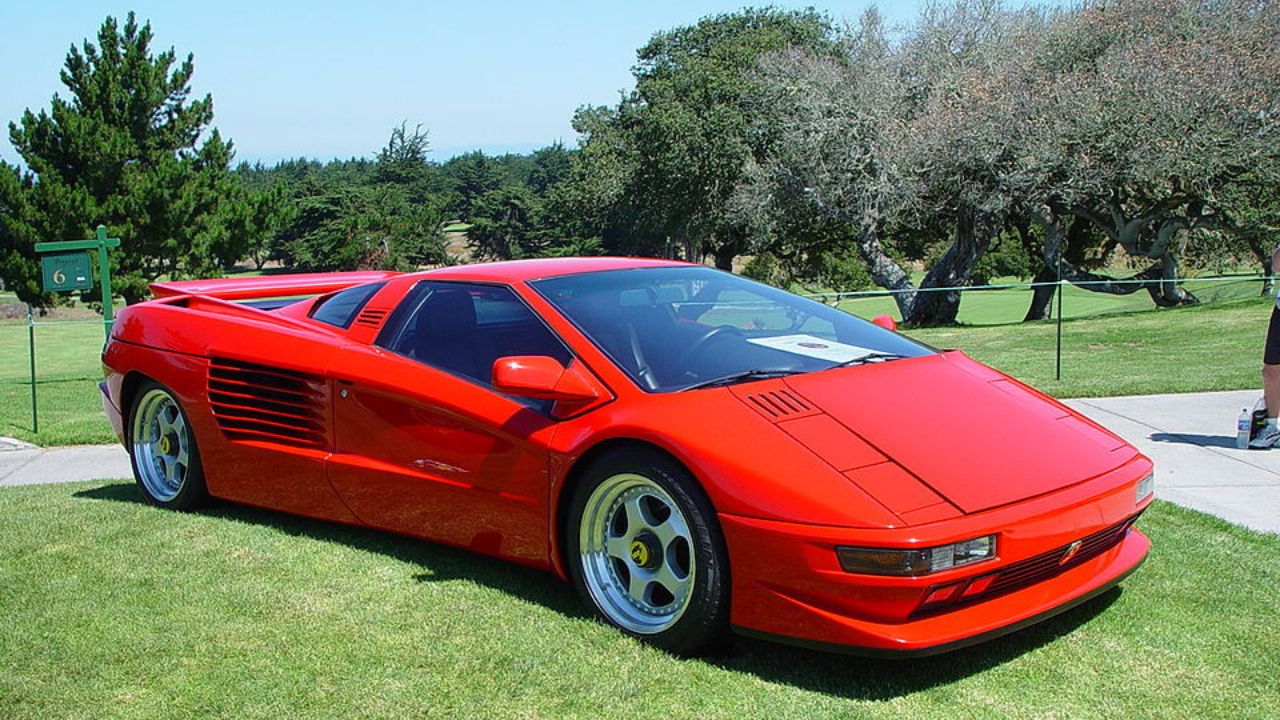
The styling matched the mechanical drama. Marcello Gandini, already known for the Lamborghini Countach and Miura, penned a wedge-shaped body with stacked pop-up headlights, deep side intakes and a high, squared-off tail. The front carried two pairs of pop-up lamps, giving the car a four-eyed look when fully raised, while the flanks were dominated by broad strakes that fed air toward the huge mid-mounted engine bay. The cabin sat low and forward, with a steeply raked windshield and a sharply pointed nose that made the car appear even longer than it was.
Inside, the V16T followed the era’s supercar template but with some bespoke touches. The dashboard wrapped around the driver with a bank of analog gauges, while the center console housed a gated manual shifter for the five-speed transmission. Leather-covered surfaces and thick carpeting tried to balance the car’s race-inspired engineering with grand touring comfort. Even so, the focus remained on the mechanical centerpiece right behind the seats, visible through vents and louvers that dominated the rear deck.
Production reality never matched the early ambition. Financial strain and the sheer complexity of building a low-volume V16 supercar limited output to only a handful of cars. One of the most documented examples is the very first prototype, chassis 001, which carried the full Cizeta-Moroder badging and served as the public face of the project. That car has since appeared in auctions and specialist listings, where its status as the original development and showpiece vehicle has been highlighted for collectors who track ultra-rare Italian exotics.
The partnership between Zampolli and Moroder later dissolved, and the car’s branding shifted. Some subsequent examples lost the Moroder name and were known simply as Cizeta V16T, while minor design and trim differences appeared between early and later builds. All versions, however, retained the same fundamental mechanical architecture: a transverse V16, a longitudinal gearbox, rear-wheel drive and bodywork that clearly carried Gandini’s signature angles and proportions.
The V16T’s rarity has only increased its visibility in specialist circles. Auction catalogs, enthusiast write-ups and technical features have revisited the car as an outlier from the analog supercar era, describing its engineering choices in detail and tracking the whereabouts of surviving examples. One French-language feature on the car’s sale highlighted its connection to Giorgio Moroder and framed it as a strange but compelling sports car from the “father of disco,” underlining how unusual the collaboration was between a record producer and a low-volume Italian constructor. That feature, focused on an example offered to collectors, presented the V16T as a once-in-a-generation opportunity to acquire a piece of supercar history linked directly to Moroder’s name, and illustrated just how few of these machines exist in private hands.
Specialist coverage has also stressed the car’s obscurity relative to its specification. One detailed profile described the 1988 Cizeta-Moroder V16T as an Italian supercar that many enthusiasts had never heard of, despite its extreme engine layout and Gandini styling. That write-up emphasized how the car’s performance and design placed it in the same conversation as contemporary Lamborghinis and Ferraris, yet its tiny production run and troubled business backing kept it from reaching the same cultural saturation.
Another in-depth piece focused specifically on chassis 001, describing it as the first Cizeta-Moroder V16T ever built and framing it as a supercar that buyers effectively could not have, given its unique status and the limited access offered to the market. That coverage detailed the car’s early show appearances and its role as a development platform, treating it as the definitive reference point for the model’s engineering and design decisions.
Technical explainers have gone further into the engine’s origin story. One analysis connected the V16’s design to engineering work originally intended for a Lamborghini project, then reimagined for Zampolli’s independent brand. By tracing the engine’s layout and internal structure, that piece argued that the Cizeta’s powerplant represented a fork in the road for Italian supercar engineering, where a concept that might have served a larger manufacturer instead became the heart of a niche, almost experimental vehicle.
Why it matters
The Cizeta-Moroder V16T matters first as a case study in unconstrained supercar engineering. While most manufacturers of the late 1980s refined existing V8 and V12 platforms, Zampolli’s team created a bespoke V16 and packaged it in a way that defied conventional layout wisdom. The transverse mounting of such a long engine, combined with a longitudinal gearbox, produced a powertrain configuration that even today remains extremely rare. In an era before hybrid systems and multi-motor electric setups, the V16T showed how far internal combustion packaging could be pushed in pursuit of power and drama.
That ambition came with clear tradeoffs. The car’s width and rear mass distribution created packaging and cooling challenges, and the complexity of the engine itself made production expensive and time consuming. These factors help explain why only a handful of cars were built. Yet the very impracticality of the project is part of what makes it significant. It illustrates the tension between pure engineering bravado and the realities of running a sustainable car company, a tension that still shapes modern supercar programs.
The V16T’s story also highlights the role of personalities in automotive history. Giorgio Moroder’s involvement gave the car a cultural hook that most boutique supercars lack. Coverage of a recent sale framed the car as the “strange sports car” of the disco pioneer, reminding readers that this was a machine funded in part by a figure better known for synthesizers than crankshafts. That crossover between music and engineering underscores how supercar projects sometimes rely on patrons from outside the traditional automotive world, and how those relationships can both accelerate and complicate development.
From a design perspective, the Cizeta anticipated and exaggerated trends that would become more common in the 1990s. Gandini’s angular surfaces, deep side intakes and stacked lights pushed the wedge theme to an extreme that even Lamborghini did not adopt in production. Some observers have noted that the car’s profile resembles an alternate path the Diablo might have taken, with even sharper creases and a more aggressive stance. That resemblance is not accidental, given Gandini’s involvement in both projects, and it positions the V16T as a kind of parallel-universe flagship for Italian supercar aesthetics.
In collector circles, the car’s significance is amplified by its scarcity. With production numbers far below those of contemporary Ferrari and Lamborghini models, each surviving V16T represents a large fraction of the entire brand’s history. Auction descriptions of chassis 001, for example, present it not just as a rare car but as a unique artifact that encapsulates the entire Cizeta story. The combination of first-of-its-kind status, prototype history and Moroder branding gives that particular car a weight that extends beyond its spec sheet.
The V16T also serves as a reference point in debates about what makes a supercar “iconic.” It lacks the racing pedigree of a Ferrari F40 or the broad cultural presence of a Lamborghini Countach, yet its engineering is at least as daring. Enthusiast features that describe it as an Italian supercar many have never heard of implicitly question how fame is assigned in automotive culture. They suggest that marketing budgets, production volume and media exposure can overshadow pure technical merit when history decides which cars become household names.
Technically minded readers often focus on the engine as the car’s key contribution to automotive lore. Detailed explainers on the V16’s design, including its likely roots in aborted Lamborghini projects, frame it as an example of how engineering ideas can migrate from large manufacturers to small independents. That migration can preserve concepts that would otherwise vanish in corporate reshuffles. The Cizeta’s engine, therefore, is not only a curiosity but also a repository of design thinking that might have influenced mainstream supercars if circumstances had been different.
The V16T’s limited commercial success also offers a cautionary angle for modern boutique brands. The car demonstrates that technical boldness alone cannot guarantee survival. Without a robust dealer network, service infrastructure and financial backing, even the most impressive machinery can struggle to find enough buyers. The same story can also be read more optimistically: although the company faded, the car itself has outlived its business context and now commands attention precisely because it refused to compromise.
In a broader historical sense, the Cizeta-Moroder V16T captures a transitional moment in performance car development. It arrived at the tail end of the analog era, just before electronic aids, advanced aerodynamics and later hybrid systems began to reshape the segment. Its focus on displacement, cylinder count and dramatic packaging reflects a mindset that prioritized mechanical theater over efficiency or usability. That mindset has become rarer as regulations and customer expectations have shifted, which makes surviving examples of the V16T feel like time capsules from a more experimental period.
What to watch next
Interest in the Cizeta-Moroder V16T has grown as collectors search for underappreciated 1980s and 1990s exotics. Auction listings that feature the car, especially chassis 001, tend to attract attention from buyers who have already secured more mainstream icons and now want something truly obscure. As more information surfaces about individual cars, including restoration histories and original specifications, the market’s understanding of the model’s true rarity is likely to sharpen.
More From Fast Lane Only: