The Lamborghini Jalpa has spent decades in the shadow of its more famous siblings, yet the 1985 model in particular shows how much performance and character can hide behind a relatively modest badge premium. Built as the “junior” Lamborghini of its era, it combined a usable V8 package with genuine supercar pace and a driving experience that still feels raw beside many modern exotics. For enthusiasts priced out of Countach territory, the Jalpa has quietly become one of the most compelling ways to experience classic Lamborghini drama.
From today’s collector market, the 1985 Jalpa looks like a missed opportunity for many buyers who once dismissed it as the “cheap” Lamborghini. Period figures, surviving cars, and owner accounts instead reveal a well-sorted chassis, a charismatic 3.5-liter V8, and a car that bridged the gap between old-school analog machines and the more polished era that followed.
What happened
The Jalpa arrived in the early 1980s as Lamborghini’s second attempt at a smaller, more accessible model after the Urraco and Silhouette. By 1985 the car had settled into its final specification, with a 3,485 cc all-alloy V8, four twin-choke Weber carburetors, and output quoted at around 255 horsepower for European versions. That figure did not match the headline numbers of the Countach, yet it put the Jalpa squarely in the performance bracket of contemporary Porsche 911s and Ferrari 308s.
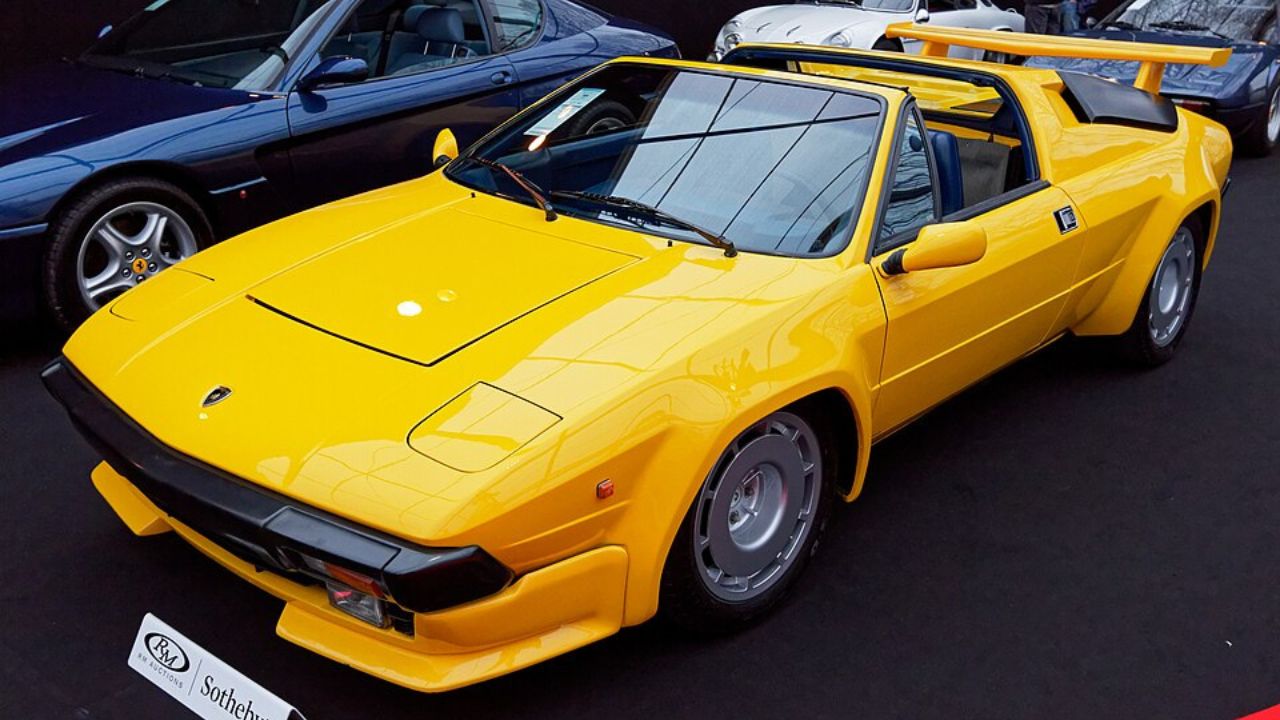
Lamborghini positioned the Jalpa as a more usable everyday car than its flagship. The body, styled by Bertone, adopted a targa roof panel that could be removed and stowed behind the seats, giving the car a different character from the wedge-shaped Countach. Inside, the cabin layout placed the driver closer to the centerline, with better outward visibility and slightly more space for luggage and passengers, a conscious move toward practicality that period brochures highlighted for customers who wanted a supercar they could actually drive to work.
Production numbers remained low, which has shaped the car’s reputation. Over its entire run, Lamborghini built only a few hundred Jalpas, and 1985 sat near the middle of that cycle. Surviving registries and marque specialists typically cite total output at just over 400 units, with a fraction of those delivered in any single model year. That scarcity, combined with the car’s position as a “baby” Lamborghini, meant it rarely appeared in the spotlight while new and quickly slipped into obscurity once the Diablo era began.
Even so, the Jalpa did enjoy a brief burst of mainstream attention. The model appeared on screen in a high-profile boxing film, where a black example shared scenes with the lead character and introduced the car to audiences who might never have seen one in person. Enthusiast coverage has since revisited that cameo, describing the Jalpa as a forgotten V8 supercar whose movie moment did little to change its long-term market fortunes.
Under the skin, the 1985 Jalpa continued Lamborghini’s tradition of using a steel monocoque chassis with tubular subframes. Suspension used unequal-length double wishbones front and rear with coil springs and telescopic dampers, a layout that gave the car a balance closer to a mid-engine race car than a grand tourer. Ventilated disc brakes at all four corners and a five-speed manual gearbox completed a package that was simple, focused, and relatively easy to service compared with the more complex V12 cars.
The V8 itself represented an evolution of the earlier Urraco unit, enlarged and refined for better torque and drivability. Period road tests often remarked that the Jalpa felt stronger in the midrange than its output suggested, with a broad spread of torque that made it easier to exploit on real roads. While the factory quoted a top speed in the region of 145 to 155 miles per hour depending on gearing and market specification, contemporary testers were more impressed by the car’s in-gear acceleration and flexibility than by its ultimate speed.
Inside, the Jalpa struck a balance between luxury and function. Leather-trimmed seats, a full set of analog gauges, and a relatively straightforward dashboard layout contrasted with the more theatrical, cramped cabins of the larger Lamborghinis. Air conditioning, electric windows, and decent ergonomics made the car surprisingly habitable for long drives, although owners still had to contend with heavy controls at low speeds and the usual quirks of an Italian supercar of that era.
By the mid-1980s, competition in the segment had intensified. Ferrari had the 308 and later 328, Porsche offered the 930 Turbo and Carrera models, and Japanese manufacturers were beginning to push performance boundaries of their own. Against that backdrop, the Jalpa’s combination of hand-built Italian character and relatively accessible performance positioned it as a connoisseur’s choice rather than a volume seller.
Why it matters
The Jalpa’s significance rests on two intertwined stories. One is the car’s role inside Lamborghini’s history, as a bridge between the rough-edged 1970s and the more polished 1990s. The other is the way the market has treated it for decades as a second-tier model, only recently starting to recognize its strengths.
Within the company’s lineage, the Jalpa marked the end of a particular approach to engineering. It was the last Lamborghini road car powered by a V8 until the much later introduction of the Urus SUV, and the final mid-engine model to rely entirely on carburetors. That places the 1985 Jalpa in a narrow window where analog controls, mechanical fuel delivery, and a compact naturally aspirated engine defined the driving experience. For enthusiasts who value that era, the Jalpa offers a purer connection to the brand’s past than many more famous models that followed.
The car also illustrates how Lamborghini tried to survive in a turbulent business environment. The early 1980s were financially difficult for the company, with ownership changes and limited resources. Developing a smaller V8 model allowed Lamborghini to broaden its customer base without the cost of designing an all-new V12 flagship. The Jalpa’s relatively simple mechanicals and shared components made it cheaper to build and maintain, which in turn helped keep the brand visible in key markets.
From a performance standpoint, the Jalpa challenges assumptions about what qualifies as a “real” Lamborghini. Its acceleration times and handling characteristics placed it firmly in supercar territory for the mid-1980s. Period tests recorded zero to 60 miles per hour in the mid six-second range for European cars, with strong midrange pull and impressive braking performance. On twisty roads, the lighter V8 layout and shorter wheelbase gave it an agility that some drivers preferred to the heavier, more dramatic V12s.
Yet for years, collectors treated the Jalpa as an odd footnote. Values lagged far behind the Countach and even behind some Ferrari contemporaries. Part of that gap came from styling, which some enthusiasts found less extreme than the brand’s poster cars. Another factor was the persistent perception that “true” Lamborghinis needed twelve cylinders. That view overlooked the way the Jalpa’s engine delivered power and sound, with a distinctive V8 bark that encouraged drivers to explore the upper half of the rev range.
The market’s slow reevaluation of the Jalpa reflects a broader shift in how enthusiasts view analog performance cars. As modern supercars have added weight, electronic aids, and complex drivetrains, interest has grown in simpler, more tactile machines. The Jalpa fits that brief neatly. Its unassisted steering, manual gearbox, and carbureted throttle response demand engagement from the driver, while its relatively compact size makes it less intimidating on narrow roads than many larger exotics.
Practicality also plays a role in its emerging reputation. Compared with a Countach, the Jalpa offers better visibility, easier ingress and egress, and more forgiving low-speed manners. Owners often report that they are more likely to take a Jalpa on a spontaneous drive or into urban traffic because it feels less fragile and more manageable. That usability aligns with the car’s original mission as a “daily drivable” Lamborghini, a trait that has gained new relevance as collectors look for cars they can actually enjoy rather than simply store.
From a design perspective, the Jalpa captures a specific moment in Italian styling. The wedge profile, pop-up headlights, and sharp creases tie it to the late 1970s and early 1980s, yet details such as the integrated bumpers and flared wheel arches hint at the more muscular shapes that would dominate the 1990s. The targa roof adds a hint of open-air drama without compromising the structural rigidity too severely, a compromise that many owners appreciate when the weather cooperates.
The car’s underappreciated status has had one clear benefit. For a long period, Jalpas remained significantly more affordable than other classic Lamborghinis, which allowed a different type of enthusiast to enter the brand. Instead of speculators chasing headline auction results, many Jalpa buyers were hands-on owners willing to maintain and drive their cars. That culture has helped preserve knowledge about the model’s quirks and strengths, from carburetor tuning to suspension setup.
As interest in 1980s cars has grown, the Jalpa has started to gain recognition at concours events and specialist gatherings. Judges and spectators increasingly see it not as a compromised junior model but as a distinct expression of Lamborghini’s character. The V8 soundtrack, the compact proportions, and the car’s rarity all contribute to its appeal among those who value individuality over sheer badge prestige.
For the broader performance car conversation, the Jalpa offers a case study in how market narratives can diverge from driving reality. On paper, it lacked the outrageous styling and power figures that defined poster cars of its era. On the road, it delivered a level of involvement and pace that still satisfies today. That disconnect has become more visible as owners share experiences and as specialist media revisit the model with fresh eyes.
What to watch next
The next chapter in the Jalpa’s story will likely be written in auction halls, specialist workshops, and online communities. As more collectors seek analog driving experiences, demand for well-preserved and correctly maintained Jalpas is expected to rise. The limited production run means supply cannot easily respond, which tends to push values upward once a model reaches a certain level of recognition.
Condition and originality will be critical. Many Jalpas lived quieter lives than their V12 counterparts, but age and limited parts availability can make restoration challenging. Cars that retain their original engines, interiors, and factory colors will likely command a premium, while heavily modified examples may struggle unless changes can be reversed. Prospective buyers are already paying closer attention to documentation, including service histories that show regular use rather than long periods of storage.
Specialist support is another factor to watch. Independent workshops that understand carbureted Italian V8s are essential to keeping these cars on the road. As younger technicians learn from older experts, the knowledge base around Jalpa maintenance should improve, which in turn makes ownership less intimidating. Parts supply, from body panels to interior trim, will remain a challenge, but the growth of reproduction components and 3D scanning techniques offers some reassurance.
More From Fast Lane Only: