The 1973 Ferrari Dino 246 GT sits at a rare intersection of classic beauty and modern usability, a compact Berlinetta that rewards deliberate inputs rather than insulating its driver. Far from a museum piece, a well-sorted Dino can feel remarkably current on the road, with light, communicative steering and a free-revving V6 that encourages drivers to work through every gear. Its appeal today lies not just in its shape or its badge, but in the way it connects the driver to the mechanical process of going quickly.
While collectors increasingly chase ever more powerful supercars, the Dino 246 GT shows how modest numbers on paper can still translate into an involving, satisfying drive. The 1973 model year in particular captures the car at its most mature, with refined details, improved cooling and a chassis honed over several years of production.
What happened
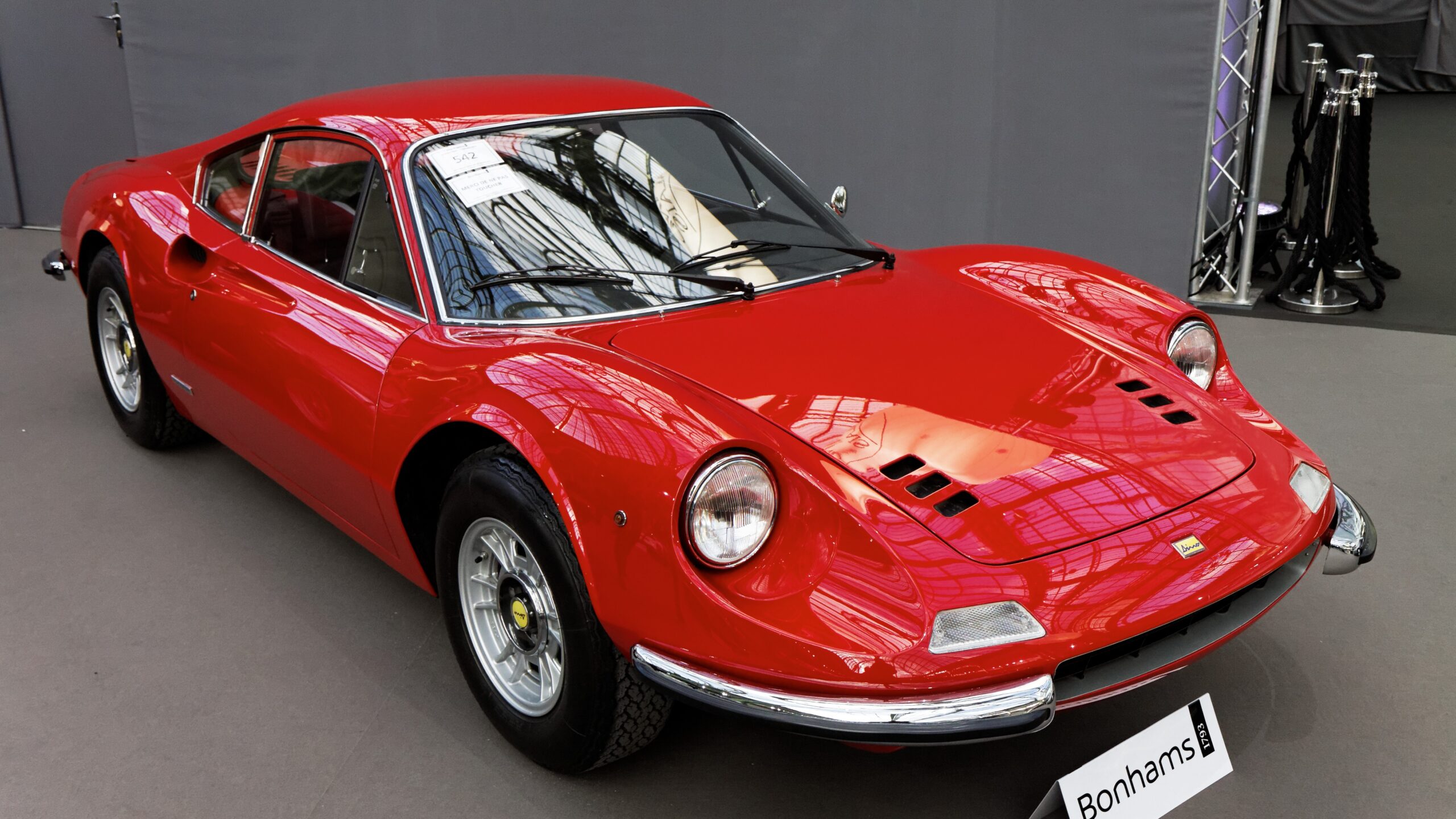
Interest in the Dino 246 GT has surged in recent years, and that momentum is now visible in the auction world. A 1973 example finished in Rosso Chiaro with a black interior is being offered by a specialist classic car auction house, presented as a matching-numbers car with detailed history and recent mechanical attention. It is described as one of the later “E-series” examples, which means it benefits from incremental updates that Ferrari applied through the production run.
According to the auction listing, the car retains its original 2.4‑litre V6, the same 2,418 cc all-alloy engine that helped define the Dino’s character. Mounted transversely behind the seats and ahead of the rear axle, the unit gives the 246 GT its mid‑engined balance while keeping overall dimensions compact. The listing notes that this particular car has been kept largely to factory specification, with correct trim, original-style Cromodora alloy wheels and the correct triple Weber carburettors still in place, all of which supports its authenticity as a collector-grade example.
Documentation included with the car traces its life through multiple owners, with service records and past invoices outlining regular maintenance and periodic refurbishment. The auction notes that the Dino has received recent mechanical work to keep it road-ready, including attention to the cooling system and ignition components, areas that can suffer if a car is left standing for long periods. The vendor highlights that the Dino is offered with a UK V5C registration document and a current MOT, an indication that it has been used and tested on public roads rather than stored purely as a static asset.
The sale has been framed as an opportunity to acquire a car that is both collectible and genuinely usable. The auctioneer describes the Dino as a “driver’s car” that encourages regular use, rather than a fragile exotic that needs to be trailered to events. Photographs in the listing show tidy panel gaps, clean underbody sections and a well-presented engine bay, all of which support the claim that this is a well‑cared‑for example. The car is being promoted as a highlight among several classic Italian models, with particular emphasis on its combination of condition, originality and desirable late-production specification in the auction description.
The renewed spotlight on this 1973 246 GT comes at a time when many classic Ferraris have moved firmly into blue-chip territory, with values that can push them out of reach for drivers who actually want to use their cars. The Dino occupies a more approachable corner of the market, at least relative to twelve‑cylinder models, yet retains the essential ingredients that enthusiasts associate with Maranello: a sonorous engine, tactile controls and a shape that still turns heads in modern traffic.
Why it matters
The Dino 246 GT has always occupied a slightly different place in Ferrari lore. Named for Enzo Ferrari’s son Alfredo “Dino” Ferrari, the car was originally positioned as a separate sub‑brand, without the prancing horse badge on its nose. It used a smaller V6 rather than a V12, and its mission was to bring mid‑engine handling to a wider audience. That positioning meant the Dino was never about outright power, but about feel, balance and response, qualities that matter as much today as they did in the early 1970s.
On paper, the 2.4‑litre V6 produces a modest output by current standards, yet the way it delivers that power defines the experience. The engine thrives on revs, with power building cleanly as the needle sweeps toward the red line and a distinct change in induction note as the triple Webers open up. Drivers are encouraged to use the full rev range and to shift frequently, which keeps them engaged rather than relying on low‑end torque. The five‑speed manual gearbox, with its open metal gate, demands deliberate, accurate movements and rewards them with a satisfying mechanical click as each gear engages.
Steering feel is another key part of the equation. The Dino uses unassisted rack‑and‑pinion steering, so low‑speed maneuvering requires some effort, but once on the move the wheel comes alive in the driver’s hands. Small inputs translate directly into changes of direction, and the front axle communicates surface changes and grip levels with a clarity that many modern cars filter out. Combined with the mid‑engine layout and relatively low weight, this steering gives the Dino a sense of agility that drivers can exploit on a winding road.
The chassis tuning reflects an era before widespread electronic aids. There is no traction control, no stability program and no adjustable dampers. Instead, the car relies on a well‑sorted suspension geometry, with unequal‑length wishbones and coil springs that allow the body to move in a controlled but expressive way. The Dino leans slightly in corners, giving the driver early warning of the forces building up, and the car will adjust its line readily with small throttle or steering changes. Rather than isolating the driver from the process of managing weight transfer, the car invites active participation.
Inside, the cabin layout reinforces this sense of connection. The driver sits low, close to the floor, with the pedals offset slightly toward the centerline due to the intrusion of the front wheel arch. The view forward is framed by slim pillars and a low dashboard, while the curved front wings provide visual reference points that help place the car on the road. The instrument cluster is dominated by a large tachometer and speedometer directly ahead of the driver, with auxiliary gauges arranged in a secondary pod. Switchgear is minimal and largely mechanical in feel, with toggle switches and simple rotary knobs.
Compared with many later Ferraris, the Dino’s modest footprint and relatively generous glass area make it easy to place in traffic. The car is narrow by modern standards, and the mid‑engine layout frees up space around the front wheels, which helps with steering lock and maneuverability. These traits contribute to its reputation as a classic that can be driven regularly, not just taken out for occasional high days. Owners often describe the Dino as a car that feels “alive” at legal speeds, which is increasingly relevant as road networks become more congested and speed limits more strictly enforced.
From a collector perspective, the Dino 246 GT also illustrates how driving dynamics can influence long‑term values. While rarity and provenance always matter, the cars that continue to attract strong interest are often those that people still want to drive. The Dino’s combination of usability and feedback has helped it transition from an underappreciated model to a sought‑after classic. The 1973 E‑series cars in particular benefit from incremental improvements in build quality and reliability, which further enhance their appeal to enthusiasts who value seat time as much as investment potential.
The connected driving experience that defines the Dino also stands in contrast to the direction of many modern performance cars. Contemporary supercars often chase headline power figures and rely on sophisticated electronics to manage traction, stability and ride quality. While these systems can deliver astonishing performance and safety, they can also create a layer of separation between driver and machine. The Dino, by comparison, offers a more analog interaction, where skill and attention directly shape the outcome. For many enthusiasts, that purity has become increasingly attractive as digital interfaces proliferate.
There is also a cultural dimension. The Dino represents an era when sports cars were designed with a focus on mechanical elegance and human-scale performance. Its modest size, clear sightlines and relatively simple controls make it approachable even for drivers who are new to classic cars. In an age when some modern supercars feel too wide or too powerful for real roads, the Dino’s balance of performance and accessibility feels refreshing. That helps explain why a well-presented 1973 example can draw strong interest at auction, even as newer, faster models sit in showrooms.
What to watch next
The sale of this 1973 Dino 246 GT will be watched closely by collectors and market analysts who track classic Ferrari values. The result will provide another data point in the ongoing conversation about how driver-focused analog cars are performing relative to more modern, electronically assisted models. Strong bidding would reinforce the idea that buyers are willing to pay a premium for cars that deliver engagement rather than just numbers.
Market observers will pay particular attention to how the car’s specification and condition influence the final price. Late E‑series Dinos are generally considered the most desirable within the 246 GT family, thanks to their improved details and refined engineering. A matching‑numbers engine, original colors and thorough documentation all tend to support stronger bids. The presence of recent maintenance work and a current MOT also signals that the car can be driven immediately, which may attract buyers who want to enjoy the car on the road rather than embark on a lengthy restoration.
Beyond this single auction, the Dino’s trajectory will feed into a broader trend that favors analog, mid‑power sports cars from the 1960s and 1970s. Models that combine modest weight, naturally aspirated engines and manual gearboxes are increasingly seen as offering a more authentic experience than some of their modern counterparts. As emissions regulations, electrification and driver assistance systems reshape the new-car market, classics like the Dino stand as reference points for a different philosophy of performance.
Enthusiasts will also watch how owners choose to use cars like this 1973 246 GT in the coming years. There is a growing movement toward driving events that celebrate classic machinery in real-world conditions, from touring rallies to track days tailored for vintage cars. The Dino’s approachable performance and strong feedback make it well suited to such events, where drivers can explore the car’s capabilities without needing racetrack-level speeds. Increased visibility at these gatherings can further boost the model’s profile and reinforce its reputation as a driver’s car.
Another area to monitor is the availability of specialist support and parts. The Dino’s mechanical simplicity relative to later Ferraris means that experienced workshops can maintain and restore these cars effectively, but long-term values depend in part on the continued supply of quality components and knowledgeable technicians. As more Dinos are restored to high standards, expectations among buyers rise, which can put pressure on cars that remain unrestored or modified. The market may increasingly reward originality combined with careful, sympathetic refurbishment.
More From Fast Lane Only: