The Ferrari 488 GTB arrived in 2015 as more than a replacement for the 458 Italia. It marked the moment Ferrari shifted its mid-engined V8 flagship from high-revving natural aspiration to turbocharged power, reshaping expectations for how a modern supercar should perform and sound. That single engineering decision rippled through the brand’s identity, motorsport strategy, and even how rivals defined their own next-generation performance cars.
A decade on, the 488 GTB reads like a turning point in Ferrari’s history: a car that had to satisfy regulators, outrun competitors, and reassure loyalists that forced induction could still feel like Maranello at its best.
The turbocharged leap from the 458 Italia
When Ferrari introduced the 488 GTB, it replaced the 4.5‑litre naturally aspirated V8 of the 458 Italia with a 3.9‑litre twin‑turbocharged V8. Power climbed to around 661 bhp, with torque swelling dramatically compared with the outgoing car. The engine, codenamed F154, delivered supercar performance that pushed the 488 into territory once reserved for limited‑run specials, while also improving efficiency to meet tightening emissions standards.
Avoiding the traditional drawbacks of turbocharging was key to the project. Ferrari’s engineers focused on throttle response, torque delivery, and acoustic character so the 488 would not feel like a blunt, boosty departure from the 458. The result was a powertrain that produced far more mid‑range shove yet still chased the redline with urgency, narrowing the emotional gap between naturally aspirated and turbocharged performance.
The chassis evolved in parallel. The 488 used an updated aluminium spaceframe, an aerodynamic package that generated significantly more downforce than the 458, and recalibrated electronic aids that allowed the extra power to be deployed cleanly. Systems such as the latest Side Slip Control worked with the car’s adaptive suspension and electronic differential to keep the 488 approachable on the road yet devastatingly quick on circuit.
How Ferrari framed a new kind of performance
Ferrari did not present the 488 GTB as a compromise forced by emissions rules. Instead, it positioned the car as a step change in usable performance. Official figures for the 0 to 100 km/h sprint, top speed, and lap times around Ferrari’s own Fiorano test track all moved ahead of the 458 by clear margins, with the 488 cutting significant time from its predecessor on the company’s benchmark lap.
Reviewers who drove early cars highlighted how the twin‑turbo V8 delivered its torque in carefully managed stages, rather than dumping maximum boost all at once. This approach allowed the 488 to maintain a sense of progression through the rev range, so the driver still felt encouraged to chase higher rpm rather than short‑shifting to ride a torque plateau. The calibration of the seven‑speed dual‑clutch gearbox reinforced that character, with rapid upshifts and intuitive downshift logic that supported both road and track driving.
Aerodynamics underlined the same philosophy. Features such as the sculpted side intakes, active rear aerodynamics, and a carefully profiled underbody helped the car generate substantial downforce without resorting to oversized wings. The styling looked more aggressive than the 458, yet every vent and crease served a defined purpose in cooling or stability.
First reveal and early reaction
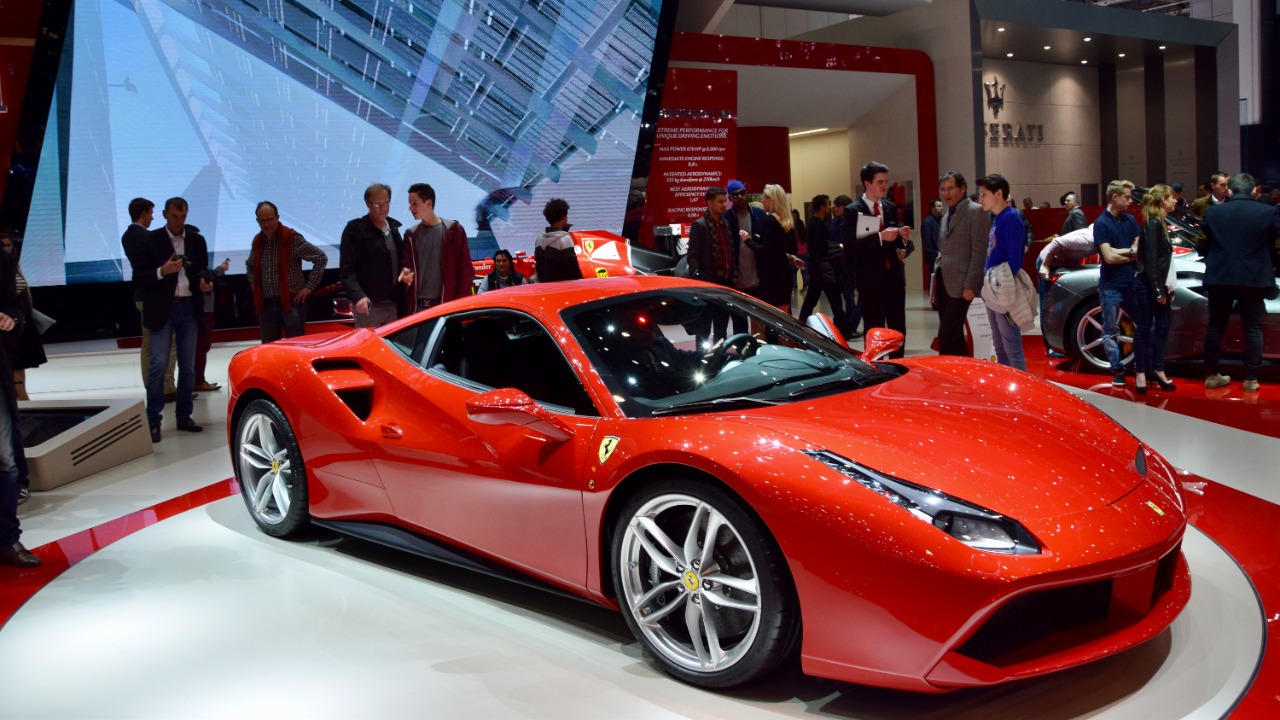
The 488 GTB was unveiled ahead of its official Geneva motor show debut, giving Ferrari a global stage for its new turbocharged flagship. Coverage of the launch focused on the move to a 3.9‑litre twin‑turbo V8 and the headline power and torque figures that eclipsed the 458 Italia. The company framed the car as a direct evolution of its mid‑engined lineage, while also pointing to the technology transfer from its turbocharged Formula One programme.
Early reports from the reveal highlighted how Ferrari stressed both performance and efficiency gains. The 488 was presented as quicker, more responsive, and more aerodynamically effective than its predecessor, yet also cleaner and more fuel efficient. That dual message was essential at a time when supercar makers were under growing pressure to reconcile high performance with stricter environmental rules.
Public reaction mixed curiosity with skepticism. Enthusiasts who loved the 458’s naturally aspirated wail worried that turbos would blunt the soundtrack and character. Others were more interested in the numbers and saw the 488 as a necessary step to keep pace with rivals that were already embracing forced induction. The Geneva debut gave Ferrari a chance to show the car in the metal, explain the engineering choices, and begin shifting the conversation from what had been lost to what had been gained.
Road tests and the driving experience
Once independent tests began, the 488 GTB quickly established a reputation as one of the most capable road cars Ferrari had built. Detailed drives of the car reported that the twin‑turbo V8 felt almost as immediate as a naturally aspirated engine, with minimal lag and a linear surge of power that built toward the redline. Reviewers praised the way the car combined brutal acceleration with a delicacy in its steering and chassis balance that kept it engaging rather than intimidating.
One extensive road and track evaluation of the Ferrari 488 GTB described how the car’s electronics worked in harmony with its mechanical grip. Modes selected via the steering‑wheel manettino allowed the driver to tailor the car from relatively soft and compliant road settings to aggressive track configurations that loosened the stability net. In the more permissive modes, the 488 could be steered on the throttle, with the systems smoothing rather than smothering the driver’s inputs.
The soundtrack remained a recurring talking point. Compared with the 458, the 488’s engine note carried more whoosh and whistle from the turbos and a slightly flatter top‑end shriek. Yet many testers concluded that the car still sounded special, particularly at higher revs, and that the trade‑off in torque and performance justified the change. The exhaust tuning and intake resonance worked hard to preserve a sense of Ferrari theatre, even if purists continued to prefer the older car’s voice.
Positioning within Ferrari’s line‑up
The 488 GTB sat at the heart of Ferrari’s range as the standard mid‑engined V8 berlinetta, slotting below the V12 grand tourers and above entry‑level models that focused more on daily usability. It replaced the 458 Italia as the core supercar that defined what a modern Ferrari should feel like for most buyers. In that role, it had to balance track capability with real‑world comfort and manageability.
The 488 platform also spawned several key derivatives that extended its impact. The 488 Spider added an open‑top experience without sacrificing much structural rigidity, while track‑focused variants pushed the chassis and powertrain further toward circuit performance. These models reinforced the idea that turbocharging could support a wide range of characters within a single architecture, from road‑biased grand tourer to near‑race car.
Ferrari’s decision to standardise turbocharging on its V8 line also prepared customers for later models that would integrate hybrid assistance. By acclimatising buyers to a different kind of power delivery and sound, the 488 helped smooth the path for even more complex powertrains that would arrive in subsequent years.
How does the 488 compare with rivals
In the mid‑2010s, the 488 GTB entered a segment crowded with high‑performance alternatives. Competitors such as the McLaren 650S and later 720S, along with turbocharged versions of the Porsche 911, were already demonstrating the performance benefits of forced induction. Against that backdrop, Ferrari needed the 488 not just to match the numbers but to maintain a distinctive driving feel.
Independent comparisons frequently highlighted the 488’s blend of precision and drama. Its steering feel, the way it managed body control on challenging roads, and the sophistication of its electronic aids gave it an edge in driver engagement. At the same time, its performance figures placed it firmly among the quickest cars in its class, with acceleration and lap times that justified its billing as a new benchmark for Ferrari’s V8 line.
Design was another battleground. The 488’s sculpted bodywork, with large side intakes feeding the intercoolers and a tightly drawn rear section, gave it a distinctive identity that set it apart from both the more organic 458 and the often more angular styling of its rivals. The car’s appearance communicated its turbocharged purpose without abandoning the elegance expected of a Ferrari.
Technical lineage and model evolution
The 488 GTB did not exist in isolation. It formed part of a broader family of Ferrari 488 models that shared its core engine and chassis architecture. Over time, this family expanded to include track‑oriented variants and special editions that pushed the 3.9‑litre twin‑turbo V8 to even higher outputs and more aggressive tuning.
Technical overviews of the Ferrari 488 range emphasise how the F154 engine served as a foundation for multiple configurations, from road‑legal supercars to competition cars. Changes in turbo sizing, cooling, and engine mapping allowed Ferrari to tailor power delivery and durability for different use cases, whether daily driving or endurance racing. The modular nature of the platform made it easier for the company to respond to customer demand for both comfort‑oriented and track‑focused variants.
This adaptability also supported Ferrari’s motorsport ambitions. The same basic architecture underpinned GT racing cars that competed in international endurance series, where reliability and efficiency are as critical as outright speed. That motorsport feedback loop informed ongoing refinements to the road‑going 488, closing the gap between showroom models and race machinery.
Launch messaging and brand strategy
When the 488 GTB was first unveiled, Ferrari’s messaging leaned heavily on heritage and innovation. The company framed the car as a continuation of the Gran Turismo Berlinetta tradition, while also highlighting the advanced aerodynamics and turbocharging as evidence of its engineering progress. Coverage of the early reveal described how Ferrari balanced references to past icons with detailed explanations of new technology.
Reports on the unveiling ahead of Geneva noted how the company stressed the 488’s improved acceleration, higher power output, and increased downforce relative to the 458. At the same time, Ferrari drew attention to the car’s reduced emissions and fuel consumption, presenting the turbocharged engine as a solution that met both performance and regulatory demands. The early launch coverage made clear that the brand wanted customers to see the 488 as a step forward on every measurable front.
That positioning reflected a broader shift in how supercar makers communicated with their audience. Raw performance figures remained central, but efficiency metrics and technological sophistication became part of the sales pitch. Ferrari used the 488 to show that it could adapt to new constraints without abandoning the emotional appeal that defined its cars.
Impact on Ferrari’s identity
The move to turbocharging carried symbolic weight. For decades, Ferrari’s naturally aspirated engines had been celebrated for their high‑revving character and distinctive sound. By fitting turbos to its core V8 supercar, the company signalled a willingness to alter one of its most cherished traits in pursuit of performance and compliance with modern standards.
The 488 GTB helped redefine what enthusiasts expected from a Ferrari. Rather than judging the car solely on its soundtrack or the purity of its induction, many began to value the way it combined immense torque with accessible handling and electronic sophistication. The car set a template for future models that would blend combustion engines with hybrid systems, where outright responsiveness and torque delivery matter more than the absence of forced induction.
More from Fast Lane Only
- Unboxing the WWII Jeep in a Crate
- 15 rare Chevys collectors are quietly buying
- 10 underrated V8s still worth hunting down
- Police notice this before you even roll window down
*Research for this article included AI assistance, with all final content reviewed by human editors.