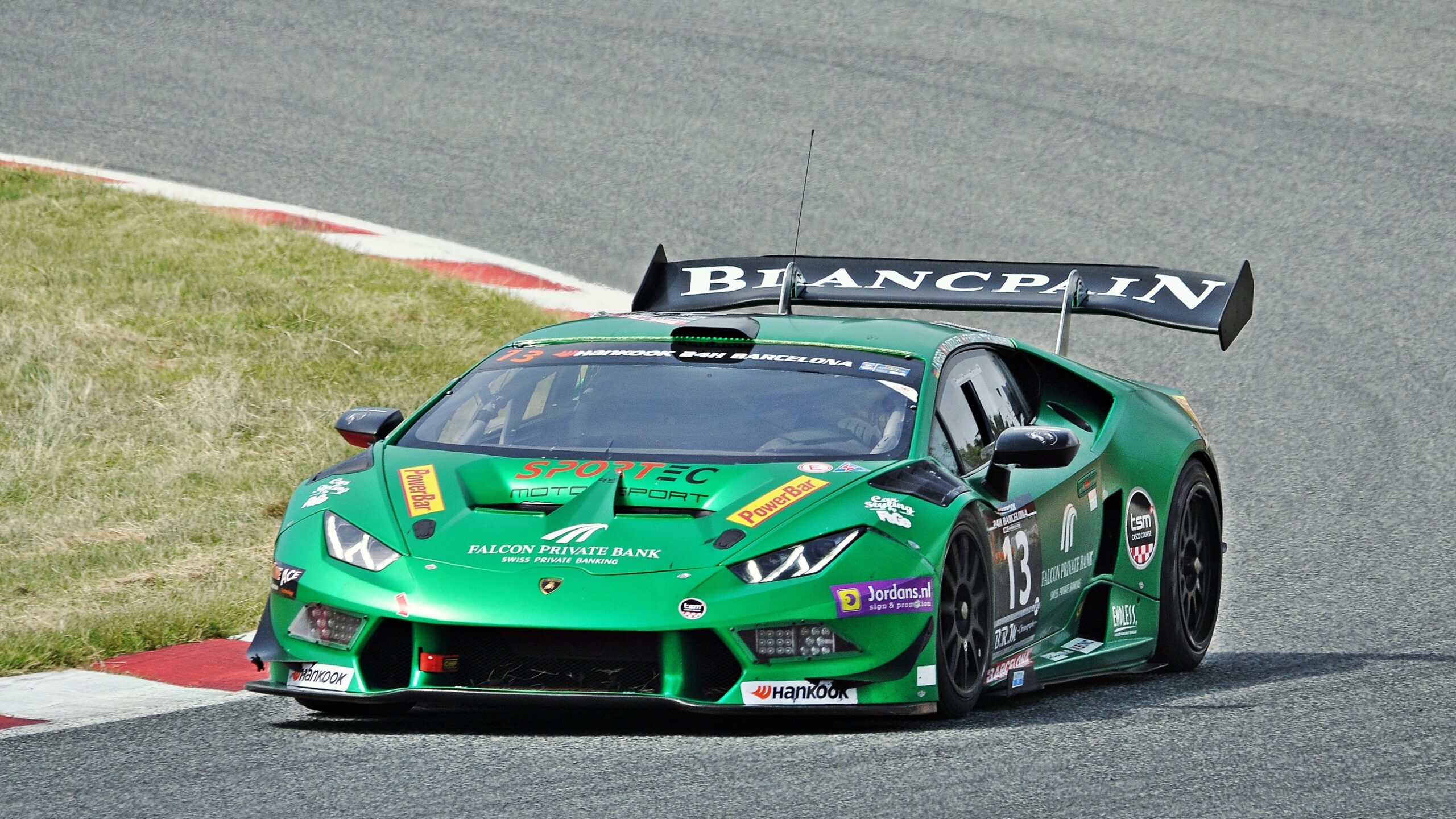
The 2015 Lamborghini Huracán arrived with a clear mission: replace the wild Gallardo with a supercar that could still thrill on track yet behave with precision and polish on the road. Its naturally aspirated V10, rated at 610 horsepower, sat at the center of that brief, but the real story was how Lamborghini wrapped that performance in a far more refined chassis and cabin.
The result was a car that kept the drama and noise expected from Sant’Agata while adding stability, usability, and everyday civility. The Huracán marked a turning point for the brand, proving that aggressive character and modern sophistication could share the same carbon and aluminum shell.
A New Generation of V10 Supercar
The Huracán LP 610-4 launched as Lamborghini’s new mid-engine V10 flagship, with its 5.2‑liter engine producing 610 metric horsepower and sending power to all four wheels. It rode on a hybrid chassis that combined aluminum with carbon fiber sections, a structure that improved rigidity while trimming weight compared with a traditional all-metal platform.
In place of the Gallardo’s single-clutch automated manual, the Huracán introduced a 7‑speed dual-clutch gearbox that shifted far more quickly and smoothly. Paired with electronically controlled all-wheel drive and a sophisticated stability system, that transmission gave the car much sharper responses under hard acceleration and braking.
On paper, the numbers were startling. The LP 610-4 sprinted from zero to 100 km/h in around 3.2 seconds and pushed on to a top speed beyond 320 km/h. Those figures put it squarely in the territory of contemporary V10 and V12 exotics while using a smaller, lighter engine than Lamborghini’s own flagship twelve-cylinder models.
Design That Balances Drama and Discipline
Lamborghini wrapped this new hardware in a body that looked every bit as extroverted as fans expected, yet the surfaces were more controlled and cohesive than the Gallardo’s. The Huracán’s low nose, crisp side intakes, and sharply cut rear deck drew heavily on the angular design language that defined the brand’s modern era.
Despite the visual aggression, the bodywork served clear aerodynamic purposes. The front splitter, side skirts, and integrated rear diffuser helped generate downforce while managing airflow around the wheels and underbody. That work delivered high-speed stability that felt far more planted than the previous car, especially in fast sweepers and under heavy braking.
Inside, the cabin shifted toward a more premium, technology-forward environment. The driver faced a fully digital instrument cluster instead of traditional analog gauges, and the center console housed aviation-style toggles and a red flip-up starter cover. The layout still felt theatrical, but the materials, ergonomics, and visibility made the Huracán noticeably easier to live with than its predecessor.
From Gallardo to Huracán: Evolution, Not Rebellion
To understand why the Huracán’s character mattered, it helps to see where it came from. The Gallardo had carried Lamborghini through the 2000s with raw sound and sharp styling, but its single-clutch gearbox and older electronics felt outdated by the mid-2010s. The new car needed to keep the emotional appeal while aligning with modern expectations for usability and tech.
Early technical rundowns of the Huracán highlighted how the aluminum and carbon chassis, updated V10, and dual-clutch transmission created a more cohesive package than the outgoing model. Overviews of the Huracán range have since underlined that this basic formula proved flexible enough to support rear-wheel-drive variants, higher-performance evolutions, and open-top versions without losing its core identity.
The 2015 LP 610-4, then, was not a radical break from the Gallardo so much as a careful rethinking. It kept the mid-engine layout and V10 soundtrack but surrounded them with better structural engineering, more advanced electronics, and a cabin that felt closer to a luxury GT than a stripped-out track toy.
Engineering the 610 Horsepower Package
The heart of the car, the 5.2‑liter V10, combined direct and port fuel injection to improve both performance and efficiency. In LP 610-4 trim, it produced 449 kW, or 610 PS, at high revs, along with a torque curve that built strongly as the tachometer climbed. The engine’s character encouraged drivers to chase the redline, where the intake howl and exhaust note merged into a signature Lamborghini shriek.
Technical breakdowns of the Huracán LP 610-4 detailed the car’s dimensions and mechanical layout. The car measured around 4.46 meters in length and used a wheelbase of roughly 2.62 meters, with the engine mounted longitudinally behind the occupants. Dry weight sat near 1,422 kilograms, which gave the Huracán a power-to-weight ratio that justified its supercar status.
The all-wheel-drive system used a central coupling to distribute torque between the front and rear axles, while an electronic rear differential and stability control system could subtly adjust power delivery mid-corner. Together, these systems allowed the car to put all 610 horsepower to the ground with surprising composure, even on imperfect surfaces.
On-Track Behavior: Aggressive Yet Predictable
Track impressions from early testing made clear that the Huracán’s performance was not just about straight-line speed. During an Australian circuit evaluation, reviewers found that the LP 610-4 delivered immense grip and traction, especially under power out of slower corners. The car’s all-wheel-drive system and dual-clutch gearbox combined to fire it out of bends with minimal drama.
Drivers who sampled the car at speed noted that the steering felt more precise than the Gallardo’s, with better weighting and feedback through the wheel. Braking performance from the standard carbon-ceramic discs was described as strong and consistent over repeated hard stops, which is critical for a car expected to spend time on track. Reports from that Australian track test also highlighted the way the chassis stayed neutral through fast corners, allowing skilled drivers to adjust the car’s attitude with small throttle or steering inputs.
Even so, the Huracán did not lose the sense of occasion that defines a Lamborghini. The V10’s soundtrack, the rapid-fire gear changes, and the sharp, angular cockpit all contributed to a driving experience that felt intense even when the electronics quietly tidied up any mistakes in the background.
Road Manners and Everyday Usability
On public roads, the Huracán’s refinement came to the forefront. The dual-clutch gearbox shifted smoothly in automatic mode, removing the low-speed lurch that had plagued earlier single-clutch systems. In the car’s more relaxed driving settings, throttle response softened, the exhaust quieted, and the suspension felt compliant enough for longer journeys.
The introduction of multiple driving modes, selected via a steering wheel switch, allowed the driver to tailor the car’s character. In its softest setting, the Huracán behaved like a fast, comfortable GT. In its most aggressive mode, shift speeds increased, the stability system loosened its grip, and the exhaust opened up fully, turning the car back into a track-ready weapon.
Cabin noise at highway speeds was more controlled than in the Gallardo, thanks to better insulation and more refined aerodynamics. Visibility, never a strong point for mid-engine supercars, improved just enough to make city driving less stressful, although the wide rear haunches and low roofline still demanded attention in tight spaces.
Polizia Livery and Public Service Duty
The Huracán’s blend of speed and stability did not go unnoticed by Italian authorities. Lamborghini delivered a special LP 610-4 finished in police livery for the Polizia di Stato, complete with blue and white paint, light bars, and law enforcement equipment. This car retained the full 610 horsepower powertrain but added features such as a refrigerated compartment for medical transport and communication systems integrated into the cabin.
The official presentation of the Huracán Polizia underscored the car’s reliability and high-speed stability, qualities essential for emergency response work on Italian highways. It also served as a high-visibility symbol of Italian engineering, reinforcing the connection between Lamborghini and its home country’s institutions.
That a 610-horsepower supercar could be adapted for police duty without major structural changes spoke to the underlying robustness of the platform. The same attributes that made the Huracán a confident track car also made it a capable, if highly specialized, service vehicle.
Open-Top Evolution and Platform Versatility
The basic architecture introduced by the 2015 coupe soon supported an open-top variant. The Huracán LP 610-4 Spyder arrived with a folding soft top and structural reinforcements that preserved much of the coupe’s stiffness while allowing open-air driving. The engine output and all-wheel-drive system remained broadly similar, which meant the Spyder still delivered supercar performance even with the roof lowered.
Early drives of the Huracán Spyder highlighted how the platform’s inherent rigidity helped control flex and vibration, a common challenge for convertibles. The car’s chassis tuning, already on the firm side, handled the extra weight of the roof mechanism without losing its precision.
This evolution from coupe to Spyder illustrated how carefully Lamborghini had engineered the original structure. By designing the chassis and drivetrain with future variants in mind, the company could maintain the core driving experience while offering different body styles and personalities.
How the Huracán Stacked Up Against Rivals
In the mid-2010s, the Huracán faced fierce competition from other high-performance sports cars, particularly those with turbocharged engines or hybrid assistance. Rivals often produced similar or greater power, but many relied on forced induction to achieve their outputs. Lamborghini’s decision to retain a naturally aspirated V10 gave the Huracán a distinct character, with instant throttle response and a linear power delivery that turbocharged engines struggled to match.
Comparative tests of the 2015 LP 610-4 emphasized that while some competitors offered slightly quicker acceleration in certain conditions, the Huracán’s combination of sound, feel, and chassis balance created a uniquely engaging experience. The car’s dual-clutch gearbox and all-wheel-drive traction allowed it to launch hard from a standstill, while its braking and cornering performance kept it competitive on track.
Where the Huracán particularly distinguished itself was in its ability to blend that performance with everyday usability. Rivals with more extreme setups or less sophisticated transmissions often felt tiring in daily driving, while the Lamborghini could settle into a calmer rhythm when required.
Why the 2015 Model Still Matters
More than a decade after its debut model year, the first Huracán continues to hold significance in Lamborghini’s history. It marked the point where the brand fully embraced dual-clutch gearboxes, advanced electronics, and digital instrumentation without sacrificing the emotional intensity of its cars.
The 610-horsepower output, impressive at launch, set a baseline for later, more focused variants that pushed power and grip even higher. Yet many enthusiasts still regard the original LP 610-4 as the purest expression of the car’s character, with its combination of all-wheel drive, naturally aspirated power, and relatively restrained styling.
For Lamborghini, the Huracán’s success validated a strategy that combined aggressive performance with greater refinement and usability. That formula has influenced subsequent models and will likely continue to shape the brand’s approach as it navigates electrification and stricter emissions standards.
What Comes Next for the Huracán Legacy
As the industry moves toward hybrid and electric powertrains, the naturally aspirated V10 that defined the Huracán faces increasing regulatory pressure. Future successors are expected to incorporate some form of electrification, which will inevitably change the character of the power delivery and sound. The 2015 model therefore stands as a snapshot of a particular moment in supercar history, when high-revving, non-turbo engines still sat at the center of the segment.
More from Fast Lane Only
- Unboxing the WWII Jeep in a Crate
- 15 rare Chevys collectors are quietly buying
- 10 underrated V8s still worth hunting down
- Police notice this before you even roll window down
*Research for this article included AI assistance, with all final content reviewed by human editors.