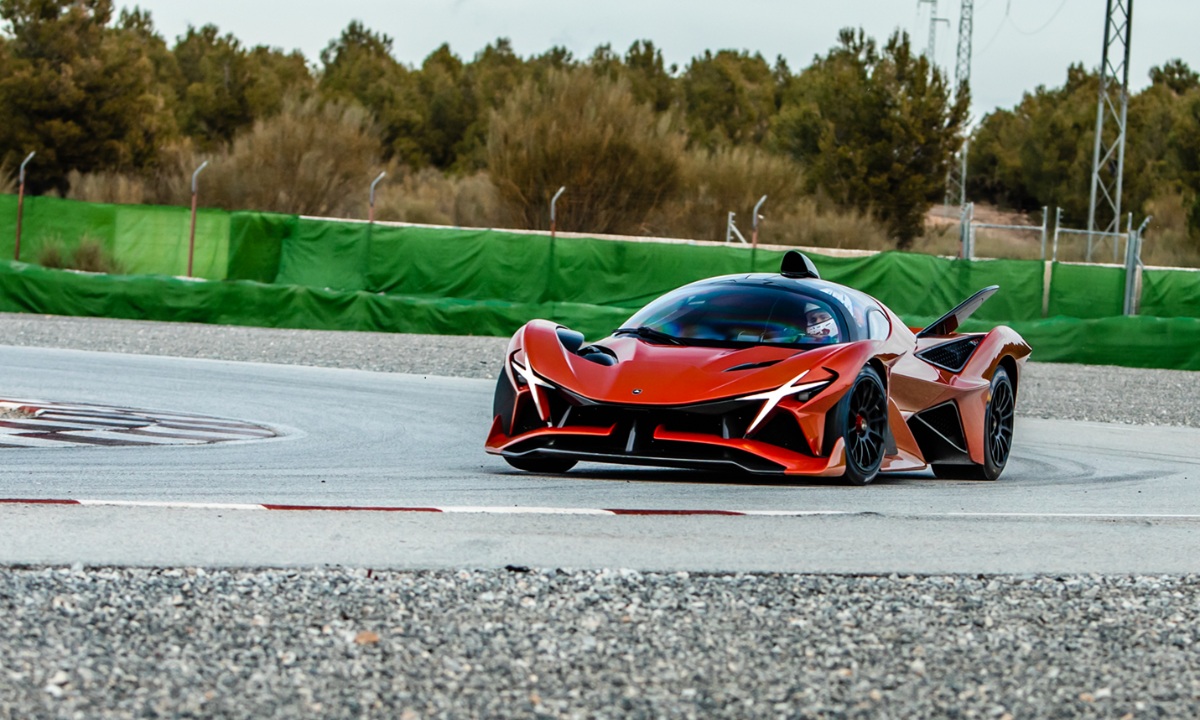
The Apollo EVO has returned as a track-only spectacle, a $3.5 million sculpture of carbon and wings that chases lap times rather than lap belts. Yet in a year when the Chevrolet Corvette family is casually rewriting performance records, this ultra-rare German machine finds itself in the strange position of being almost, but not quite, as quick as America’s latest bargain hypercar. The contrast between a limited-run V12 exotic and a relatively attainable hybrid Corvette says as much about where performance engineering is headed as it does about either car’s spec sheet.
A $3.5 million German statement piece
The Apollo EVO is unapologetically exclusive, with a starting price of €3,000,000, which converts to a little under $3.5 million before taxes and fees, and production capped at just 10 units globally. The car is described as a German supercar with no shortage of aero, its bodywork bristling with fins, flaps, and ducts that make it look more like a science experiment than a conventional 208-mph supercar, a design approach that underscores Apollo’s focus on downforce and stability rather than subtlety. Germany’s only supercar maker positions the Apollo EVO as a centerpiece for dedicated track collectors rather than a garage ornament, and the price tag reflects that ambition.
Beneath the dramatic bodywork sits a naturally aspirated 6.3 liter V12 that revs to 8,500 rpm, a configuration that deliberately rejects the hybrid assistance and turbocharging that dominate modern performance cars. The engine produces around 800 horsepower, delivered through a six speed sequential transmission to the rear wheels, with carbon ceramic brakes and forged aluminum wheels sized 20×10 inches at the front and 21×13 inches at the rear to manage the forces involved. The result is a claimed 0 to 60 time of under 2.7 seconds and a top speed of 208 mph, performance that places the Apollo EVO firmly in hypercar territory while preserving what its creators describe as a raw, unfiltered connection between driver and machine, free from hybrid systems and artificial enhancement.
Skeletonised engineering and track-only focus
Where many modern exotics still nod to road usability, the Apollo EVO is effectively a racing prototype that happens to be sold to private owners. The chassis and body are described as skeletonised, with exposed structural elements and minimal concessions to comfort, a philosophy that keeps weight down to about 2,866 pounds and leaves little doubt about the car’s intended environment. The forged aluminium wheels can be swapped for a design optimized for slick tyres, and Apollo notes that no two EVOs will be exactly alike, with extensive customization built into the program for the handful of buyers who secure a build slot.
The hardware choices reinforce that single minded purpose. The V12 is paired with a six speed sequential gearbox rather than a dual clutch unit, prioritizing direct mechanical engagement over everyday smoothness, while the carbon ceramic brakes and aggressive aero package are tuned for repeated hard use on racing circuits across the globe. The company describes the EVO as free from hybrid systems, a deliberate counterpoint to the current wave of electrified hypercars, and positions its naturally aspirated 8,500 rpm engine as a last stand for traditional high revving combustion in a world that is rapidly moving toward batteries and boost. For owners, the appeal is as much about that purist identity as it is about the stopwatch.
Corvette’s hybrid shock: ZR1 and ZR1X reset expectations
Against that backdrop, the latest Corvette models arrive with a very different mission, yet they end up encroaching on the same performance territory at a fraction of the price. The road going Corvette ZR1 starts at $185,000 and delivers 1,064 horsepower at 7,000 RPM and 828 lb ft of torque at 6,000 RPM, with a claimed 233 MPH top speed that has already been demonstrated with a Chevrolet executive at the wheel. Those numbers place the ZR1 squarely in the realm once reserved for million dollar exotics, yet it remains a production car with road manners, a warranty, and a price tag that, while steep, is still an order of magnitude below the Apollo EVO.
Above it sits the Chevrolet Corvette ZR1X, an all wheel drive hybrid flagship that pushes the concept even further. The ZR1X is described as a 1,250 hp AWD hybrid monster, capable of 0 to 60 mph (97 km/h) in under two seconds and covering the quarter mile in the nine second range, performance that would have been unthinkable for a factory Corvette only a generation ago. Independent testing reports that the 2026 Chevrolet Corvette ZR1X just ran 0 to 60 in 1.68 Seconds, with the same figure repeated in other coverage that notes the car’s 1.68-Second 0-60 Time as a benchmark for street legal acceleration. Chevrolet itself highlights the ZR1X as the most powerful American performance car, a claim that aligns with these figures and underscores how far the Corvette nameplate has evolved.
Almost as fast as a Corvette, at ten times the price
Set side by side, the Apollo EVO and the Corvette ZR1X illustrate how divergent engineering philosophies can converge on similar performance outcomes. The Apollo’s naturally aspirated V12, revving to 8,500 rpm and sending power through a rear drive layout, delivers a 0 to 60 time of under 2.7 seconds and a top speed of 208 mph. The Corvette ZR1X, by contrast, uses a hybrid powertrain and all wheel drive to achieve 0 to 60 in 1.68 Seconds and sub two second runs in some reports, while the road going ZR1 variant reaches 233 MPH at the top end. In raw numbers, the American hybrid is quicker off the line and, in ZR1 form, faster at v-max, which makes the Apollo EVO’s seven figure price and limited production look less like a performance necessity and more like a statement of exclusivity.
That disparity is even starker when cost is factored in. The Apollo EVO’s €3,000,000 starting price, translating to just under $3.5 million, buys a track only toy that is only marginally slower to 60 than the Corvette ZR1X and significantly slower in top speed than the 233 MPH Corvette ZR1. Meanwhile, a buyer could theoretically purchase nearly twenty ZR1s at $185,000 each for the cost of a single Apollo EVO, or acquire a ZR1X that delivers 1,250 hp and all wheel drive traction for a fraction of the German car’s outlay. The Corvette’s ability to make these million dollar hypercars look slow has already been noted in comparisons with other exotics, and the Apollo EVO now finds itself in that same crosshair, its value proposition rooted less in outright speed and more in rarity, craftsmanship, and the emotional appeal of a screaming V12.
Emotion versus efficiency in the hypercar era
Ultimately, the Apollo EVO and the latest Corvettes are chasing different kinds of glory, even if their lap times overlap. The Apollo is positioned as a German sculpture for the track, a car that leans into its skeletonised construction, bespoke forged Wheels, and naturally aspirated V12 to deliver what its creators describe as a Free and unfiltered driving experience. Its 208-mph capability, 2,866 pound Weight, and 564 lb ft of torque are impressive, but the real selling point is the sense of occasion that comes from piloting one of only 10 examples, each tailored to its owner and intended for private track days rather than public roads.
More from Fast Lane Only