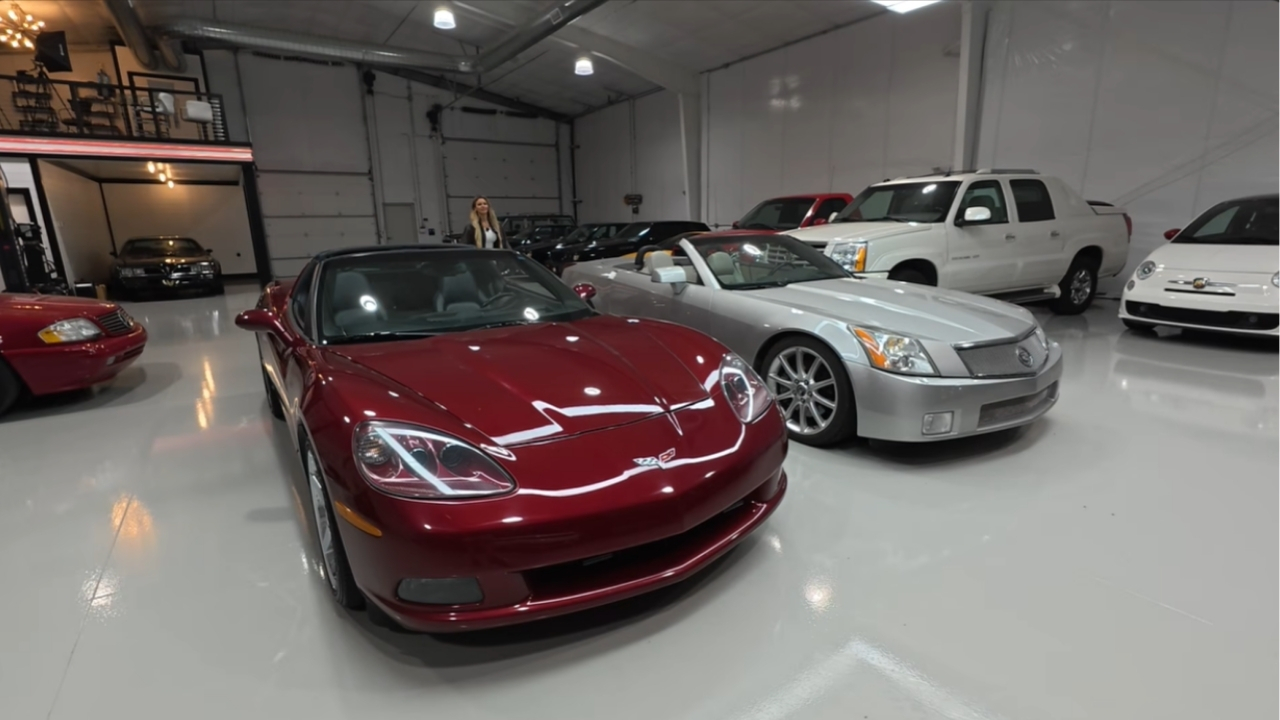
Two cars rolled off the exact same assembly line in Bowling Green, Kentucky, in 2006. They shared a platform, a supercharger-adjacent horsepower figure, identical door release buttons, and even the same key fob shape. One of them became one of the best-selling performance cars in America. The other became such a hard sell that a dealership owner eventually gave up and shipped an unsold example to his own house.
That’s the strange history behind the Cadillac XLR-V and the C6 Corvette, two cars built almost like siblings that ended up living completely different lives. A recent side-by-side look at both, filmed with a former Chevrolet salesman who actually sold Corvettes off the showroom floor in 2006, makes the gap between them even harder to explain.
A platform built for two very different reputations
Both cars used the same rear-mounted transaxle layout, and starting in 2006, both carried GM’s small “chicklet” badge on the lower rocker panels, a branding detail the automaker rolled out across multiple models for a couple of model years. The exterior door releases, an electronic touch pad rather than a traditional handle, worked identically on both cars, and on the two well-worn examples featured here, one a 68,000-mile trade-in and the other a 100,000-mile project car, both occasionally needed a second press to respond. Inside, the door release buttons matched as well, and even the key fobs were functionally the same part with different badging stamped on top.
Under the hood, the numbers landed close enough to raise eyebrows. The Corvette ran a naturally aspirated 6.0-liter LS2 V8, while the XLR-V used a supercharged Northstar V8 in the 4.4-liter range. Both were rated at roughly 400 horsepower. Both also used GM’s MagRide active suspension system, an unusual feature to find on two cars occupying such different corners of the market.
The price gap nobody could get past
Where the two cars diverged sharply was on the window sticker. The Corvette carried a base price around $45,000 in 2006, while the XLR-V started at roughly $97,000, more than double the cost for a car built on the same platform with comparable output. A former Chevrolet salesman who worked the floor during that era summed up the math bluntly, joking that offering a customer the same performance for twice the price was never much of a contest.
That price gap showed up directly in sales figures. Chevrolet moved somewhere around 200,000 C6 Corvettes over the model’s run, while Cadillac built only about 15,000 to 20,000 XLRs total, with the high-performance V variant accounting for roughly 2,000 of those. One dealership’s experience captured the disparity well: an unsold new XLR-V reportedly sat on the lot long enough that the dealership’s owner eventually had it shipped to his personal residence rather than continue trying to sell it.
Two very different ownership experiences today
Decades later, that early unpopularity has flipped into a different kind of problem for XLR-V owners: scarcity. Because so few were built and aftermarket support never developed around the car, replacement parts have become expensive and hard to find. Original tail lights alone can fetch up to $4,000 a pair on the used market, a price driven largely by parts cars being bought and stripped rather than repaired, since there’s no aftermarket production to fall back on.
The Corvette’s popularity created the opposite outcome. With a far larger production run and decades of aftermarket demand, C6 owners have no shortage of replacement parts, performance upgrades, or repair options. It’s a strange twist on the original story: the car that once seemed like the “safe” mainstream choice is now the easier one to actually live with and maintain.
Two badges, one platform, two very different legacies
In the end, the closer these two cars are examined, the stranger their sales gap looks. They came out of the same factory, wore comparable output on paper, and even shared everyday hardware most owners would never think to check. What separated them wasn’t really engineering. It was branding, pricing, and a market that, in 2006, simply couldn’t justify paying nearly double for a badge, even with a supercharger under the hood.
More from Fast Lane Only
- Unboxing the WWII Jeep in a Crate
- 15 rare Chevys collectors are quietly buying
- 10 underrated V8s still worth hunting down
- Police notice this before you even roll window down
*Research for this article included AI assistance, with all final content reviewed by human editors.