The turn of the 21st century was a dark era for Detroit. Caught in a vortex of plunging market share, outdated product lineups, and severe corporate crises, the Ford Motor Company was teetering on the edge of financial ruin. Morale was at an all-time low. Ford desperately needed an engineering miracle—not just to sell units, but to prove to a skeptical global market that the company was still capable of world-class greatness. The result was a high-stakes supercar gamble that permanently rewrote automotive history: the 2005 Ford GT.
The Genesis of a Centennial Legend
In the early 2000s, Ford was preparing for its historic centennial anniversary, but there was little to celebrate. To inject a fierce dose of pride back into the blue oval brand, legendary Ford Chief Designer J Mays spearheaded a top-secret initiative called “Project Petunia.” The goal was highly ambitious: build a modern, road-going reincarnation of the legendary 1960s Ford GT40 race car that had famously humbled Ferrari at Le Mans.
The project was an immense engineering risk. Ford had very little time and an extremely tight budget to develop an aluminum-chassis supercar from scratch. Skeptics within corporate management argued that building a low-volume exotic car was a waste of critical cash reserves during a financial crisis. However, J Mays and the leadership team persevered, driven by a deep belief that a halo vehicle could completely shift public perception, restore investor confidence, and save the brand’s identity from impending doom.
Design and Innovation: Rules Rewritten
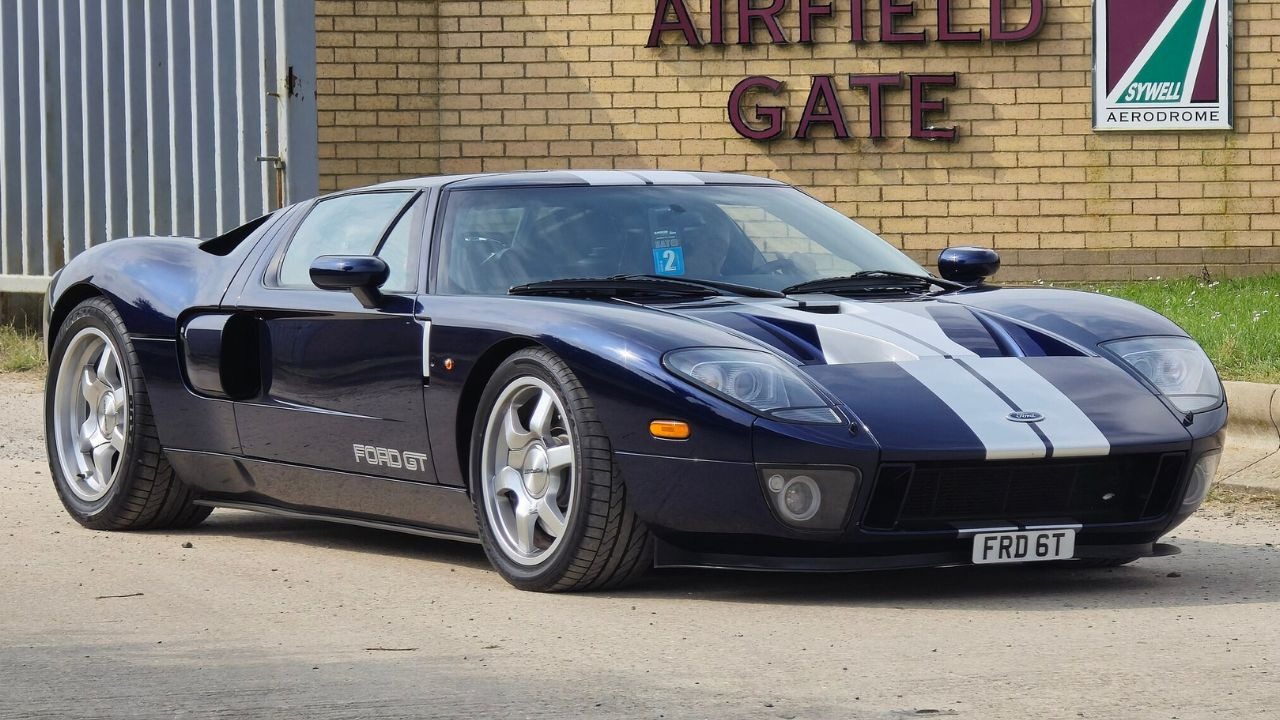
When the production 2005 Ford GT officially debuted, it completely stunned the automotive press. Visually, J Mays pulled off a masterclass in retro-futurism, perfectly capturing the low-slung, aggressive silhouette of the original racing icon while packaging it with modern ergonomics. Under the rear glass sat a mid-mounted, supercharged 5.4-liter V8 engine pumping out a terrifying 550 horsepower and 500 lb-ft of torque, mated exclusively to a six-speed manual transmission.
The car was a technological tour de force for its time. It featured a super-plastic-formed aluminum frame, a friction-stir welded center tunnel, and a cap-less fuel filling system. It didn’t rely on modern electronic driver aids like traction or stability control; it was a raw, analog weapon capable of rocketing from 0 to 60 mph in 3.3 seconds and hitting a top speed of 205 mph—putting it firmly in the crosshairs of contemporary Ferraris and Lamborghinis at a fraction of the price.
From Corporate Savior to Million-Dollar Icon
The media and public reception were overwhelmingly ecstatic. Automotive journalists universally praised the Ford GT as a mechanical masterpiece, noting that it was more reliable, easier to drive, and faster than its European exotic rivals. It instantly achieved its goal of shifting the corporate narrative, transforming Ford overnight from a struggling corporate giant into a highly capable king of performance.
Only 4,038 units were built during its brief two-year production run, creating an immediate collector frenzy. While the car originally rolled out of showrooms with a base price of roughly $140,000, its status as a legend has only intensified over the decades. Today, the 2005–2006 Ford GT is highly sought after by collectors worldwide, with pristine, well-maintained examples routinely commanding between $350,000 and $500,000+ at elite auctions like Mecum and Barrett-Jackson. What started as a desperate gamble to save a company’s soul ended up becoming one of the greatest investment-grade automotive icons of the 21st century.
More from Fast Lane Only
- Unboxing the WWII Jeep in a Crate
- 15 rare Chevys collectors are quietly buying
- 10 underrated V8s still worth hunting down
- Police notice this before you even roll window down
*Research for this article included AI assistance, with all final content reviewed by human editors.