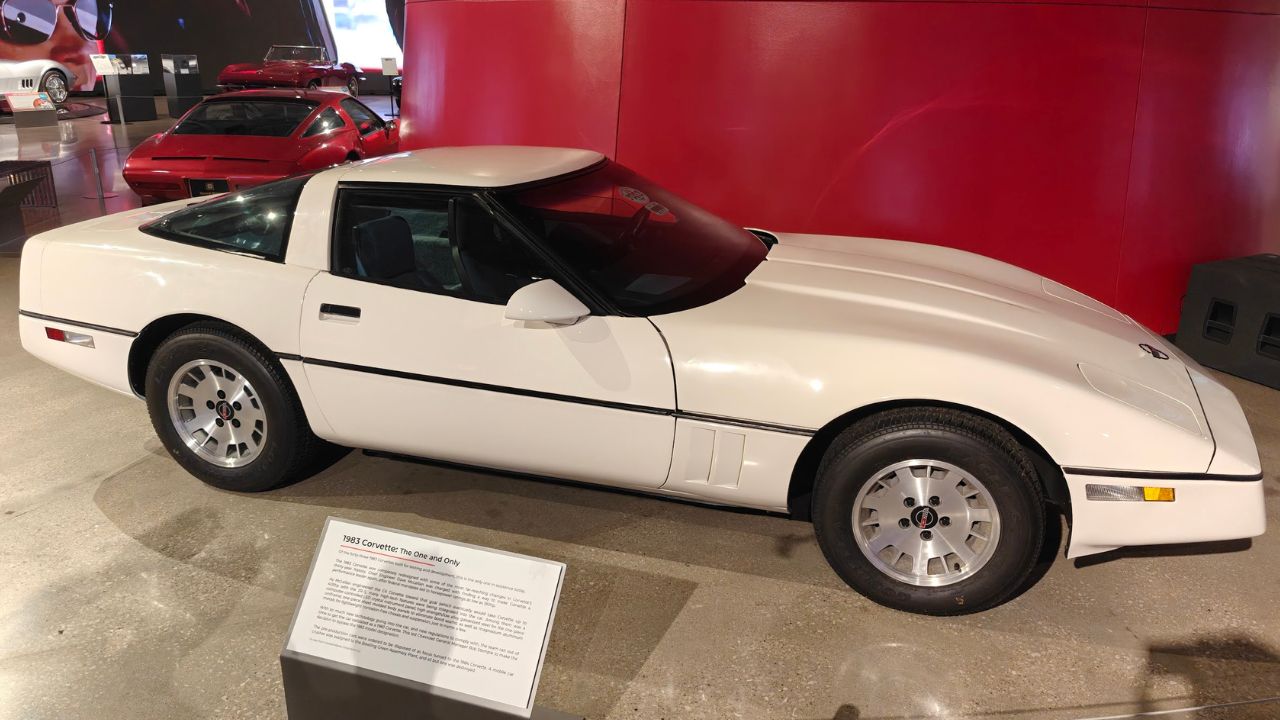
Ask most Corvette owners about their 1983 model, and you’ll get a strange answer: it doesn’t exist. Not because it never happened — Chevrolet built dozens of them — but because not a single one was ever sold to the public. It remains one of the strangest gaps in American automotive history, and the true story behind it is stranger than any invented one.
A Model Year That Was Never Supposed to Disappear
Since its debut in 1953, the Corvette had gone through steady evolution, but by the late 1970s the third-generation “C3” body style — introduced all the way back in 1968 — was starting to show its age. Chevrolet had an ambitious replacement in the works: the fourth-generation Corvette, or “C4,” featuring a completely redesigned chassis, a new composite body, and a sleeker, more aerodynamic shape built for both performance and efficiency.
The plan was to launch the C4 as the 1983 model. Chevrolet even printed sales brochures for it. But 1983 never happened — at least not for customers.
What Actually Went Wrong
The C4’s development ran into real, well-documented trouble. GM had moved Corvette production from its longtime home in St. Louis to a brand-new factory in Bowling Green, Kentucky, built specifically to handle the C4’s new composite body panels. But a late change to the composition of those panels caused serious manufacturing problems, and the new plant struggled to produce consistent, high-quality bodies on schedule.
At the same time, the C4 itself was more ambitious than a routine redesign — new chassis engineering, updated emissions compliance, and a heavily reworked interior all needed final validation. According to Dave McLellan, Corvette’s chief engineer at the time, Chevrolet built a batch of “pilot line” cars — commonly cited as 43 of them, alongside a smaller number of true engineering prototypes — to test assembly procedures, run crash evaluations, and work out the remaining kinks before full production began.
None of those cars were ever intended for sale. Pilot-line vehicles exist purely to prove out a factory’s production process, and standard GM procedure was to destroy them once testing was complete.
The Decision to Skip the Year Entirely
Rather than rush a flawed car to market, Chevrolet made the call to scrap the 1983 model year altogether and launch the finished C4 as an early 1984 model instead. That extra time paid off: when the 1984 Corvette finally reached showrooms, it was a genuine leap forward for the nameplate, and it sold well — Chevrolet moved more than 51,000 units in its first year, a huge rebound for the model line.
The One That Survived
Of the roughly 43 pilot-production 1983 Corvettes built, every single one was destroyed after testing — except one. A single white 1983 Corvette with a blue interior escaped the crusher, reportedly saved by a plant employee, and today it’s preserved as one of the most unusual artifacts in Corvette history. It now lives at the National Corvette Museum in Bowling Green, Kentucky, the only Corvette from that model year in existence anywhere in the world.
Because it was never a production car, it isn’t quite a “collector’s item” in the traditional sense — it’s something rarer: a car that was built, tested, and, in the eyes of the public, never technically born.
Why the Real Story Still Matters
There’s a temptation to romanticize a “lost” Corvette design as a beautiful failure that was pulled from showrooms after a single glorious year. The truth is more interesting: the 1983 Corvette isn’t a design that came and went — it’s a car that Chevrolet flatly refused to sell until it was ready. That decision is a big part of why the 1984 C4 became such a milestone for the brand, and why, decades later, the one surviving 1983 prototype draws a crowd every time it’s shown.
More from Fast Lane Only: