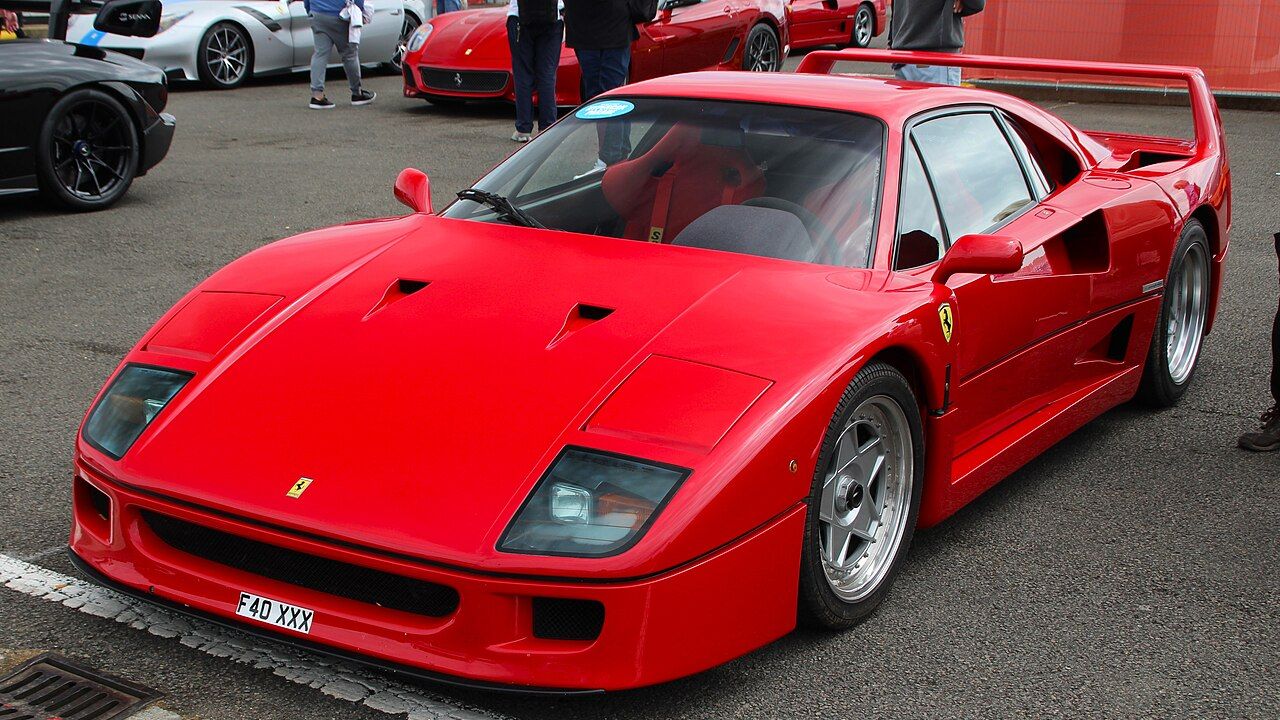
The Ferrari F40 didn’t arrive as just another flagship—it landed as a raw statement of intent from Maranello. Built to celebrate Ferrari’s 40th anniversary, the car stripped away comfort, added turbocharged aggression, and redefined what a road-legal supercar could be. Even today, the Ferrari F40 is remembered not as a refinement of its era, but as a hard reset.
What happened
When Ferrari developed the F40 in the late 1980s, the goal wasn’t luxury or usability—it was speed, lightness, and purity. The result was a car built around a twin-turbocharged 2.9-liter V8 producing around 478 horsepower, though the real number mattered less than how brutally it delivered power.
Unlike many exotic cars of its time, the F40 was intentionally minimal. There was no sound insulation, no carpets in early examples, and even door handles were replaced with fabric pull straps. The interior looked closer to a race car than a grand touring machine. Ferrari engineers focused on reducing weight wherever possible, eventually bringing the car down to roughly 1,100 kilograms.
The design reflected the same philosophy. Large fixed rear wing, NACA ducts carved into the bodywork, and exposed functional aerodynamics made it clear this wasn’t a styling exercise. It was built to stay stable at extreme speed, not to look elegant in traffic.
On the road, the experience was even more extreme. The turbocharged V8 delivered a sudden surge of power with noticeable lag, followed by a sharp, aggressive rush that demanded full attention. There were no electronic aids—no traction control, no stability systems, and no ABS in early versions. Every input from the driver mattered.
Period road tests placed its top speed around 201 mph, making it one of the fastest production cars of its era. But more than numbers, it was the character that defined it. The F40 felt uncompromising, even by supercar standards of the late 1980s.
Why it matters
The F40 became a turning point because it challenged the idea that supercars needed to be comfortable or forgiving. Before its arrival, high-end performance cars often balanced speed with luxury. After the F40, raw performance became a valid philosophy on its own.
It also cemented Ferrari’s identity as a manufacturer willing to prioritize emotion over refinement. While competitors were beginning to explore digital systems and early driver assistance, Ferrari went in the opposite direction—removing complexity and exposing the driver directly to the machine.
That philosophy influenced how future performance cars were judged. The F40 set a benchmark for what “analogue” driving meant: mechanical steering feel, unfiltered turbo response, and a chassis that communicated every detail of the road surface. Even modern comparisons still use it as a reference point for purity.
The car’s motorsport DNA also played a major role. Derived from Ferrari’s racing experience, the F40 borrowed heavily from competition engineering principles. Its twin-turbo V8 was closely related in concept to Ferrari’s Group B and endurance racing development work, and the aerodynamic focus came directly from track testing.
Over time, the F40 became more than just a Ferrari flagship—it became a symbol of an entire era when supercars were transitioning from mechanical brutality to electronic sophistication. It stood at the end of one philosophy before the industry shifted toward regulation, safety systems, and drivability enhancements.
What to watch next
Today, the Ferrari F40 is firmly established as one of the most desirable collector supercars in the world. Values have climbed steadily as enthusiasts and investors recognize its historical significance as the final Ferrari personally approved by Enzo Ferrari during his lifetime.
Condition and originality are now critical factors. Cars with original turbos, factory-correct interiors, and documented service history command significantly higher interest than modified examples. Even small deviations from factory specification can heavily affect collector value.
The F40 also continues to influence modern design language. Contemporary supercars often reference its exposed functionality and aerodynamic honesty, even if they incorporate advanced electronics and hybrid systems. It remains a benchmark for what a pure driver-focused supercar looks like.
Looking ahead, the F40’s status is unlikely to diminish. As modern performance cars become increasingly complex, hybridized, and software-dependent, the appeal of a lightweight, twin-turbo, analog supercar grows stronger. The F40 represents a point in time that cannot be repeated under today’s regulations and engineering priorities.
For enthusiasts and collectors alike, its importance is not just in how fast it was, but in how decisively it changed expectations. After the F40, supercars were never judged the same way again.
More from Fast Lane Only