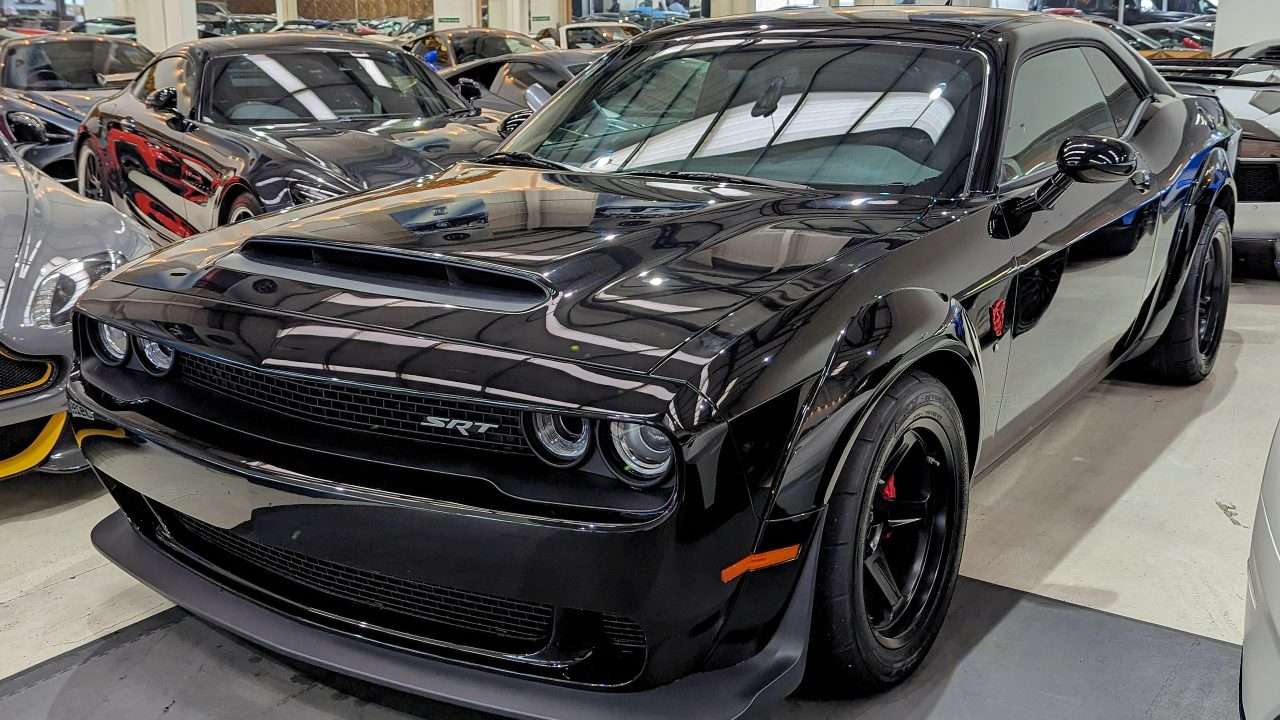
The last Dodge Challenger to leave the factory is not just another end-of-line car. It is the capstone to a modern muscle era that is already closed, and that finality is exactly what is turning the 2023 models into instant collectibles. As I look at the production cutoff, the special editions, and the way enthusiasts are already treating these cars, it is clear that the final Challenger generation has crossed from showroom product into rolling memorabilia.
The end of the line is already history
Collectibility usually arrives slowly, but the Challenger’s story is different because the ending is already written. The Dodge Challenger has been formally discontinued, and the brand itself confirms that it is no longer in production, noting that production ended on December 31, 2023. Separate reporting specifies that the final Dodge Challenger, a Pitch Black Demon 170, rolled off the Brampton assembly line on December 22, 2023, and that it was also the very last vehicle built at that plant. When a nameplate with this kind of cultural weight stops so definitively, the final model year becomes a historical marker rather than just another entry in a price guide.
The corporate strategy behind that cutoff only reinforces the sense that the 2023 cars are the closing chapter of a particular kind of American performance. Production of the Dodge Challenger ended with the 2023 model year as Dodge shifts toward next‑generation performance vehicles and electrified powertrains, and other research on what happened to the Challenger and Charger makes clear that Dodge discontinued the Challenger and the Challenger and Charger together to focus on electrified performance. In other words, there is no 2026 Dodge Challenger waiting in the wings. For collectors, that hard stop, combined with a pivot toward a very different type of car, turns the final gasoline Challengers into the last representatives of their species.
“Last Call” editions and factory rarity
Rarity is the currency of the collector world, and Dodge leaned into that reality as it wound down Challenger production. The company announced that it would unveil seven special editions to mark the end of the Charger and Challenger in their current form, a move framed quite openly as a response to Sad times for traditional muscle fans. Ordering information for the 2023 Dodge Challenger confirms that, in addition to the normal variety of trims, the brand added seven special limited‑edition versions for the cars’ final model year, with one final special edition still to be revealed at the time. That deliberate creation of a finite set of “Last Call” cars gives collectors a clear hierarchy of desirability from day one.
Within that group, the Dodge Challenger SRT Demon 170 sits at the top of the pyramid. Coverage of all seven Last Calls notes that the end of the line for the Last Calls was the wicked 2023 Dodge Challenger SRT Demon 170, a strip‑ready beast that marked the ultimate expression of the platform. The Wikipedia entry on the Dodge Challenger adds that the final car built was a Pitch Black Demon 170, tying the production bookend directly to that halo variant and preserving the number 170 as a kind of shorthand for the car’s place in history. When the very last unit is not just a standard model but the most extreme version ever offered, the entire run of related special editions gains reflected prestige.
Market signals: premiums, auctions, and early speculation
Collectors do not just respond to badges and brochures, they respond to money changing hands, and the Challenger is already sending strong signals on that front. One detailed look at why buyers should move quickly on a 2023 Dodge Changer points out that, once new inventory dries up, one of the alternative sources will be the used market, and that buying a 2023 car before they are gone could prove wise because the supply‑and‑demand balance will change. That logic is already visible in enthusiast discussions, where owners debate whether 2023 Challengers with the Last Call plaque will gain value over time, with some posters on a Jul thread calling future appreciation a huge wildcard but acknowledging that, if these cars gain any value, the special‑edition and low‑mileage examples will lead the way.
At the top of the market, the numbers are even more emphatic. Reporting on the final Dodge Challenger Demon 170 built for charity notes that Naturally, all 3,300 allocations were spoken for quickly, and that Dodge decided to build one more car for the Barrett‑Jackson auction in Las Vegas, where it sold for a total $700,000. That is not a typical transaction, but it is a powerful data point: a brand‑new Challenger, still in its contemporary generation, already commanding rare‑Ferrari money in a high‑profile sale. When I see a car bring that kind of figure while it is still effectively new, I read it as a clear sign that the market has already assigned it collectible status.
Design, performance, and emotional pull
Collectible status is not just about scarcity; it is also about how a car makes people feel, and the final Challengers are rich in that emotional currency. A detailed video review framed around the iconic V8 notes that, looking at this car, you may just get a little bit tearyeyed, precisely because this is a 2023 Dodge Challenger the final iteration of a shape and sound that defined modern muscle for a generation. Another walkaround of a 2019 Challenger SRT Hellcat Widebody describes the car in mechanical terms as Mechanical This Challenger SRT Hellcat with a supercharged 6.2L HEMI V8 that truly connects the driver to the vehicle, underscoring how central the HEMI soundtrack and analog driving feel are to the car’s appeal. When that experience is about to disappear from new‑car showrooms, the last examples that still deliver it become emotionally charged objects.
The aesthetic and customization side of the final cars also feeds their future desirability. A recent feature on a 2023 Dodge Challenger SRT Hellcat Jailbr describes a car finished in Pitch Black Clearcoat over a Demonic Red and Black interior, calling it factory customization at its peak. That combination of bold paint, dramatic interior color, and high‑output hardware is exactly what collectors look for when they hunt for standout specifications years later. I see the same pattern in earlier limited‑run Challengers: a 2014 Dodge Challenger R/T Shaker that has covered just 11,200 miles from new is described as a showroom‑pristine example of a limited‑production muscle car and is already positioned as sure to be a favorite among collectors. The final‑year cars, with their Last Call plaques and carefully curated options, are set up to follow that trajectory even faster.
Lessons from other icons and what comes next
To understand why the last Challengers are already treated as collectibles, I find it useful to look at how other enthusiast vehicles behave once their eras end. A discussion of the so‑called ancient Dodge Challenger on a Jan thread points out that They were too deep to cancel it and that the right vehicle at the right time for the market can keep selling strongly even when the basic design is old. That same staying power tends to translate into long‑term affection and, eventually, collector interest. A separate analysis of why Land Rover Defenders retain their value notes that Defenders blend classic style with modern convenience, appealing to both collectors and practical owners and creating a unique, high‑value investment over time. The Challenger’s mix of retro styling, modern powertrains, and daily usability fits that template closely.
The shift in Dodge’s lineup only sharpens that comparison. A detailed look at the next‑generation Dodge Charger, filmed in Arizona, describes the all‑new Dodge Charger as the latest evolution of the brand’s performance strategy, implicitly positioning it as the car that sort of replaces the Challenger. At the same time, Dodge executives have already previewed the future of electrified muscle with the Dodge Charger Daytona SRT Concept during Speed Week, signaling that the brand’s next chapter will be defined by batteries and new technology rather than supercharged HEMI engines. When I put those pieces together, I see the final Challengers, especially the Last Call cars and the Pitch Black Demon 170 that closed the line at Brampton, as the last fully realized expression of a philosophy that is not coming back. That is why the final Challenger is already collectible: the story is complete, the market has noticed, and the cars themselves are worthy of the attention.
More from Fast Lane Only: