The factory Hellcat 6.2‑liter V8 did something no modern production engine had any business doing: it took showroom horsepower into territory that once belonged to drag strips and race shops. In a single move, Dodge turned a niche obsession with big power into a mainstream, warrantied product that anyone with a loan and a steady job could buy.
That decision reshaped muscle cars, super trucks, and even the tuning industry around a new benchmark. The Hellcat did not just raise the bar for stock performance, it redefined what “stock” could mean.
What happened
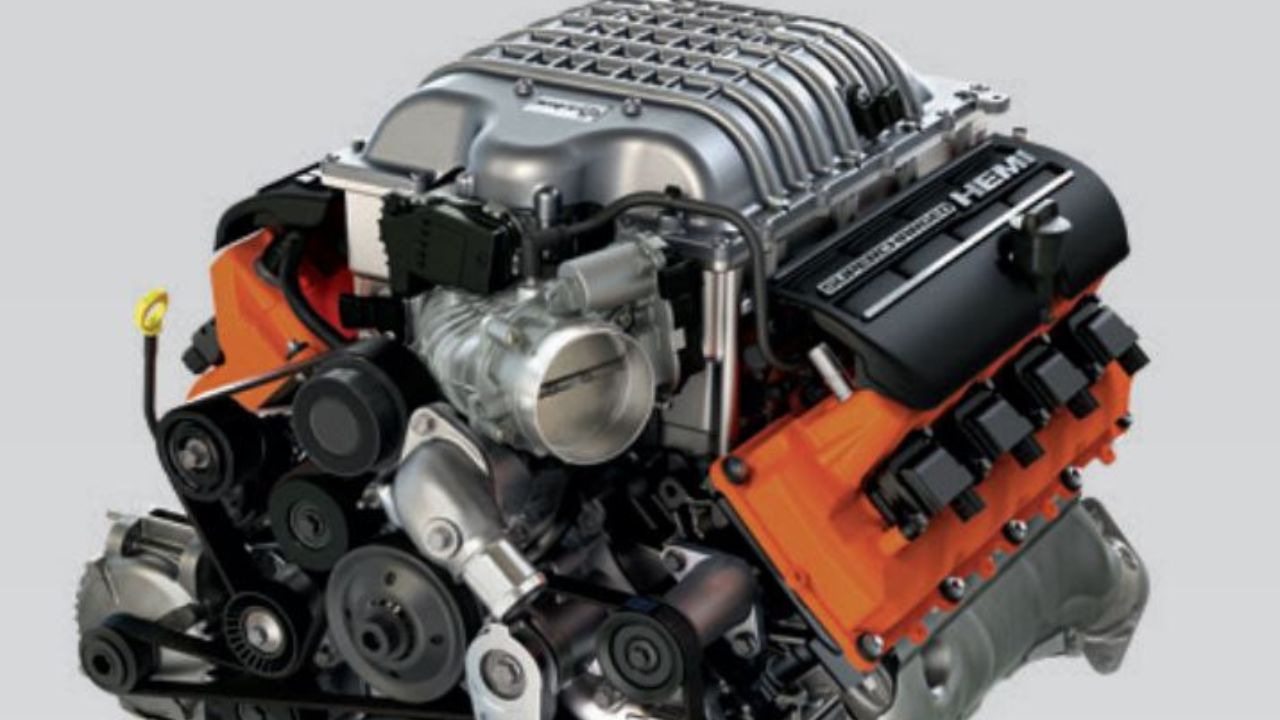
When Dodge launched the supercharged 6.2‑liter Hellcat HEMI V8, the headline number was 707 horsepower and 650 pound‑feet of torque, all on pump gas and backed by a full factory warranty. The engine used a deep‑skirt iron block, forged steel crankshaft, forged connecting rods, and forged aluminum pistons to survive boost from a 2.4‑liter IHI twin‑screw supercharger that could move more than 30,000 liters of air per minute at peak speed. Engineers paired that hardware with high‑flow cylinder heads, sodium‑filled exhaust valves, and an integrated charge‑air cooling system inside the supercharger housing.
The Hellcat’s rotating assembly and block structure were built with a level of strength that had previously been reserved for race applications. The crankshaft was induction hardened and secured with cross‑bolted main caps, the rods were shot‑peened forged units, and the pistons carried thick ring lands and oil cooling jets. Even the supercharger drive system received attention, with a dedicated eight‑rib belt and heavy‑duty tensioner to keep the blower spinning reliably at high rpm. Together, these choices allowed the engine to deliver its 707 horsepower rating in production Challenger and Charger models without sacrificing basic drivability or durability.
Packaging that output into street cars required more than a stout long block. The Hellcat program added dual fuel pumps, high‑capacity fuel injectors, and a returnless fuel system capable of supporting the engine at wide‑open throttle while still meeting emissions and idle quality targets. The calibration team had to manage knock control, supercharger heat, and part‑throttle manners so the same engine that could push a heavy sedan past 200 miles per hour would also crawl through traffic without complaint. The result was a powertrain that felt docile at low load yet ferocious when the throttle was opened.
That factory package quickly became the foundation for a new wave of extreme builds. Tuners recognized that the Hellcat’s forged internals and conservative factory tune left significant headroom. Higher boost pulleys, revised engine management, and upgraded exhaust systems pushed output well beyond stock figures while still relying on the original block and rotating assembly. Builders took the engine out of Dodge chassis entirely and dropped it into classic muscle cars, off‑road rigs, and custom trucks, turning the Hellcat V8 into a crate‑engine phenomenon.
The most dramatic expression of that trend arrived when specialty shops started pairing the Hellcat 6.2‑liter with heavy‑duty four‑wheel‑drive platforms. One high‑profile example is the Hennessey Mammoth 6×6 based on the Ram 1500 TRX. That truck uses a tuned version of the supercharged 6.2‑liter V8 that pushes output deep into four‑figure territory, with the company quoting 1,012 horsepower and 969 pound‑feet of torque for its three‑axle conversion. The Mammoth 6×6 combines that power with a stretched frame, six‑wheel drive, and off‑road suspension, turning a factory performance truck into a 1,000‑horsepower desert machine that still starts with a key and idles smoothly in a parking lot.
Projects like the Mammoth 6×6 illustrate how far the Hellcat platform can go once tuners lean on its built‑in strength. The core engine architecture that began in a Dodge muscle car now powers lifted pickups on 37‑inch tires, vintage restomods, and purpose‑built drag cars. The same long block design that made 707 horsepower in stock form has become a modular building block for four‑digit horsepower across wildly different applications.
Why it matters
The Hellcat 6.2‑liter matters because it reset expectations for what a stock engine could deliver. Before it arrived, production performance cars were already quick, but 600‑plus horsepower was typically reserved for limited‑run exotics or highly tuned specials. Dodge put 707 horsepower into mass‑production coupes and sedans that anyone could finance, complete with air conditioning, full safety equipment, and a standard warranty. That move forced the rest of the industry to rethink the upper limit of street‑legal power.
From an engineering standpoint, the Hellcat proved that manufacturers could design a high‑output, forced‑induction V8 that met modern emissions standards and reliability targets without resorting to race‑only compromises. The engine’s use of forged internals, a robust block casting, and integrated supercharger cooling showed how to package extreme performance into a setup that still passed regulatory tests and survived long‑term use. That combination of strength and civility set a template that other performance divisions have studied closely.
The cultural impact has been just as significant. The Hellcat badge became shorthand for excess, a symbol that a car or truck was not simply quick but absurdly overpowered. Owners used launch control on public dragstrips, posted acceleration runs on social media, and treated the 707‑horsepower rating as both a bragging right and a starting point for modification. The result was a feedback loop in which demand for high‑power machines grew, and the tuning scene responded with ever more extreme packages built around the same 6.2‑liter core.
That environment helped specialty builders expand into new categories. The Ram 1500 TRX, which uses a factory supercharged 6.2‑liter V8, provided a pickup foundation that could comfortably house the Hellcat architecture. Tuners then used that platform to create projects like the Mammoth 6×6, where 1,012 horsepower and 969 pound‑feet of torque move a three‑axle truck aimed at customers who want supercar power in an off‑road package. That kind of build would have seemed implausible when stock half‑ton pickups made a fraction of that output.
The aftermarket’s confidence in the Hellcat engine did not arise by accident. Detailed breakdowns of the 6.2‑liter reveal features such as a 9.5:1 compression ratio optimized for boost, high‑flow ports, and a supercharger that can deliver more than 11.6 pounds per minute of air at peak. The engine uses piston oil squirters, a high‑capacity cooling system, and a carefully managed air‑fuel calibration to keep combustion temperatures in check. Those choices explain why tuners can add more boost and fuel and still operate within the structural limits of the block and rotating assembly. For builders, the Hellcat is not fragile exotica, it is a heavy‑duty foundation.
This shift in what counts as “streetable” power has changed how enthusiasts think about performance goals. Where 500 horsepower once felt like a milestone, many buyers now view that figure as a baseline for a serious modern muscle car or performance truck. The Hellcat helped normalize that mindset by showing that a factory 707‑horsepower car could be driven daily, serviced at a dealer, and insured like any other vehicle. Insurance companies, regulators, and even tire manufacturers have had to adapt to a world where a wide range of customers can buy cars that run quarter‑mile times that used to belong only to purpose‑built drag machines.
The engine has also influenced the direction of performance branding. Dodge leaned into the Hellcat identity, using distinct badging, supercharger whine, and marketing that highlighted the absurdity of the power figure. That strategy turned a powertrain into a cultural product. Other manufacturers have responded by elevating their own powertrain names and performance sub‑brands, aiming to capture some of the same attention from enthusiasts who now expect a story and an identity along with big numbers.
There is a technical legacy as well. The Hellcat program demonstrated that a high‑output supercharged V8 could coexist with modern electronic driver aids, stability control, and advanced automatic transmissions. Engineers had to integrate traction control strategies, torque management, and transmission shift logic that could handle sudden surges of torque without breaking hardware or overwhelming drivers. Those lessons inform how current and future performance vehicles manage power delivery, whether they rely on combustion engines, electrified systems, or full battery‑electric drivetrains.
Even within the HEMI family, the 6.2‑liter’s design has become a reference point. Internal documentation and technical deep dives highlight how the engine’s block casting, crank design, piston oiling, and valvetrain geometry differ from naturally aspirated HEMI variants. Those differences show how engineers evolved the architecture to survive supercharger boost and high cylinder pressures. For anyone studying modern V8 design, the Hellcat stands as a case study in how to take a heritage layout and adapt it to extreme output without losing reliability.
The Hellcat’s success has also shaped the crate engine and swap market. Builders now routinely transplant the 6.2‑liter into classic Chargers, Challengers, and Darts, as well as into non‑Dodge platforms. Complete crate packages include the engine, wiring harness, and control modules, which simplifies installation for shops that want modern power with vintage style. That trend extends the Hellcat’s influence into car shows, drag events, and off‑road meets where vehicles from multiple eras now share a common heart.
What to watch next
The Hellcat 6.2‑liter arrived near the end of an era dominated by large displacement internal combustion engines. Regulatory pressure on emissions and fuel economy is tightening, and manufacturers are rapidly expanding hybrid and battery‑electric offerings. Against that backdrop, the Hellcat stands as one of the last and most extreme expressions of the traditional supercharged V8 formula. The key question is how its legacy will carry into a future where pure combustion engines may play a smaller role.
One area to watch is how manufacturers integrate lessons from the Hellcat into electrified performance. The engine proved that customers will embrace outrageous power when it is paired with usable drivability and factory support. Electric and hybrid systems can deliver even more instantaneous torque, but they will need the same balance of daily usability and emotional character that made the Hellcat appealing. Sound design, throttle mapping, and branding will all matter as companies try to translate the visceral appeal of a supercharged V8 into quieter, electrified platforms.
The tuning industry is also at an inflection point. Builders who have spent years extracting more power from the Hellcat architecture are now experimenting with hybrid assist systems, high‑voltage drivetrains, and software‑heavy upgrades. The knowledge gained from managing heat, torque, and traction in 700‑plus horsepower combustion cars will carry over to electric performance, where battery temperature, inverter limits, and traction control present similar challenges in a different form. The Hellcat era has trained a generation of tuners to think in terms of four‑digit horsepower, and that mindset will not disappear as power sources change.
At the same time, the 6.2‑liter itself is likely to remain a fixture in the enthusiast world for years, even if new production slows or stops. The combination of strong internals, widespread availability, and a deep knowledge base makes the Hellcat engine an attractive choice for long‑term builds. Expect to see more restomods, off‑road rigs, and custom projects using crate versions of the engine, with output levels that continue to climb as tuners refine fuel systems, cooling, and forced‑induction setups. The aftermarket will keep pushing the limits of what the block and heads can handle.
More from Fast Lane Only