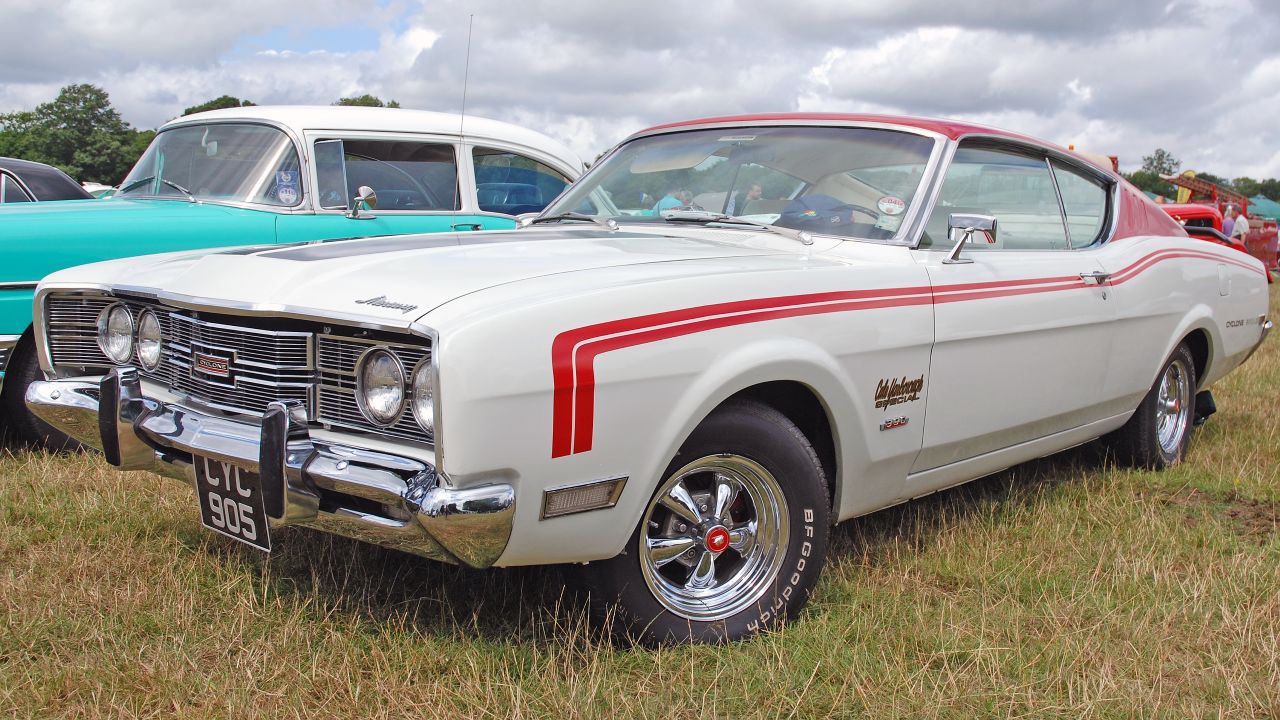
The Mercury Cyclone Spoiler has long lived in the shadow of louder legends, yet few muscle cars combined racing pedigree, radical styling, and big block power as convincingly. Conceived to win on Sunday and sell on Monday, it bridged the gap between NASCAR pit lane and suburban driveway with a level of intent that modern eyes often miss. To understand why it deserves far more recognition, it is necessary to look beyond the familiar Mopar and Chevrolet stories and examine how Mercury quietly built one of the most sophisticated performance packages of its era.
Far from being a mere trim option, the Cyclone Spoiler represented the point where Mercury’s intermediate muscle car program, NASCAR homologation rules, and Detroit’s escalating horsepower race intersected. Its limited production, competition driven aerodynamics, and serious 429 cubic inch hardware made it a focused weapon rather than a mass market halo car. That focus, combined with low build numbers, helps explain why the car is both overlooked in popular memory and increasingly prized by those who know what they are seeing.
Born from NASCAR pressure, not marketing whim
The Cyclone Spoiler did not emerge from a styling studio brainstorm, it was a direct response to NASCAR regulations that required race cars to be “produced for the street” and properly homologated. Reporting on the period notes that And NASCAR insisted any body used in competition had to be sold to the public, which pushed manufacturers to create limited runs of highly specialized intermediates. Mercury’s answer was a series of Cyclone based specials that translated track focused tweaks into road legal form, including the Spoiler and the even more extreme Spoiler II.
Earlier, Mercury had already signaled its intent with the 1969 Mercury Cyclone Cale Yarborough Special, described as an homologation special built so the brand could compete in NASCAR stock car racing against rivals such as the Dodge Char and other aero warriors. That car and the later Cyclone Spoiler II showed how far Mercury was willing to go to chase speed, stretching and reshaping the nose for better airflow at Daytona and Talladega. The regular Cyclone Spoiler that followed carried this competition DNA into a more broadly saleable package, retaining the conventional front end but adding NASCAR inspired graphics and a functional rear deck spoiler that linked showroom buyers directly to the brand’s racing program.
Aerodynamics with intent, not ornament
What separates the Cyclone Spoiler from many contemporaries is that its visual drama served a purpose. Accounts of the 1970 Mercury Cyclone Spoiler describe a bold and aggressive muscle car designed to turn heads and dominate the dragstrip, but the bodywork was more than theater. The Spoiler trim is characterized as a stunning and highly cohesive design, with lines that flowed and complemented one another, and details such as the rear spoiler and sloping canards at the ends that were shaped with airflow in mind rather than simply decoration.
Contemporary commentary on the 1970 Mercury Cyclone Spoiler Was a Gunsight, Themed, Intermediate, Sized Muscle Car underscores how the front end, with its tunneled grille and pointed center section, created a gunsight like visual signature while also narrowing the frontal area. In the broader context of NASCAR Aerodynamics, where engineers chase small reductions in drag and gains in stability at high speed, these choices were part of a deliberate strategy rather than styling excess. The Cyclone Spoiler’s form, from its fastback roofline to its integrated spoiler, reflected the same aerodynamic thinking that shaped the more radical Spoiler II, only translated into a car that could be parked in a grocery store lot without looking like a pure race refugee.
Big block hardware that matched the look
Underneath the dramatic sheetmetal, the Cyclone Spoiler carried mechanical credentials that justify its reputation among those who have driven or raced one. Factory information notes that the 429 Cobra Jet with Ram Air was the standard engine for the Cyclone Spoiler, while the 429 Super Cobra Jet with Drag Pak and Sup options was available for buyers who wanted the most aggressive configuration. The American Muscle Car Museum lists the Year as 1970, the Make as Mercury, the Model as Cyclone Spoiler 429 Super Cobra Jet, and specifies the engine as 429 ci/370 hp SCJ, figures that place the car squarely in the top tier of factory big block offerings.
Additional period descriptions explain that the spoiler model came standard with the 429 Cobra Jet V8, while the wild SCJ package added a mechanical flat tappet cam, a Holley carburetor, and dragstrip tuned rear gears, all aimed at extracting maximum performance from the big block. Contemporary testing and retrospective coverage point out that, compared to a General Motors 454, it was not the highest revving engine in the class, yet it was still capable of quarter mile times in the 13s when properly set up. In an era when GM had only just lifted its self imposed ban on fitting V8s larger than 400 cubic inches (6.5 liters) in anything but full size cars and the Corvette, Mercury was already selling an intermediate that could be ordered with a 429 and a drivetrain calibrated for serious straight line work.
Rarity that kept it out of the spotlight
If the Cyclone Spoiler had been built in Chevelle or Road Runner volumes, it might be as widely celebrated today as those cars. Instead, production was modest, which limited its cultural footprint even as it enhanced its appeal to collectors. The Volo Museum records that Only 1,631 Spoilers were made, and that 766 had automatics, with just 22 finished in a particular color combination, figures that underline how few examples ever reached buyers. That scarcity is echoed in modern discoveries, such as a report on a man who found a rare 1970 Mercury Cyclone Spoiler in a junkyard, where the car was described as so deteriorated that All told, the Mercury is pretty much unrecognizable from a distance, with only the Cyclone Spoiler decals hinting at what it once was.
This combination of low production and hard use has made surviving cars notable events when they surface. Coverage of a one owner, one of one 1970 Mercury Cyclone Spoiler SCJ highlights how specialists like Diego Rosenberg and Luke treat such cars as reference grade examples, while auction previews describe ultra rare 1970 Mercury Cyclone Spoiler SCJ models as Built for the golden age of Detroit horsepower and worthy of crossing the block at Barrett, Jackson with no reserve. Separate reporting on a Dan Gurney Mercury Cyclone Spoiler II that sold for $90,000 at Barrett, Jackson, with the observation that Anything under 100K seems like a deal, shows how the market is beginning to price in the car’s scarcity and significance even if it still lacks the mainstream name recognition of rival muscle machines.
Why enthusiasts are finally paying attention
Among dedicated muscle car fans, the Cyclone Spoiler’s reputation has been quietly rising. Recent analysis flatly describes The Mercury Cyclone Spoiler Is The Most Underrated Big Block Muscle Car Ever, arguing that among the muscle car crowd it has been overlooked both in period and in the years since despite its specification. Social media commentary from enthusiasts who admit they never expected to covet one, yet now say they really want this Mercury Cyclone Spoiler after seeing a well preserved example, reflects a broader shift in taste as collectors look beyond the usual Chevelle, Charger, and Mustang narratives.
That reassessment is helped by the car’s blend of attributes. The Spoiler trim offered a cohesive and aggressive design, serious 429 and SCJ hardware, and a direct link to NASCAR homologation history that few other intermediates can match. As more people encounter restored cars at events, in museum collections, or in detailed video walkarounds of Mercury Cyclone SCJ time capsules and historic dragsters, the Cyclone Spoiler’s story is being retold to a new audience. In that retelling, its once quiet status is shifting, from a footnote in Mercury’s catalog to a central example of how sophisticated and purposeful the muscle car era could be when racing, engineering, and design were all pulling in the same direction.
More from Fast Lane Only