The Pontiac Trans Am occupies a rare place in automotive history, remembered less as a machine and more as a shorthand for attitude, freedom, and a very specific vision of American cool. Its technical specifications and real-world performance mattered, but over time the car’s image on screens, posters, and T‑shirts eclipsed the numbers on its spec sheet. The result is a model that survives in collective memory as a symbol long after Pontiac itself disappeared from showrooms.
That transformation did not happen by accident. It was the product of deliberate branding, well-timed movie and television roles, and a design language that leaned into theater as much as engineering. From the late 1960s through the end of the muscle car era, the Trans Am evolved from a performance package into a rolling character, one that still carries cultural weight decades later.
From racing package to personality on wheels
The Trans Am name began as a performance-focused variant of the Pontiac Firebird, introduced in 1969 to connect the car to organized racing and to signal a higher level of capability. Positioned as a high-performance version of the standard Pontiac Firebird, the Trans Am quickly came to represent American muscle and style rather than just a trim line. Over time, the badge itself started to communicate a promise of speed and swagger that went beyond whatever engine happened to be under the hood.
As the model evolved through the 1970s, Pontiac leaned into that identity, using the Trans Am label to suggest a car that was as rebellious as it sounded. The name linked the brand to competition and performance heritage, but it also gave designers and marketers license to push bolder styling and more dramatic graphics. That shift from simple specification to personality laid the groundwork for the Trans Am to become a cultural reference point rather than merely a catalog option.
The “Screaming Chicken” and the power of visual myth
If the Trans Am name created the performance aura, the enormous hood decal often called the “Screaming Chicken” turned the car into instant iconography. The oversized bird, splashed across the hood of many 1970s models, was essentially branding in motion, a visual signature that could be recognized from a distance or in a fleeting movie shot. It transformed the front of the car into a piece of graphic art, reinforcing the idea that this was not just transportation but a statement.
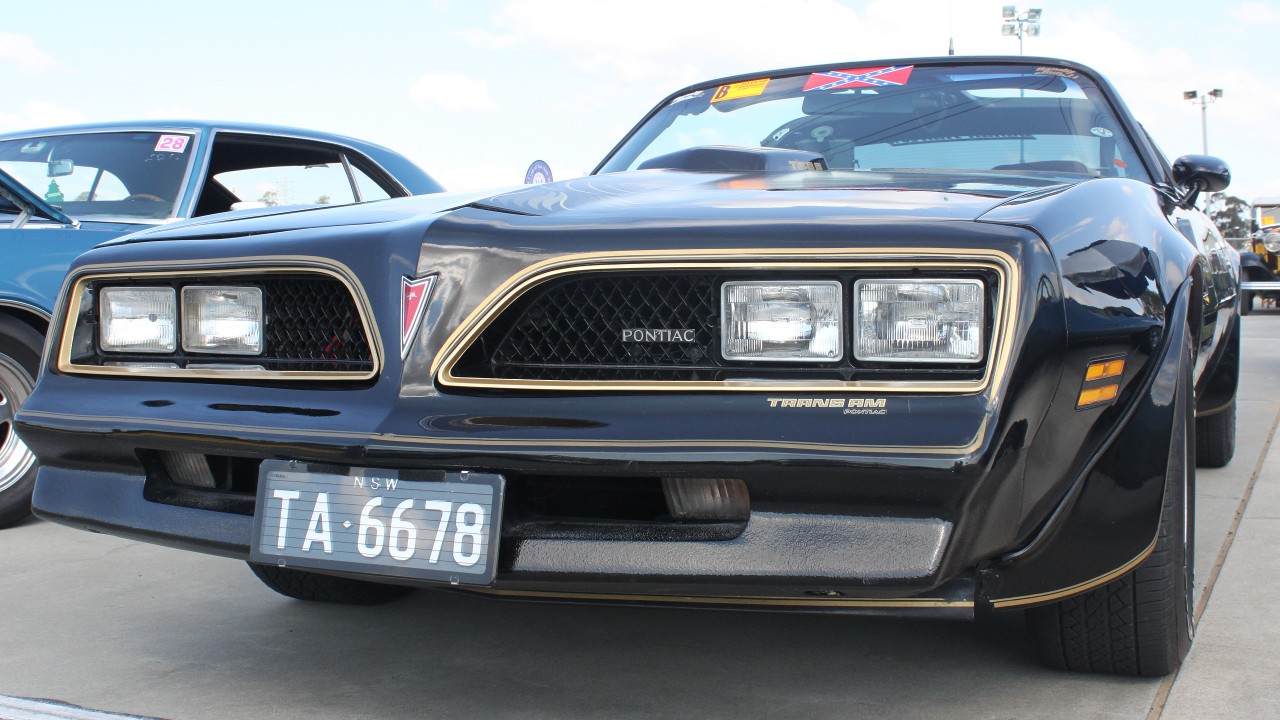
That design choice proved crucial to the Trans Am’s pop culture immortality. The bold bird, combined with aggressive front-end styling and flared bodywork, made the car impossible to mistake for anything else on the road. Enthusiast accounts describe the 1978 Pontiac Firebird Trans Am, with its prominent “screaming chicken” and muscular stance, as more than a car and closer to a cultural icon, a rolling piece of Americana that distilled the era’s taste for excess and spectacle into sheet metal and paint.
Smokey, Knight Rider, and the leap to screen legend
The leap from enthusiast favorite to mass-market symbol came when the Trans Am moved from the showroom to the silver screen. The 1977 Pontiac Firebird Trans Am became a pop culture phenomenon after its starring role in a hit road movie, where it served as both getaway car and visual punchline. The car’s black paint, gold accents, and that unmistakable hood bird turned every chase scene into marketing gold for Pontiac, and fan communities still describe that specific 1977 Trans Am as a rolling piece of Americana.
Behind the camera, director Hal Needham insisted that the stunts be real, with no CGI and no faked jumps, which meant the Trans Am had to survive genuine punishment on set. That authenticity paid off in full throttle, cementing the car’s reputation as a durable, hard-driving hero rather than a fragile prop. A few years later, another Pontiac Trans Am, affectionately known to fans of Knight Rider as KITT, extended the legend on television. In that series, the Trans Am was portrayed as a highly advanced, artificially intelligent car, reinforcing its image as something more than a production coupe and embedding it in the imaginations of viewers who might never have seen one in person.
More bark than bite, and why that did not matter
For all the mythology, period accounts acknowledge that some late‑1970s Trans Ams were more bark than bite. Emissions regulations, rising fuel prices, and tightening Government standards across the industry meant that raw horsepower figures dropped compared with the peak muscle years. One retrospective on the 1977 Trans Am notes that the car’s on-screen persona outpaced its real-world performance, even as modern builders like YearOne have created versions that finally deliver the speed the movie promised.
Yet the gap between image and reality did little to dent the Trans Am’s status. Enthusiast descriptions of the 1976 Pontiac Trans Am emphasize its aggressive styling and its role as a bold symbol of American performance during a changing era, even if the numbers on paper were compromised. The 1976–1979 Pontiac Firebird Trans Am is now celebrated as an enduring symbol of American muscle and style, with owners and fans focusing on its presence, its soundtrack, and its cinematic associations rather than quarter-mile times. In that sense, the car’s legend became self-sustaining, powered by perception more than by dyno charts.
Enduring legacy in a post‑Pontiac world
The broader Firebird line, which debuted in 1967, had already established a legacy of performance-oriented design, but it was during the 1970s that the Trans Am variant truly captured the public imagination. Enthusiast histories of The Pontiac Firebird point out that its later years were defined as much by appearances in movies and television as by engineering updates, with viewers around the world watching its escapades unfold on screen. Even as the late 1970s proved difficult for muscle cars in general, with stricter rules and economic pressures reshaping the market, the Trans Am retained its aura as a “what‑if” car that hinted at a wilder, less constrained era.
The death of Pontiac means that the original Trans Am is not coming back as a factory product, yet its symbolic power has only grown. Enthusiast groups describe the 1976–1979 Pontiac Firebird Trans Am as an enduring symbol of American muscle, while fan pages celebrate the 1978 and 1977 Pontiac Firebird Trans Am models as cultural phenomena and pop culture icons. Even modern reinterpretations, such as a 2026 Pontiac Firebird Trans Am created with a contemporary twist, are framed not just as cars but as statements of pride, freedom, and American identity for a new generation. In that ongoing afterlife, the Trans Am has completed its evolution from model name to myth, living on wherever a stylized bird spreads its wings across a black hood and someone still hears the echo of a V8 in their mind.
More from Fast Lane Only