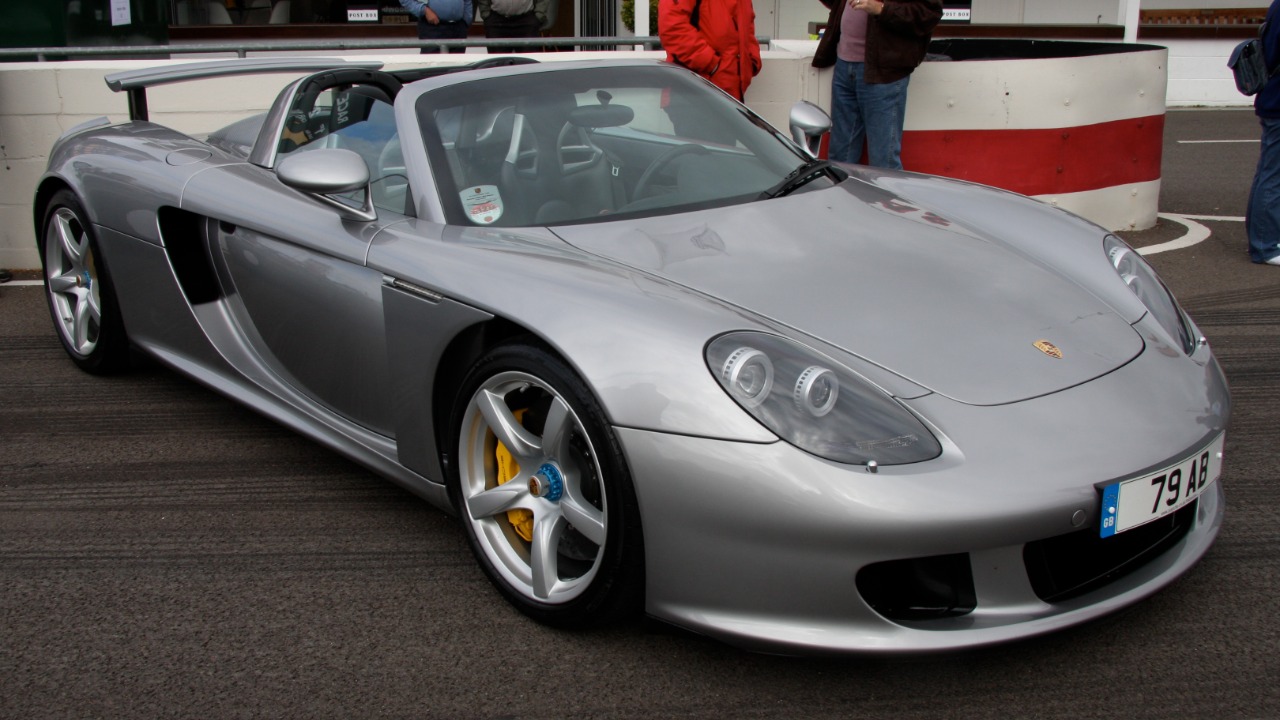
Some supercars are remembered for their speed. Others for their rarity. But a few are defined by how much they demand from the driver. The Porsche Carrera GT belongs firmly in that last category—a machine so uncompromising that even professional drivers approached it with caution.
What happened
Developed in the early 2000s, the Carrera GT was born from Porsche’s abandoned Le Mans prototype program. Instead of being softened for road use, the racing DNA remained largely intact. The result was a mid-engine supercar powered by a naturally aspirated 5.7-liter V10, paired with a lightweight carbon-fiber monocoque and a notoriously difficult manual transmission.
Unlike many modern supercars that rely on electronic aids, the Carrera GT was deliberately analog. There was no traction control in the conventional sense, no dual-clutch gearbox, and minimal intervention systems to “save” the driver from mistakes. Everything depended on mechanical grip and driver skill.
The engine itself was originally derived from Porsche’s motorsport development efforts, designed to rev aggressively and deliver power in a linear but unforgiving way. Combined with a lightweight chassis and extremely fast steering response, the car reacted instantly to every input.
Where things became challenging was not just the power, but how it was delivered. The clutch was extremely light and sensitive, requiring precise engagement. Early production versions also paired this with a ceramic clutch system that made low-speed driving notoriously difficult, especially in traffic or during parking maneuvers.
Even experienced drivers noted that the Carrera GT did not tolerate hesitation. Small mistakes at low speeds could result in sudden stalls, while high-speed overcorrection could quickly escalate into loss of control. It was a car that required full attention at all times.
Why it matters
The reputation of the Porsche Carrera GT comes from its rarity in modern automotive engineering: it represents a final era of high-performance analog supercars before electronic systems became dominant safety nets.
At a time when many competitors were moving toward automated stability control, paddle-shift gearboxes, and computer-managed performance delivery, Porsche chose a more purist approach. The Carrera GT prioritized driving involvement over accessibility.
This philosophy created a clear divide. For skilled drivers, the car offered one of the most immersive supercar experiences ever produced—direct steering, immediate throttle response, and a mechanical connection that felt unfiltered. For less experienced drivers, however, that same lack of electronic assistance made it unforgiving.
Its reputation was amplified by real-world incidents and cautionary stories shared among enthusiasts and journalists. While the car was never inherently “unsafe,” it demanded respect in a way that modern supercars rarely do today. That expectation alone shaped how it was perceived.
Over time, the Carrera GT became less about raw specifications and more about character. It wasn’t simply a fast car—it was a precision tool that required discipline, smooth inputs, and a deep understanding of weight transfer and traction limits.
That combination of beauty and difficulty is what elevated it beyond typical supercar status. It became a benchmark for what an analog supercar feels like at the absolute limit of driver involvement.
What to watch next
Today, the Porsche Carrera GT is widely regarded as one of the most important driver-focused supercars ever built. Its value has risen significantly as collectors and enthusiasts increasingly prioritize analog driving experiences over electronic performance systems.
Condition and originality are critical. Well-maintained examples with documented service history and proper clutch care command strong attention in the collector market. Due to the car’s complexity and performance level, maintenance quality plays a major role in long-term desirability.
As modern supercars continue to evolve toward hybrid powertrains and advanced driver assistance systems, the Carrera GT stands as a defining contrast. It represents a brief moment in time when manufacturers still built extreme performance cars with minimal electronic protection.
For many enthusiasts, that is exactly why it remains so respected today. The Carrera GT doesn’t just reward skill—it demands it. And in doing so, it has earned its place as one of the most challenging and revered supercars of its generation.
More from Fast Lane Only