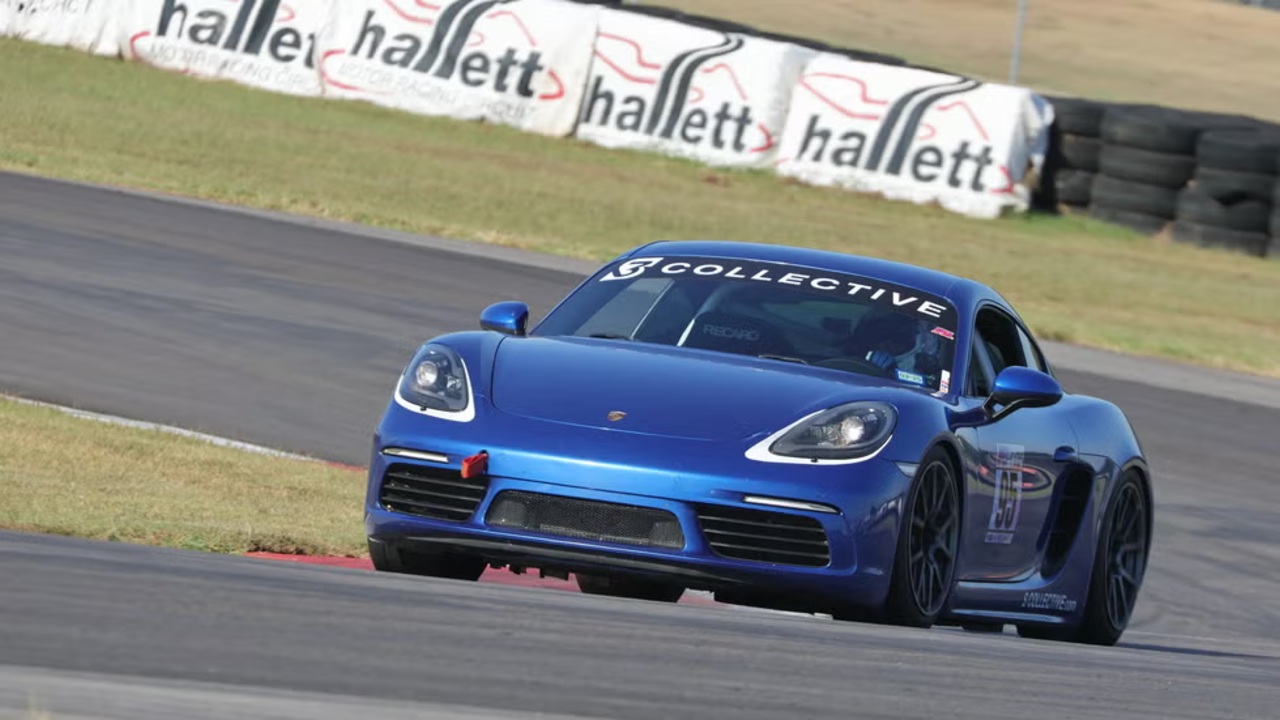
For decades, racing a Porsche has signaled a certain financial reality, one that placed the brand’s badge and mid‑engine balance well beyond the reach of most club racers. With Club Spec Cayman, the Sports Car Club of America is attempting to redraw that line, turning the 718 generation into a tightly defined, relatively attainable spec platform. By standardizing key components and targeting the heart of the enthusiast price band, the SCCA has created a package that makes a modern Porsche a realistic option rather than a distant aspiration.
How Club Spec Cayman reframes “affordable” Porsche racing
The core idea behind Club Spec is not simply to cut costs, but to concentrate spending where it delivers the most value for grassroots competitors. SCCA officials describe the philosophy of Club Spec programs as building a class of car that is flexible enough to participate in multiple forms of competition while remaining straightforward to own and maintain. In the case of the 718 Cayman, that means a ruleset that keeps the car street legal, autocross capable, and ready for track days, instead of forcing owners into a single, highly specialized format.
That multipurpose focus is written directly into the Cayman (CSC) RULES, whose stated Objective is to Provide “an affordable multipurpose package” that blends daily usability with serious performance potential. The same RULES specify that Parts such as tires, wheels, and suspension must follow a defined list, and that All components in those assemblies must remain intact, which prevents an expensive arms race in hidden hardware. By locking in a common baseline and discouraging exotic modifications, the SCCA is trying to ensure that the deciding factor is driver skill and setup discipline, not who can afford the most bespoke solution.
The 718 Cayman platform and who can play
Club Spec Cayman is built around the fourth‑generation mid‑engine platform, known best by the chassis code 718. The Cayman and Boxster for Club Spec are explicitly identified as this 718 generation, which gives the class a clear technological and performance baseline. According to SCCA guidance About the 718 Cayman/718 Boxster, these cars were sold in significant numbers and are now filtering into the used market in meaningful volume, which is essential if the program is to hit its affordability targets.
Eligibility is tightly controlled. Allowable models are “base” Boxsters and Caymans equipped with the 2.0‑liter, turbocharged four‑cylinder MA2 engine, while higher trim levels such as S, T, or GTS are excluded from the spec. Reporting on the program notes that the car must truly be a base model, with examples from the S, T, or GTS lines considered outside of spec, a decision that keeps power levels consistent and purchase prices in check. Enthusiasts have already highlighted real‑world candidates, such as a base 2018 718 Cayman with a six‑speed manual found through the Porsche Club of America, illustrating that compliant cars exist in the wild rather than only on paper.
Standardized hardware: suspension, wheels, and tires
To keep preparation simple and performance tightly grouped, the SCCA has specified a short list of mandatory hardware. Suspension upgrades will include the Porsche X73 performance Suspension kit, originally developed for the 981 chassis but confirmed to fit the 718, paired with supporting components that align the car’s behavior with the class’s goals. This approach allows owners to benefit from factory‑engineered parts rather than chasing custom coilovers or experimental setups that can be costly to tune and maintain. A $715 set of Vorshlag camber plates rounds out the allowable suspension modifications, giving drivers the alignment range needed for serious track work without opening the door to endless variation.
The wheel and tire package is equally prescriptive. Wheels will be 18×9 in the front and 18×10 in the rear, with the Club Spec Cayman RULES further specifying that the front wheel size must be 18×9 with a minimum offset of +45, and that the offset number must be 45 or greater. These Wheels and Tires requirements, combined with the mandate that Parts specified in the RULES must be used in their entirety, are designed to keep grip levels consistent and replacement costs predictable. By eliminating the temptation to chase marginal gains through ever‑wider wheels or exotic compounds, the program channels budgets into seat time rather than hardware churn.
The cost target and the “meat in the enthusiast sandwich”
Affordability in this context is not about matching the price of a used economy car, but about landing in what SCCA staff describe as the center of the modern enthusiast market. One key architect of the program, Wagner, framed the question as “Where is the meat in the enthusiast sandwich in the automotive marketplace right now?” and answered that it “really is in that $40,000 to $50,000 range.” The Club Spec Cayman is intended to sit squarely in that band once a suitable 718 chassis is purchased and the required modifications are installed, a figure that reflects both the cost of a late‑model Porsche and the realities of modern performance hardware.
That target is not arbitrary. The idea behind SCCA Club Spec programs is to create cars that can be built and run by serious amateurs who might otherwise be priced out of contemporary platforms. By focusing on base 718 models and limiting modifications to a concise list, the organization is betting that total build costs can be contained while still delivering a car that feels modern and rewarding. Wagner has described the pillars of the concept as “easy to do, easy to own, easy to build, and you can do all of the things with it,” a philosophy that aligns with the Cayman (CSC) RULES Objective to Provide a package that is as practical as it is quick.
From autocross to track days: one car, many uses
Where Club Spec Cayman diverges from traditional spec racing is in its insistence that a single build should serve multiple disciplines. The SCCA has stated that the idea behind all of its Club Spec efforts is to create a class of car flexible enough to participate in all sorts of club activities, from local autocross to regional track days and time trials. For the 718 Cayman, that means a configuration that can be driven to an event, compete competitively, and then be driven home, rather than living exclusively on a trailer.
That versatility is not an afterthought, it is embedded in the Cayman (CSC) RULES, which emphasize a street‑ready, autocross capable, and track‑day friendly configuration. The standardized Suspension package, the defined Wheels and Tires, and the insistence that All specified Parts remain intact work together to produce a car that is predictable and robust across different environments. As Wagner put it, “So the pillars of this are: easy to do, easy to own, easy to build, and you can do all of the things with it,” a description that captures the ambition of turning a modern Porsche into a genuine all‑rounder for club competitors.
More from Fast Lane Only