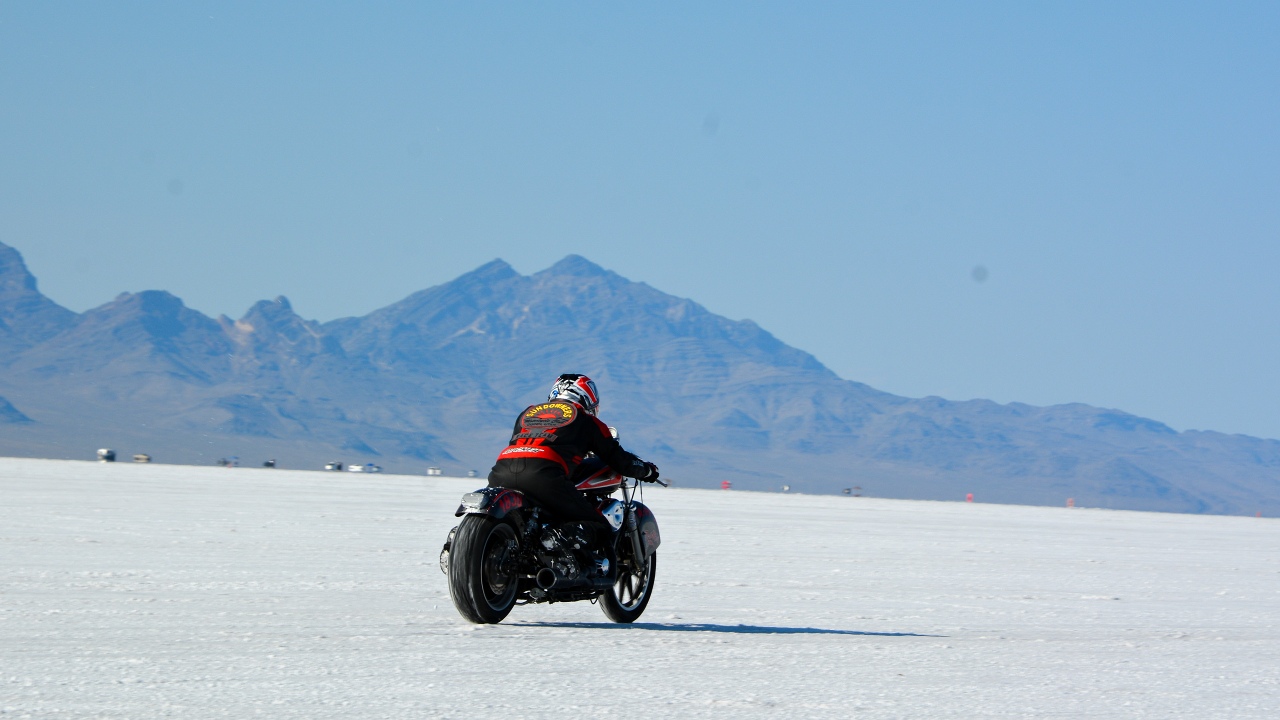
The Bonneville Salt Flats in Utah have become a proving ground where engineering obsession, physical courage, and a stark, almost lunar landscape converge. On this blinding white expanse, speed record chasers gather not for prize money or corporate glory, but to test the outer limits of what machines and humans can endure. The world they inhabit can look extreme, even irrational, from the outside, yet within it there is a precise culture, a strict code of safety, and a deep sense of community.
To understand this culture is to look beyond headline numbers and examine the place itself, the events that structure the year, and the people who keep returning to push a little faster. The salt, the schedules, the rules, and the risks all combine into a self-contained universe that is as disciplined as it is audacious.
The otherworldly stage of the salt
The Bonneville Salt Flats are not a conventional racetrack, but a natural surface that happens to be almost unnervingly flat and open. Visitors describe a place so level that the curvature of the planet seems visible and so barren that even simple forms of life appear scarce, a setting that turns every vehicle and human figure into a stark silhouette against white and sky. The terrain is often compared to concrete in hardness after winter moisture firms the crust, which makes it an ideal speedway for long, straight runs where a car or motorcycle can build velocity over miles rather than corners.
This environment is not only visually dramatic, it is physically punishing. The reflective salt amplifies sunlight, so basic survival on the flats requires planning for glare and heat, with sunglasses and sunscreen treated as essential gear rather than accessories. Guides for visitors emphasize what to bring, starting with a car that can safely drive on the salt and extending to items like protective eyewear and sun protection, because the reflection from the surface can be intense and the exposure relentless. The same qualities that make Bonneville perfect for speed also demand respect from anyone who sets foot on it.
A calendar built around speed
The culture of Bonneville is organized around a handful of recurring events that turn the empty flats into temporary cities of racers, crews, and spectators. One of the best known is SPEEDWEEK, a gathering that stretches over several days in early August and serves as a focal point for land speed attempts. Information for participants highlights that SPEEDWEEK is more than a single race, it is an EVENT with detailed INFORMATION, including technical rules and even a Sunoco Approved Gas List, which underscores how formalized and regulated the pursuit of speed has become. The dates for these gatherings are announced well in advance, with 2026 Bonneville Events listing August 1st to 7th for Speed Week and later dates for World Finals, giving teams a clear timeline to prepare.
Other organizations layer their own traditions onto the same landscape. The Utah Salt Flats Racing Association runs World of Speed in early September, describing it as an experience without grandstands or corporate suites where everyone, from first-time spectators to veteran racers, shares the same starting line. The group has Officially confirmed a 2026 USFRA event Schedule that includes Test and Tune sessions in late June and World of Speed from Sept 3rd to 7th, signaling that the salt will be active across much of the late summer. Motorcycle specialists have their own fixture in the Bonneville Motorcycle Speed Trials, billed as The AMA Land Speed Grand Championship and tied to FIM Land Speed World Records, with Confirmed Dates for BMST in 2026 from August 23rd to 27th and racing starting on August 23rd after VIR, Reg, and Scrutineering. Together, these overlapping calendars create a season in which the flats repeatedly transform from silent desert to high-speed laboratory.
Machines built for a single purpose
The vehicles that arrive at Bonneville are not typical race cars or showroom motorcycles, but highly specialized machines shaped by the unique demands of the salt. Long, needle-like streamliners, chopped and stretched motorcycles, and even modified production cars are all engineered to run in a straight line for miles, trading cornering and agility for stability and aerodynamic efficiency. Builders obsess over details like frontal area, cooling at sustained full throttle, and how tires behave on the granular surface, because the goal is not just to go fast once, but to repeat a measured speed over a defined distance under strict rules. The result is a field where a home-built machine can line up near a sophisticated, professionally engineered entry, each chasing a class record that may be defined by engine size, fuel type, or body style.
One of the most emblematic projects of recent years is Speed Demon, a streamliner associated closely with George Poteet. Reports on the latest iteration, Speed Demon III, describe how Poteet and his team have refined the car over many seasons, with You and Speed Demon mentioned together as a reminder that a single driver and machine can become inseparable in the lore of the flats. Poteet has cemented his place in land speed racing history through repeated record runs, and the evolution of Speed Demon from 2007 to 2021 illustrates how Bonneville encourages long-term experimentation rather than one-off stunts. The same spirit is visible in the motorcycle community, where the Bonneville Motorcycle Speed Trials offer a shot at the course for everything from small-displacement bikes to cutting-edge streamliners, all subject to the scrutiny of Reg and Scrutineering before they are allowed to run.
A community that welcomes spectators into the pits
Despite the extreme speeds involved, the atmosphere at Bonneville is notably open and informal compared with many professional motorsport venues. Spectator guides emphasize that visitors are encouraged to walk the pits and talk with the racers, turning what could be a distant spectacle into a participatory experience. Last year, the pits were described as stretching over 3 miles and four city blocks wide, a scale that reflects both the number of entries and the space required for trailers, tools, and support vehicles. Instead of fenced-off garages and VIP suites, the salt offers a sprawling, accessible paddock where a curious newcomer can stand a few feet from a record-chasing machine while its crew prepares it for a run.
Organizations like the Utah Salt Flats Racing Association underline that World of Speed is not like other racing events, noting that there are no grandstands and no corporate suites and that everyone shares the same starting line. This egalitarian setup reinforces the idea that Bonneville is a place where passion and ingenuity matter more than sponsorship decals. Visitor information for the broader area echoes this, portraying Bonneville as a destination where even a modest car, such as a basic Volkswagen bug, can be driven onto the flats, and where a simple day trip can turn into an education in grassroots engineering. Practical advice about what to bring, from a Car that can handle the surface to Sunglasses and Sunscr for sun protection, rounds out the picture of a community that wants newcomers to be prepared, safe, and fully engaged.
Risk, restraint, and the psychology of speed
The pursuit of land speed records at Bonneville is inherently risky, yet it is governed by a culture that treats that risk with seriousness rather than bravado. Historical accounts of early runs on the salt note that They were not going after cash or even a trophy and that Their reward was the sense of accomplishment and the satisfaction of making the event run. That ethos persists in modern events, where the absence of large cash prizes shifts motivation away from financial gain and toward personal benchmarks, engineering challenges, and the shared pride of contributing to a long-running tradition. The rules, inspections, and licensing systems that frame SPEEDWEEK and other meets are designed to keep that drive for speed within structured limits.
More from Fast Lane Only