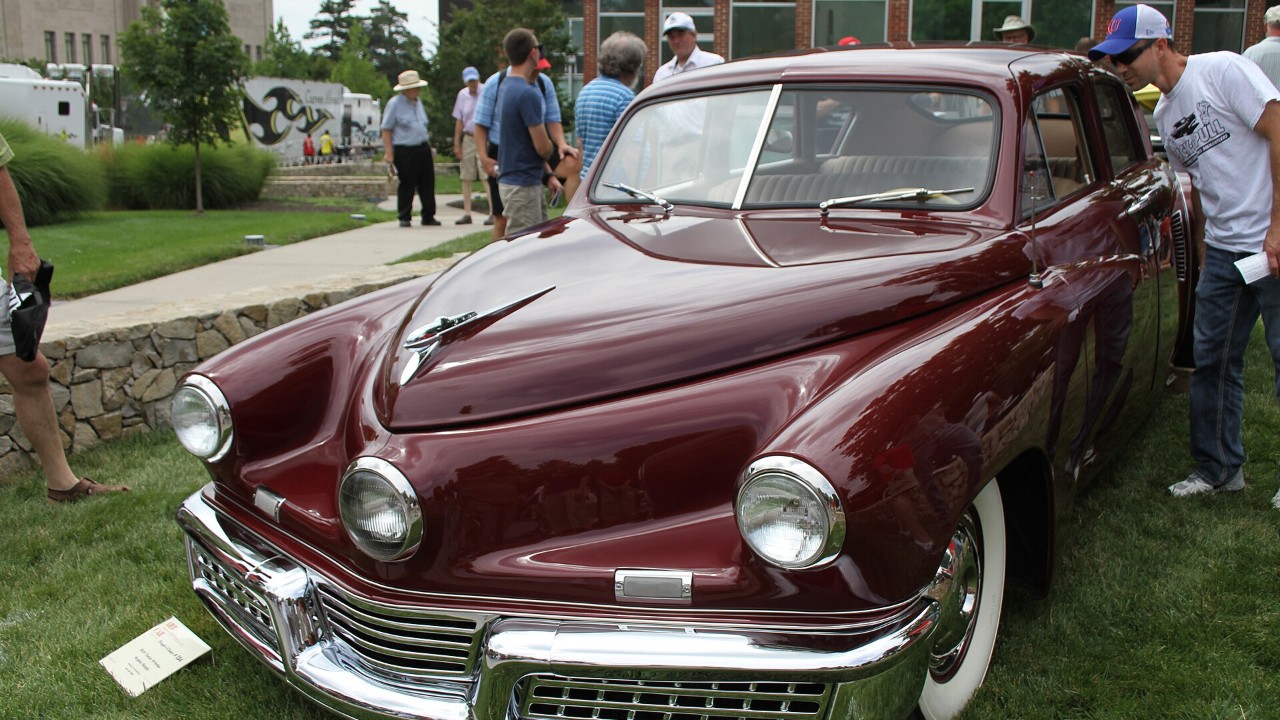
The Tucker Cyclops headlight sat in the middle of the nose of the 1948 Tucker 48, between two ordinary lamps. It turned with the front wheels, so the beam could reach into a corner before the car did. Only 51 Tucker 48s were ever built, yet that third light became the car’s signature.
Preston Tucker designed his sedan as a safety car. Several of the features he advertised never reached production. However, the center light did, and it became the detail people remember.
Here is what the light did, why some owners had to cover it up, and where you can see one today.
How the Tucker Cyclops headlight worked
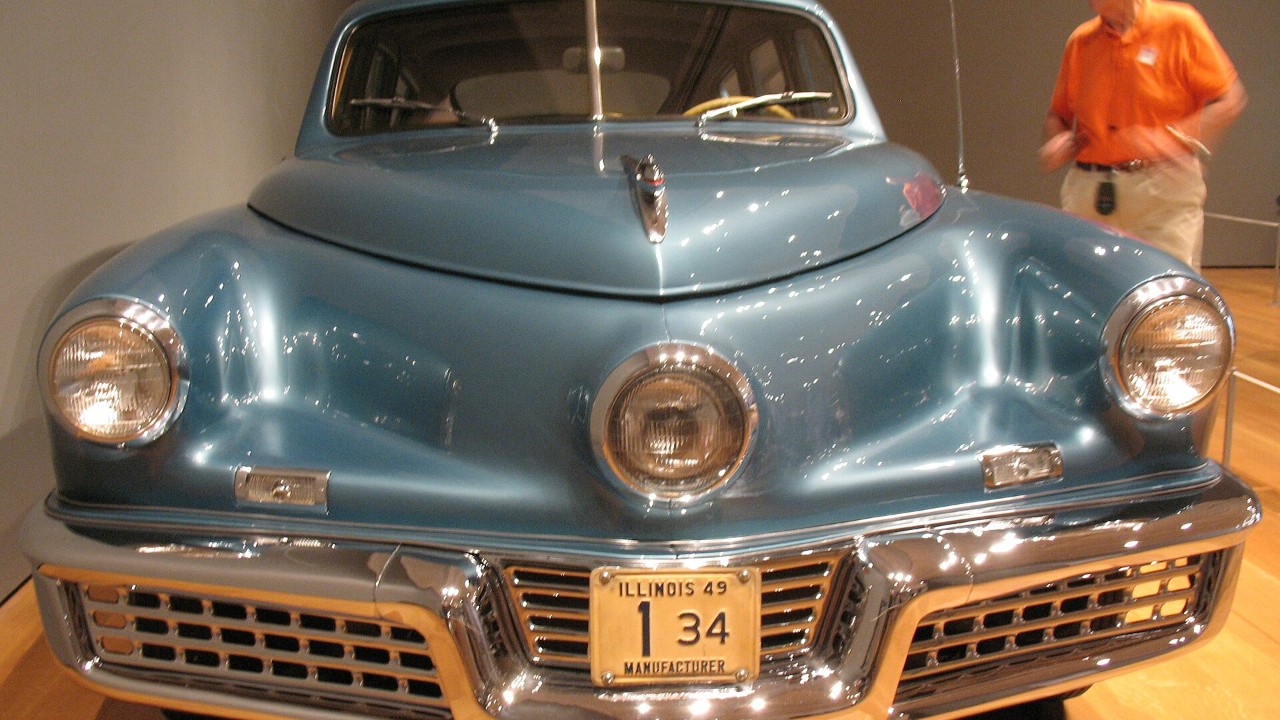
The Audrain Automobile Museum in Newport, Rhode Island, calls it a third directional headlight known as the “Cyclops Eye.” According to the museum, it would activate at steering angles greater than 10 degrees, lighting the car’s path around corners. Its specification sheet lists the part as a “Center Rotating ‘Cyclops Eye.’”
The Henry Ford museum in Dearborn, Michigan, describes the same behavior in its Preston Tucker collection. The center light turned with the front wheels, and it switched on once the steering wheel turned about ten degrees either way. On a straight road, the lamp stayed off. In other words, the driver never had to touch a switch.
The Museum of American Speed in Lincoln, Nebraska, gives the same threshold. Its page says the Cyclops Eye lit up whenever the car was steered by more than 10 degrees. That’s three museums, all landing on the same number.
Why the idea stood out in 1948
Turning lamps were not new in 1948. Still, the Audrain museum points out that no car before the Tucker had a rotating headlight that sat flush with the front end. Tucker built it into the nose, so the car kept its smooth face.
The body itself came from stylist Alex Tremulis, who had worked at Auburn before joining Tucker. The finished car stood only 60 inches tall, according to the Museum of American Speed. It also had doors that cut into the roof, rear fender vents to cool a rear engine, and a fastback tail, as the Henry Ford notes.
That engine was another reason the car turned heads. The Audrain museum lists a rear-mounted, air-cooled flat-six of 335 cubic inches, rated at 166 horsepower at 3,200 rpm. It made 372 lb-ft of torque at 2,000 rpm and drove through a Tucker “Y-1” four-speed pre-selector transmission. The museum also gives a top speed of 120 mph and a weight of 4,200 pounds.
The 17 states that said no
The third light ran straight into the law. At the time, 17 states had laws against cars having more than two headlights, the Audrain museum says. As a result, Tucker made a cover for the center light so owners in those states could drive legally.
That small part tells you a lot about the car. Tucker designed for the road he wanted, and then he built a fix for the rules he actually faced. Meanwhile, the light was only one item on a longer safety list.
For example, the Audrain museum describes a windshield designed to pop out whole in an accident, so it wouldn’t shatter over the passengers. The car also had an open space in front of the dash, where a passenger could duck down before a crash. The Museum of American Speed adds that Tucker’s original plans called for disc brakes, fuel injection and a padded dashboard.
What happened to Tucker
Long before that, the public first saw the car on June 19, 1947. That day Tucker unveiled the prototype at his Chicago plant, and about 5,000 people came, according to the Henry Ford. The factory was a war-surplus plant that had built B-29 engines during the war.
Several promised features fell away before production. The Henry Ford says fuel injection and the planned torque-converter transmission never made it. The prototype also used a 589-cubic-inch six, but production cars got a six designed for helicopters. That engine came from Air Cooled Motors of Syracuse, New York, a company Tucker bought.
Then the money ran out. The SEC investigated the company for stock fraud in 1948. The company was fully acquitted, but the backlash drove most investors away, the Audrain museum says. Tucker Car Corporation closed on March 3, 1949, about two years after sedan production began.
Later, Hollywood picked up the story. In 1988, Francis Ford Coppola directed Tucker: The Man and His Dream, with Jeff Bridges as Preston Tucker. The Henry Ford notes that the film fictionalized some scenes and characters.
Where to see a Tucker 48 today
The survival rate is high for a car built in such small numbers. Of the 51 cars produced, 50 production cars and one prototype, 47 still exist, according to the Museum of American Speed. Most of them, the museum adds, are in excellent condition.
Museums hold several of them. For instance, the Henry Ford holds a 1948 Tucker 48 sedan, and its photo archive shows the car on the museum floor in December 1964. The Audrain museum’s car is the second-to-last Tucker built, and the museum says it left the factory without a transmission. A St. Louis-area collector bought it at auction in 1950 and fitted a transmission in the early 1950s.
Look closely at the nose of any of them, and the Tucker Cyclops headlight is the first thing you’ll notice. It sits dead center, flush with the bodywork. Tucker built 51 of these cars, and 47 of them survive, according to the Museum of American Speed.
More from Fast Lane Only
- Unboxing the WWII Jeep in a Crate
- 15 rare Chevys collectors are quietly buying
- 10 underrated V8s still worth hunting down
- Police notice this before you even roll window down
This article was created with the help of AI and was reviewed and edited by Fast Lane Only editors before publication.