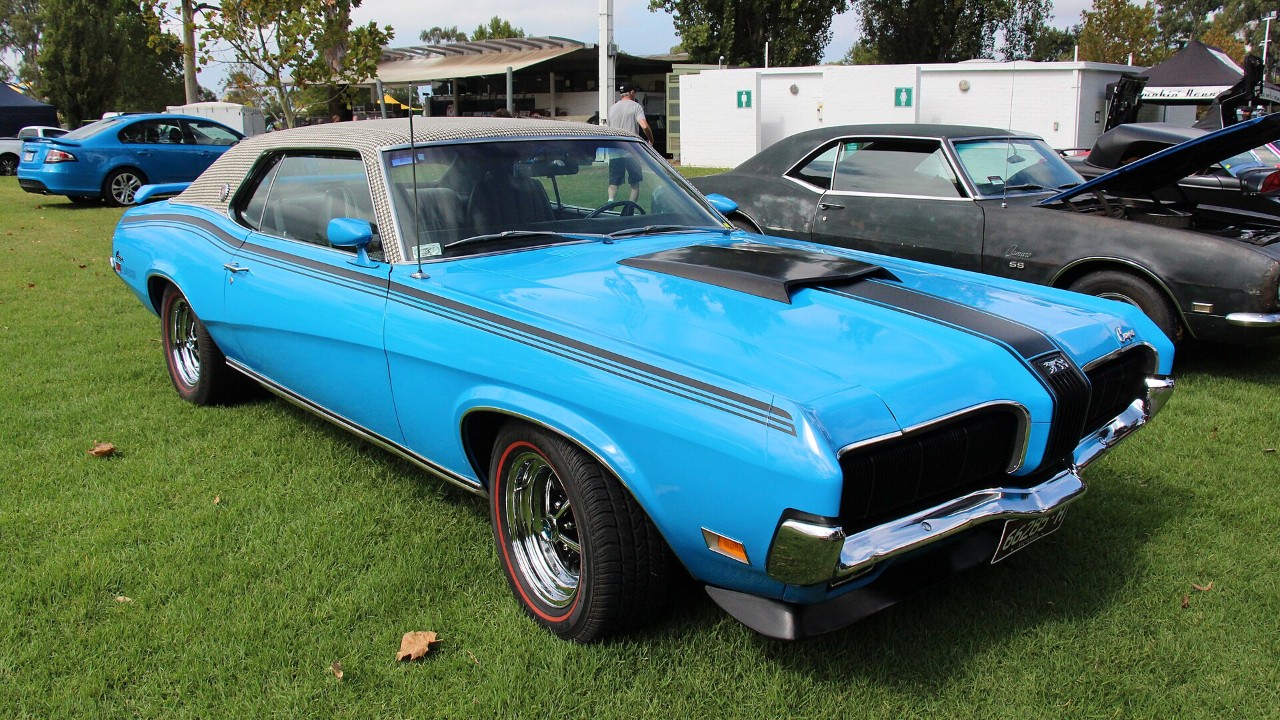
Mercury built 2,267 Cougar Eliminators for 1970, and only 469 left the factory as the Boss 302 Eliminator. Instead, the rest carried larger engines. That small group shared its small-block V8 with the Boss 302 Mustang, but it lasted just one model year.
The Eliminator was Mercury’s entry in the muscle car market. Also, it wore spoilers, stripes and a hood scoop on the Cougar’s body. The engine choice, though, is what sets the Boss cars apart.
Here is how the Eliminator came about, why the Boss 302 cars stand apart, and what one is worth now.
The Cougar behind the Eliminator
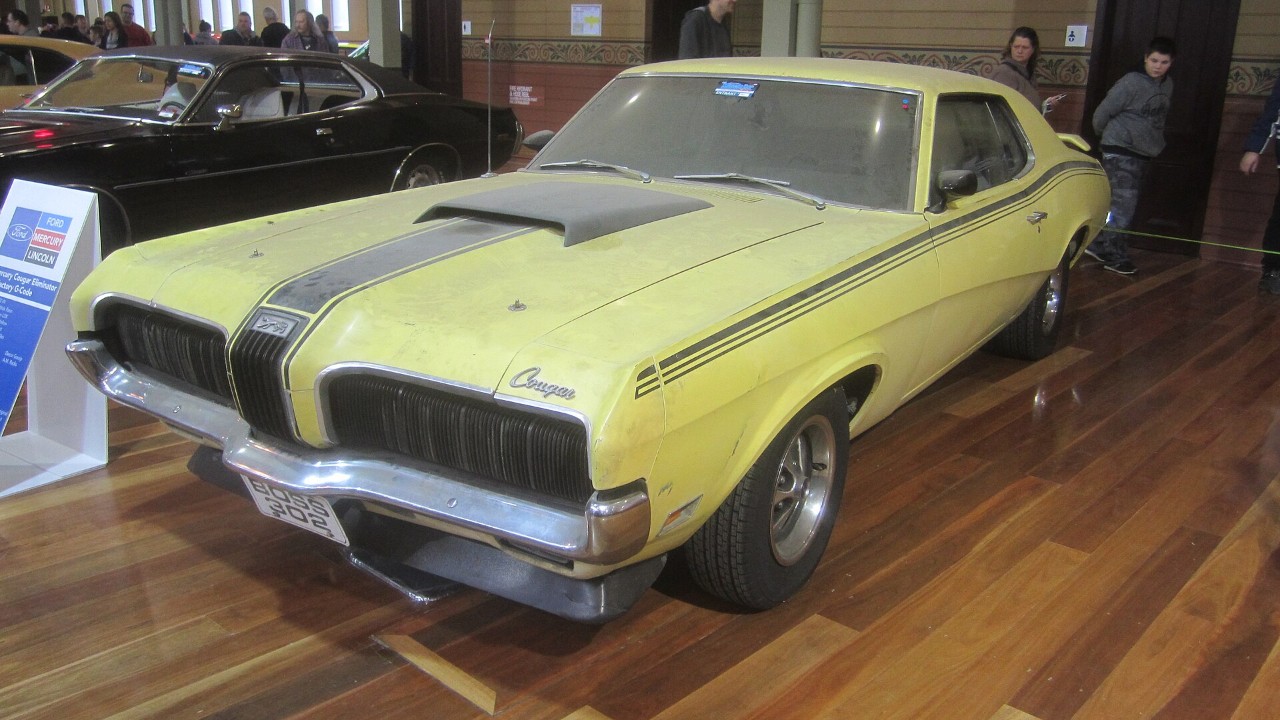
First, the Cougar arrived for 1967 as Mercury’s pony car. According to Hagerty, it rode on the Mustang’s basic platform with a wheelbase three inches longer, and it came only as a two-door hardtop. A 200-horsepower 289 V8 was standard, while the GT package brought a 320-horsepower 390.
Mercury also tied the car to racing early. Hagerty notes a Dan Gurney Special option on the XR-7, honoring the driver’s role in Mercury’s Trans-Am program. Sales were strong at first, too. Hagerty says nearly 365,000 Cougars sold in the first three years, although sales fell after 1967.
What the Eliminator package added
The Eliminator ran for just two years, 1969 and 1970, according to Street Muscle. The 1969 package brought improved suspension, its own graphics, front and rear spoilers and optional Ram Air induction. Buyers could choose from four colors: White, Bright Blue, Yellow and Competition Orange.
For 1969, Street Muscle lists a 351 Windsor four-barrel V8 rated at 290 horsepower as the base engine. Options also included the 390 GT and the 428 Cobra Jet. Mercury built 2,250 Eliminators that year, the magazine says.
Then the 1970 car got a facelift. For instance, Street Muscle describes a split, blacked-out grille with wide vertical slots, a hood extension, bolder graphics and a black hood scoop. At the same time, a 351 Cleveland rated at 300 horsepower became the new base engine. The 428 Cobra Jet stayed on the list at 335 horsepower and 440 lb-ft of torque.
Why the Boss 302 Eliminator is different
The Boss 302 was the odd engine in that group, because at 302 cubic inches it was the smallest in the 1970 lineup. According to Silodrome, the Boss 302 made 290 horsepower at 5,200 rpm and 290 lb-ft of torque at 4,300 rpm. In other words, it was the same engine Ford put in the Boss 302 Mustang.
That engine had a racing pedigree. Silodrome notes that Boss 302 Mustangs, driven by Parnelli Jones and George Follmer, won the 1970 Trans-Am championship. In the Cougar, the Boss 302 Eliminator also came with extra hardware. Silodrome lists competition suspension, power front disc brakes, a close-ratio four-speed manual, high-back bucket seats and a special gauge package.
Inside, the Eliminator had serious instruments. Conceptcarz lists an 8,000-rpm tachometer and a rally clock. It also credits the Boss 302 with unique canted-valve cylinder heads.
The numbers: 469 out of 2,267
Silodrome puts 1970 Eliminator production at 2,267 cars, and Street Muscle gives the same figure. Of those, though, Silodrome says just 469 had the Boss 302. Conceptcarz also describes a Competition Blue example as one of 469 built in 1970.
However, the sources don’t agree to the last car. Conceptcarz puts the Eliminator total at 2,268 in one passage and 2,267 in another. By comparison, an RM Sotheby’s catalog gives 468 Boss 302 cars instead of 469. Either way, roughly one Eliminator in five had the Boss engine.
For scale, Mercury built 72,365 Cougars of all kinds in 1970, according to Conceptcarz and RM Sotheby’s. That means the Boss 302 Eliminator made up well under one percent of the year’s Cougars.
One year only
The Boss 302 Cougar didn’t get a second season. According to Silodrome, Mercury halted its production after just one year. Street Muscle adds that Mercury canceled the Eliminator package itself after 1970.
That short run is a big part of the car’s appeal now. For example, the RM Sotheby’s car was a Competition Gold Boss 302 Eliminator with a black interior and a factory Super Drag Pak. Moreover, the catalog called it one of 45 in that color combination. RM Sotheby’s offered it at its Auburn Fall auction in 2016 with an estimate of $150,000 to $175,000, and the car did not sell.
Still, the record is clear on the main point, since Mercury built 2,267 Cougar Eliminators for 1970, and Silodrome counts 469 Boss 302 cars among them.
More from Fast Lane Only
- Unboxing the WWII Jeep in a Crate
- 15 rare Chevys collectors are quietly buying
- 10 underrated V8s still worth hunting down
- Police notice this before you even roll window down
This article was created with the help of AI and was reviewed and edited by Fast Lane Only editors before publication.