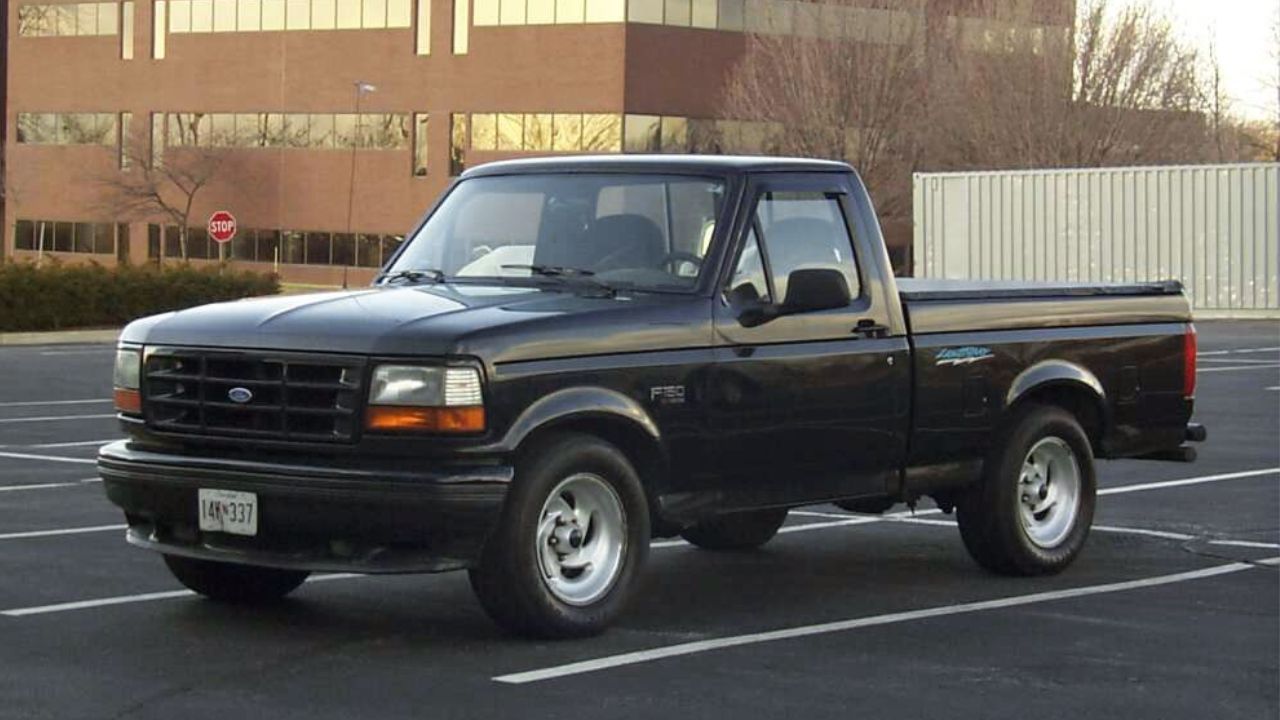
The 1993 Ford SVT Lightning arrived at a time when pickup trucks were still judged primarily by their towing capacity and payload ratings. Instead of building a work truck with more utility, Ford created one focused on performance and driver enjoyment. What began as a niche project from the newly formed Special Vehicle Team unexpectedly became one of the most influential performance trucks in automotive history.
Ford Wanted to Showcase Its New Performance Division
In the early 1990s, Ford established the Special Vehicle Team (SVT) to develop high-performance versions of existing production vehicles. Rather than designing an entirely new truck, engineers selected the popular F-150 as the foundation for their first performance pickup.
The goal was to create a truck that handled more like a sports car while preserving the everyday usability buyers expected from a full-size pickup. SVT upgraded the suspension, steering, brakes, and chassis, while installing a specially tuned 5.8-liter Windsor V8 that delivered stronger performance than the standard engine.
Unlike many appearance packages of the era, the Lightning received meaningful mechanical improvements that transformed how it drove. It represented Ford’s commitment to proving that trucks could deliver excitement as well as capability.
Performance Took Priority Over Maximum Capability
Unlike traditional pickups that emphasized hauling heavy loads, the first-generation Lightning was engineered with on-road performance in mind. SVT lowered the suspension, fitted performance-oriented shocks and springs, and installed wider tires to improve grip through corners.
The specially prepared V8 delivered strong torque, while a recalibrated four-speed automatic transmission helped make the most of the engine’s power. Larger brakes and quicker steering further distinguished the truck from ordinary F-150 models.
Although towing and payload capacities were slightly reduced compared with some standard pickups, buyers embraced the Lightning because it offered something entirely different. It was designed for enthusiastic driving rather than maximum work capability.
That shift in priorities helped redefine what a factory-built pickup could become.
Enthusiasts Helped Build Its Reputation
The Lightning quickly earned praise from automotive journalists, who admired its balanced handling and confident road manners. It demonstrated that a full-size pickup could be genuinely enjoyable on winding roads instead of feeling like a vehicle designed solely for heavy-duty tasks.
Owners also appreciated its understated appearance. Aside from unique wheels, subtle badging, and a slightly lowered stance, the truck remained relatively restrained compared with later performance pickups. This gave it the character of a sleeper, surprising drivers who underestimated its capabilities.
As enthusiast clubs and aftermarket companies embraced the Lightning, its reputation continued to grow. Owners shared performance upgrades, attended truck shows, and demonstrated that pickups could have communities traditionally associated with sports cars and muscle cars.
Its popularity steadily expanded beyond Ford’s original expectations.
A Legacy That Changed Performance Trucks
Although production numbers remained relatively modest, the first-generation SVT Lightning had an impact that extended well beyond its sales figures. It proved there was genuine demand for factory-built performance pickups engineered with the same attention given to sports cars.
Ford later introduced a more powerful second-generation Lightning, while other manufacturers entered the segment with increasingly capable high-performance trucks. Today’s factory performance pickups owe much of their existence to the path the original Lightning helped establish.
Collectors now view the 1993–1995 SVT Lightning as a milestone in American automotive history. Well-preserved examples continue to attract enthusiasts who appreciate their combination of V8 performance, everyday practicality, and historical significance.
Looking back, the unusual rise of the 1993 Ford SVT Lightning came from its willingness to challenge expectations. Instead of asking what a pickup truck could carry, Ford asked how enjoyable it could be to drive—and in doing so, helped launch a new era of factory-built performance trucks.
More from Fast Lane Only
- Unboxing the WWII Jeep in a Crate
- 15 rare Chevys collectors are quietly buying
- 10 underrated V8s still worth hunting down
- Police notice this before you even roll window down
*Research for this article included AI assistance, with all final content reviewed by human editors