The muscle car era didn’t end with coupes and fastbacks. In fact, one of its most surprising survivors came in the form of a pickup truck that looked more like a work vehicle than a street terror. The Dodge Li’l Red Express Truck became one of the most unexpected performance legends of the late 1970s—an era when most factory horsepower had already been strangled by emissions rules.
What happened
By the late 1970s, American performance cars were in decline. Stricter emissions regulations, fuel economy concerns, and rising insurance costs had dulled the once-brutal output of traditional muscle machines. While most manufacturers were detuning engines, Dodge took a different approach.
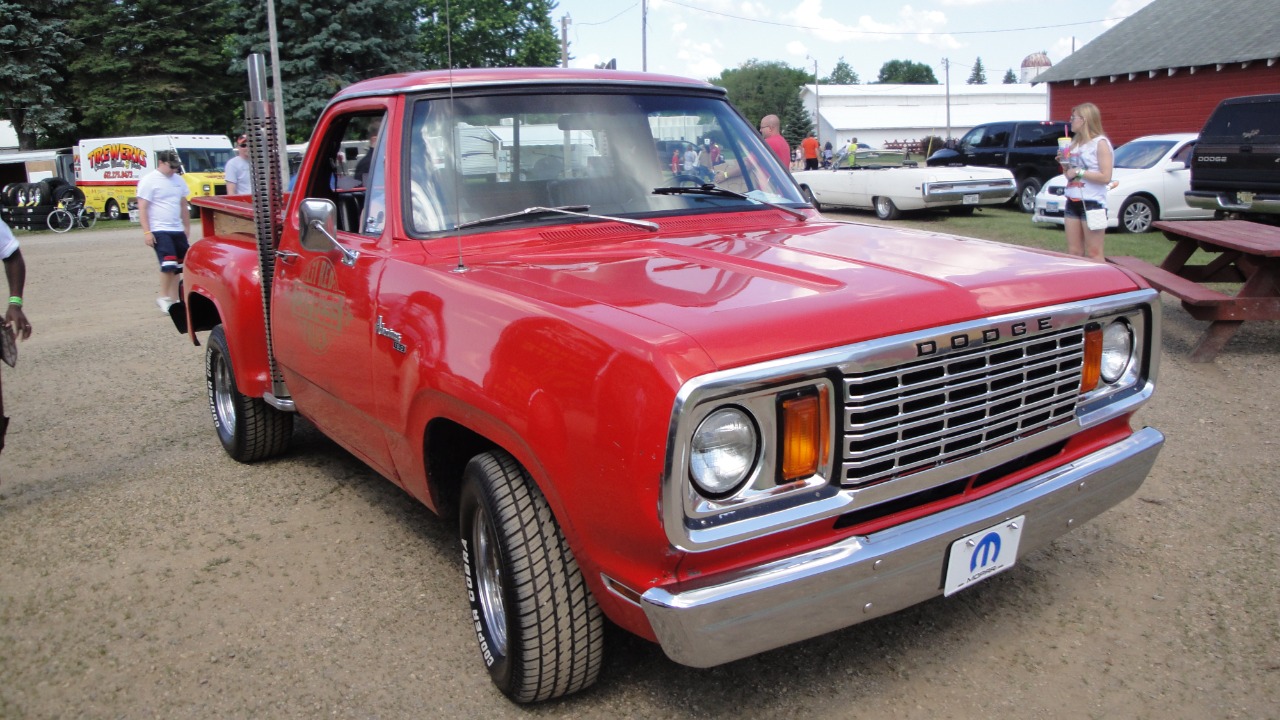
Using the light-duty truck platform, engineers built a performance-oriented pickup based on the Dodge D-Series. Instead of disguising its intent, the result was bold and unmistakable: a bright red pickup with vertical chrome exhaust stacks mounted behind the cab, wood side panels, and aggressive badging.
Under the hood, the Dodge Li’l Red Express Truck used a high-performance 360 cubic-inch V8, tuned with police-spec components and optimized for torque and mid-range power. Crucially, it was exempt from some of the stricter emissions equipment of the time, allowing it to breathe more freely than many passenger cars of its era.
That advantage translated into real-world performance. In period testing, the Li’l Red Express Truck posted acceleration figures that rivaled—and in some cases beat—many contemporary muscle cars. Despite its weight and truck proportions, it could run quarter-mile times that surprised even experienced testers.
Unlike traditional performance cars, it didn’t rely on lightweight construction or aerodynamic design. Instead, it used raw engine output and gearing to overcome its physical disadvantages. The result was a straight-line performer disguised as a utility vehicle.
Why it matters
The significance of the Dodge Li’l Red Express Truck lies in its timing. It arrived during one of the lowest points in American factory performance, when many iconic muscle car nameplates had been softened or discontinued entirely.
While coupes and sports cars were struggling to adapt to emissions regulations, Dodge found a loophole in the commercial truck category. By classifying the vehicle as a light-duty truck, engineers were able to retain a higher-output engine configuration than was typically allowed in passenger cars at the time.
This made the Li’l Red Express one of the fastest American production vehicles of its year, a surprising fact given its utilitarian appearance. It also helped redefine what a performance vehicle could be. Instead of focusing on sleek styling or coupe proportions, Dodge proved that speed could come from unexpected platforms.
Culturally, the truck also became a symbol of rebellion against the slowdown of the late 1970s. It didn’t pretend to be refined or subtle. The chrome stacks, bold graphics, and loud exhaust note all emphasized performance identity in a period when most manufacturers were moving away from it.
Over time, it gained recognition as a transitional vehicle—bridging the gap between the muscle car era and the modern performance truck segment. It showed that performance didn’t have to disappear; it just needed a different platform.
What to watch next
Today, the Dodge Li’l Red Express Truck has become a niche but respected collector vehicle. Its rarity, combined with its unusual place in performance history, has helped it gain appreciation among enthusiasts who value unconventional muscle-era survivors.
Original examples are increasingly difficult to find, especially those with intact factory exhaust stacks and original drivetrain components. Like many performance vehicles of its era, survival rates were impacted by heavy use and modifications over time.
The broader trend of performance trucks has also helped revive interest in the Li’l Red Express. Modern high-performance pickups now dominate segments that didn’t exist in the same form in the 1970s, but the Li’l Red Express is often seen as one of the earliest factory examples of that concept.
Looking forward, its legacy continues to grow as enthusiasts re-evaluate overlooked vehicles from the emissions-era slowdown. What was once considered a novelty has become recognized as a genuine performance milestone.
In the end, the Dodge Li’l Red Express Truck proved something simple but important: even when the muscle car era was fading, American performance didn’t disappear—it just found a different shape.
More from Fast Lane Only