Toni Breidinger has become a rare crossover figure in American sports, splitting time between the cockpit of a race truck and the runway of a global lingerie brand. When she talks about the friction between her Victoria’s Secret work and her NASCAR ambitions, she is really describing a deeper tension over who gets to define what a racer looks like and how a woman in a male-dominated series is allowed to build her career.
Her story, from grassroots racing to a Victoria’s Secret campaign and a NASCAR Truck Series start, shows how commercial opportunity and cultural expectations collide. By opening up about being told she could not do both, she has forced the industry to confront whether its old assumptions still fit a new generation of drivers and fans.
The moment Victoria’s Secret met the NASCAR garage
The turning point in Breidinger’s public profile came when her modeling work stopped being a separate lane and instead rolled directly into the NASCAR paddock. She was announced as the driver of the No. 1 Toyota Tundra for TRICON Garage at Kansas Speedway, with Victoria as the primary sponsor on the truck, a visual statement that a lingerie brand and a professional race program could share the same sheet metal. That pairing put her dual identity on full display, not in a photoshoot but at a high-speed, high-stakes event where performance is measured in lap times.
In that Kansas start, Breidinger was not just another young driver getting a shot in the NASCAR Craftsman Truck Series, she was also the face of a Victoria-backed entry that challenged the sport’s traditional sponsor mix. The No. 1 Toyota Tundra TRD Pro carried Victoria’s Secret branding into a space more accustomed to motor oil, tools, and telecom logos, signaling that a driver’s off-track portfolio could be as diverse as any other modern athlete’s. The partnership with TRICON Garage gave her a competitive platform, while the Victoria sponsorship made clear that her modeling career was not a side hobby but a core part of her commercial value, integrated directly into her racing program.
“I was told I couldn’t do both” and what that reveals
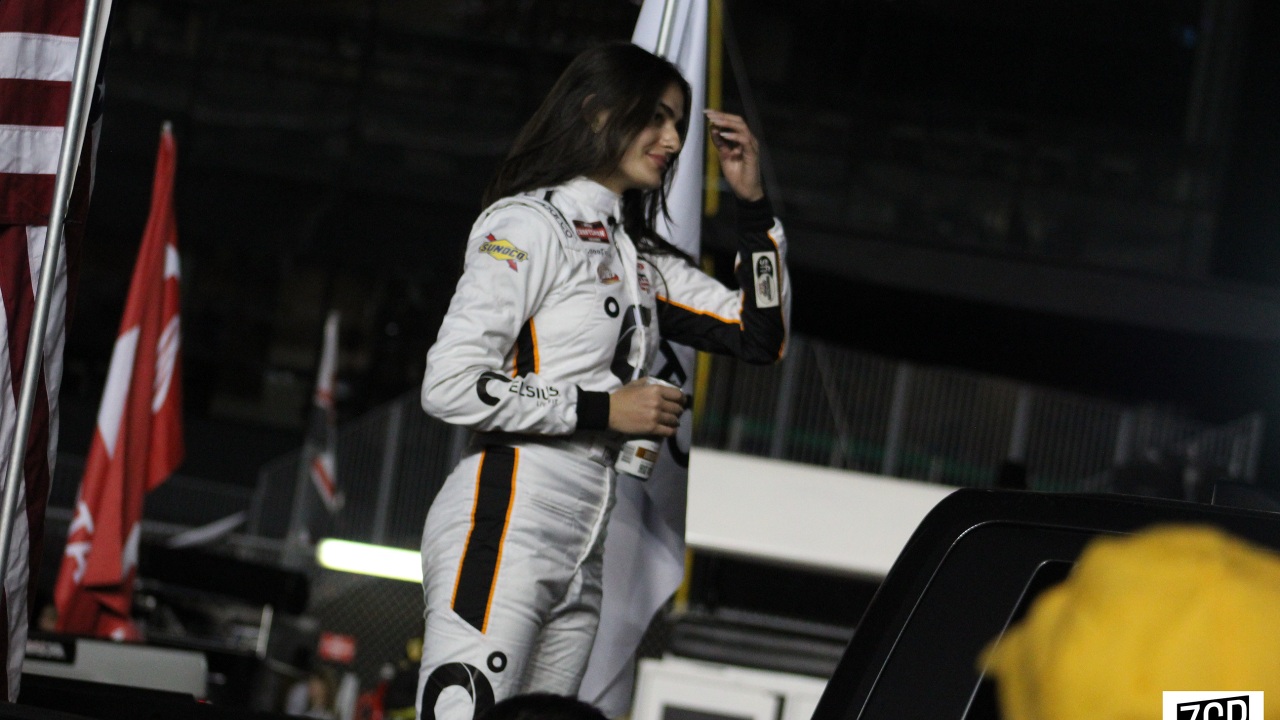
Breidinger has been candid that her path was not universally encouraged, recalling that when she was younger she was told she could not be both a Victoria’s Secret model and a NASCAR driver. That warning captured a long-standing bias that women in motorsports must choose between being taken seriously as competitors and embracing opportunities tied to their appearance. By later announcing that she would be driving the No. 1 Victoria Secret Toyota Tundra TRD Pro at Kan, she effectively turned that old message on its head, using the very combination she was warned against as proof that the binary was false.
Her willingness to repeat that line publicly matters because it exposes how gatekeeping often works in subtle, offhand comments rather than formal rules. When a young driver hears that she has to pick one identity, the implication is that sponsors, teams, or fans will not accept a woman who is both marketable in fashion and credible in a race seat. Breidinger’s Kansas entry, backed by Victoria and TRICON Garage, showed that at least some stakeholders are ready to reject that thinking. It also reframed the “issue” around Victoria’s Secret not as a moral debate but as a practical question of whether the sport will allow women to leverage every legitimate avenue of support available to them.
Building a team to navigate two high-pressure worlds
Balancing a NASCAR schedule with a modeling career is not something a driver can manage alone, and Breidinger has been open about the infrastructure behind her. She has described how, along the way, she built a strong team around her, working with agents and signing with representation that helps coordinate opportunities across both racing and fashion. That kind of professional support is standard for top athletes in other sports, but in stock car racing, where many drivers still handle their own outreach, it underscores how seriously she treats both sides of her career.
Her comments in a Jan video about having agents and a great team highlight that this dual path is not improvised or casual. Instead, it is a deliberate strategy that treats a Victoria’s Secret campaign and a Truck Series start as complementary pieces of the same brand. By formalizing that structure, Breidinger reduces the risk that one commitment will undercut the other, and she signals to sponsors like Victoria and organizations like TRICON Garage that she can deliver on-track performance and off-track visibility without burning out. The professionalization of her support system is part of how she has turned what some saw as a conflict into a coordinated career plan.
Confidence, criticism, and the reality of a male-dominated paddock
Breidinger’s openness about the Victoria’s Secret question also fits into a broader pattern of how she talks about surviving and thriving in a male-dominated space. In an Oct clip offering advice to girls who want to start racing, she explained that she stays confident by maintaining a strong inner circle, surrounding herself with people who believe in her and help her navigate the pressures of the sport. That emphasis on internal support is a direct response to the external scrutiny that comes with being both a driver and a lingerie model in a series where women are still rare.
Her focus on confidence is not abstract. When critics frame her Victoria’s Secret work as a distraction or question whether it undermines her seriousness as a racer, she leans on that inner circle to keep the noise from dictating her choices. The same mindset that lets her strap into a truck at Kansas Speedway and compete at high speed also informs how she handles social media commentary and paddock whispers. By linking her advice to young girls with her own experience, she makes clear that the real issue is not the presence of a lingerie brand in NASCAR, but the persistence of attitudes that treat women’s success as conditional on fitting a narrow mold.
What Breidinger’s stance signals for NASCAR’s future
When I look at how Breidinger talks about the Victoria’s Secret partnership, I see less a controversy and more a test case for where NASCAR is headed. Her No. 1 Toyota Tundra for TRICON Garage at Kansas Speedway, wrapped in Victoria branding, showed that a driver can bring nontraditional sponsors into the garage without diluting the competitive product. It also hinted at a future where the sport’s commercial ecosystem is broad enough to accommodate brands that speak directly to female fans, rather than treating them as an afterthought.
By insisting that she can be both a Victoria’s Secret model and a NASCAR driver, and by backing that up with a structured team, agents, and a clear sense of self, Breidinger has reframed the “issue” as a question of whether the sport will evolve with her. Her path, from early warnings that she could not do both to a Victoria Secret Toyota Tundra TRD Pro at Kan and a growing media presence, suggests that the old either-or choice is losing its grip. If NASCAR embraces that shift, the next generation of drivers may find that their off-track identities, whether in fashion, tech, or entertainment, are seen not as liabilities but as assets that help keep the series culturally relevant and commercially strong.
More from Fast Lane Only: