The two-door sedan was the plain choice of its day, with a fixed pillar and a modest roofline. People bought cars like the 1971 AMC Hornet two-door sedan as everyday transportation. That plain-wrapper start is why, in our view, a full restoration rarely makes sense.
These seven are our picks of the two-door sedans we would rather fix and drive than restore. A ground-up job costs about the same on a plain car as on a rare one. So, in our view, these are cars to enjoy, not to rebuild bolt by bolt.
1. 1971 AMC Hornet two-door sedan

The Hornet replaced the Rambler American for 1970, and in its first year the base two-door listed at $1,994. For 1971, AMC made the 232 cubic-inch six standard across the range. The Hornet that collectors chase is the 1971 SC/360, with AMC’s 360 V8, and AMC built only 784. Unless yours is one of those, we would keep it running and skip the rotisserie.
2. 1968 Plymouth Valiant Signet two-door sedan
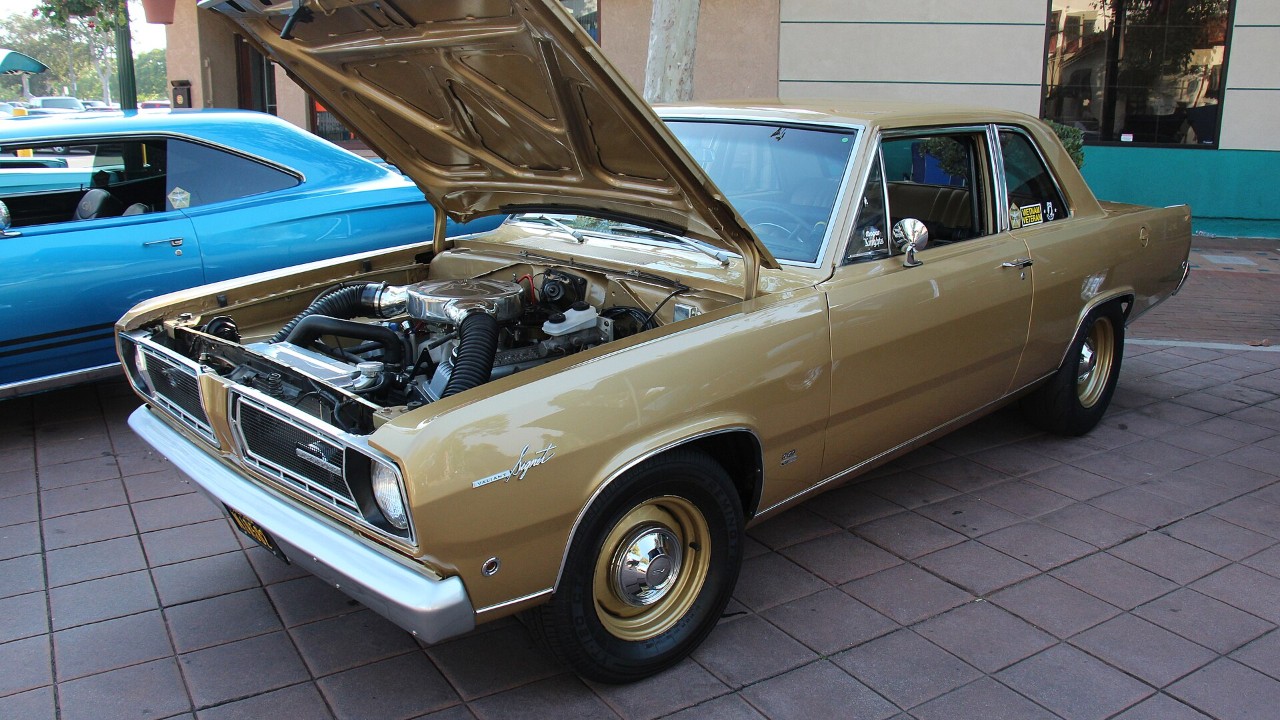
For 1968, the Valiant came as the 100 or the better-trimmed Signet. The standard 170 cubic-inch slant six made 115 horsepower, while the optional 225 made 145. Valiant.org lists the 273 V8 at 190 horsepower and the 318 at 230. The slant six earned a reputation for dependability, which is the whole appeal. In other words, a Signet two-door is a car to drive, and our list of Valiants that looked like the future shows the ones worth more effort.
3. Ford Fairmont two-door sedan

The Fairmont ran from 1978 to 1983 as the first car on Ford’s Fox platform. Ford built 1,598,631 Fairmonts, and 201,714 of them were two-door notchbacks. The base engine was a 2.3-liter four, rated at 88 horsepower when new. It was a sensible family car, and nobody meant it to be precious. Our story on why the 1978 Fairmont mattered more than it looked explains its legacy. Still, a full restoration on one is love, not math.
4. 1962 Dodge Dart two-door sedan

Chrysler shrank the 1962 Dart and its Plymouth siblings to a 116-inch wheelbase, and the cars came out 7.5 inches shorter than the 1961 models. According to Ate Up With Motor, the cars dismayed dealers, and Virgil Exner himself called the cars “plucked chickens.” Dodge sales then fell from about 198,000 to around 159,000. The 1962 Darts that drag racers remember carry the mid-year 413 Ramcharger V8, rated at 415 horsepower. A slant-six Dart is a fun oddity, but we would not pour restoration money into one.
5. 1963 Plymouth Savoy two-door sedan

Plymouth used the Savoy name from 1951 through 1964, and by 1963 it sat on the downsized 116-inch wheelbase. For 1963, the big Plymouth grew 3 inches longer overall, and Plymouth sales rose 44% from the 1962 slump. Unless one has a factory big-block, we would treat it as a driver and let the patina stay.
6. 1960 Rambler American two-door sedan

AMC revived the 1955 Nash Rambler body for 1958 and called it the Rambler American. In 1958, the base two-door sold for $1,789, and AMC called it the lowest-priced car made in America. By 1960, two-doors accounted for 44,817 of the 120,603 Americans built. Better yet, a Custom two-door won the compact class of the 1960 Mobilgas Economy Run at 28.35 mpg. Thrift was always the point, so a pricey restoration misses it.
7. 1963 Studebaker Lark two-door sedan

For 1963, Brooks Stevens restyled the Lark and removed its wraparound windshield. However, sales fell to about 77,000 cars that year. Studebaker then announced on December 9, 1963, that its South Bend plant would close. The Lark lived on in Hamilton, Ontario, until March 1966. A two-door Lark is a charming piece of history, but in our view, it rewards a careful tune-up far more than a full restoration.
More from Fast Lane Only