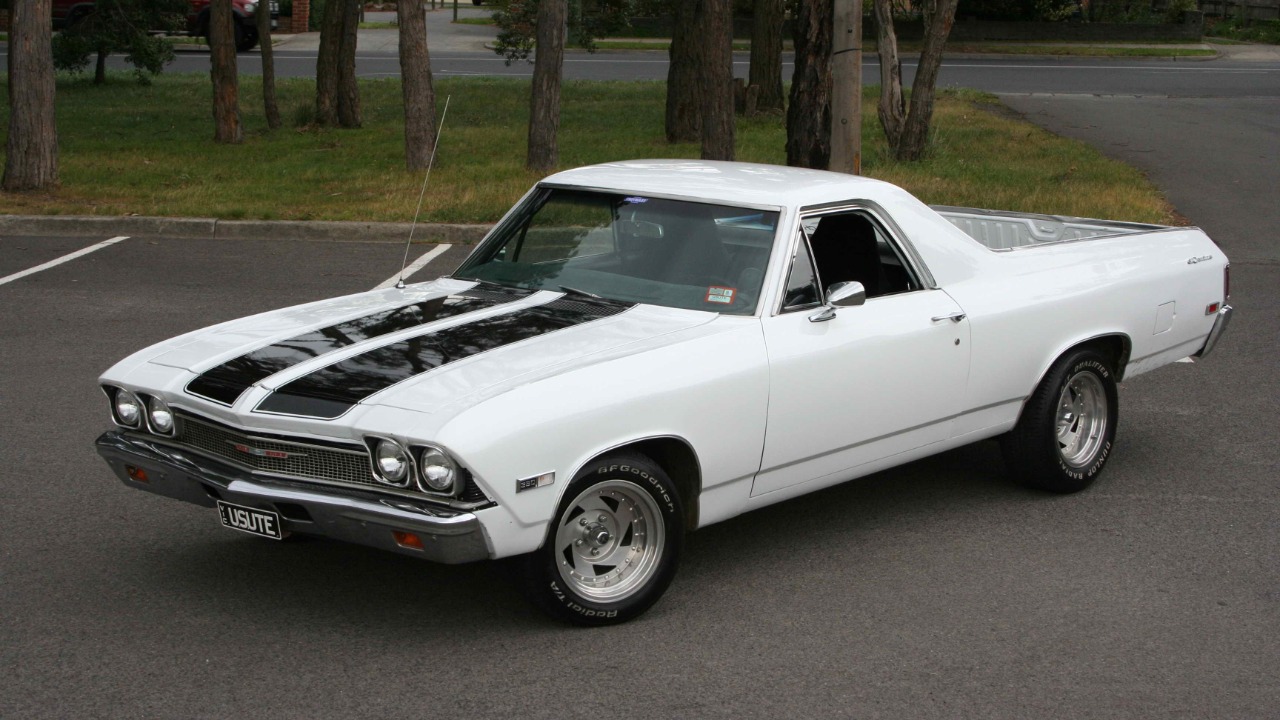
The 1968 Chevrolet El Camino arrived at a moment when American drivers were starting to want it all, and it answered with a shape that refused to pick a side. It looked like a muscle coupe from the front, worked like a pickup from the rear, and helped turn a niche idea into a mainstream statement. When I look at that model year now, I see the point where Chevrolet stopped apologizing for the mash‑up and leaned into a confident, third‑generation redesign that still feels surprisingly modern.
The third generation that finally clicked
By 1968, Chevrolet had already tried the car‑truck formula twice, but the third generation is where the El Camino really found its stride. The company shifted the utility coupe onto a redesigned A‑body platform, stretching it to a longer wheelbase and giving it a sleeker, fastback‑inspired profile that made the bed look like a natural extension of the cab rather than an awkward add‑on. In period descriptions, the 1968 Chevrolet El Camino is singled out as the start of this third act, with that longer 116‑inch wheelbase and a body that finally looked cohesive from nose to tail.
The market noticed. Production for the 1968 model year reached a Total of 41,791, a figure that shows how quickly buyers warmed to the new shape once Chevrolet committed to the idea. That number may not match the volumes of a mainstream sedan, but for a body style that had once seemed like a curiosity, it signaled that the El Camino had become a serious part of the lineup rather than a side project.
Styling that walked a line between coupe and truck

What makes the 1968 El Camino so compelling to me is how deliberately it split the difference between muscle car drama and work‑truck honesty. General Motors kept tweaking the styling of each model year from 1968 to 1972, but the most obvious changes came every other year and were easiest to spot at the front, where the face of the car did most of the talking. Contemporary buying guides point out that GM tweaked the styling across those years, yet the 1968 version set the template with its long hood, crisp fenders, and a cab that flowed into the bed with far more grace than earlier attempts.
Seen in vivid colors, the design still pops. One Matador Red example marketed today is described as a way to Find the fiery spirit of the 1960s, with that bold finish wrapped around a muscular pickup truck profile. The paint only underscores what the sheet metal was already saying: this was not a farm implement with a bowtie badge, it was a stylish personal vehicle that just happened to have a bed big enough for lumber, engines, or a weekend’s worth of swap‑meet finds.
SS 396: when the hybrid went full muscle
If the basic 1968 El Camino blurred categories, the SS 396 version practically erased them. Chevrolet borrowed heavily from the Malibu playbook, giving the SS 396 a blacked‑out grille, a bulging hood, and a standard 396 cubic inch big‑block V‑8 rated at 325-horsepower, all of which turned the utility coupe into a legitimate muscle machine. Period specs note that, Like its Malibu based counterpart, the El Camino SS 396 wore that hardware proudly, making it clear that hauling could be done at serious speed.
The platform underneath was up to the task. A model description of the 1968 SS 396 notes that a redesigned A‑body platform translated into a longer wheelbase for Model year 1968, and that Sales went up as buyers responded to the combination of practicality and performance. In practice, that meant you could tow, carry, and still line up at a stoplight with confidence, a mix that helped cement the El Camino’s reputation as something more than a novelty.
Big blocks, legends, and the hunt for the ultimate spec
For some enthusiasts, the 325-horsepower SS 396 was only the starting point. Performance fans in early 1968 were already chasing rumors that General Motors would build an El Camino with an even hotter big block, and stories from that era read like treasure hunts. One account describes how performance enthusiast Al Marshall and a friend heard that GM was going to produce an Al Marshall and his circle were especially interested in an El Camino with the 375-horsep option, a configuration that would have turned the already potent SS into one of the fiercest hybrids on American roads.
The appetite for power did not stop there. A few years later, Chevrolet pushed the formula even further with the LS6 454, rated at 450 horsepower, which enthusiasts still cite as a high‑water mark in the muscle truck world. That later engine, described as a 454 with 450 horses in period coverage of Chevrolet performance, shows how far the idea had evolved from a simple parts hauler. By then, the El Camino was not just blurring lines, it was setting benchmarks for how outrageous a factory‑built utility vehicle could be.
From drag strips to today’s collector market
The El Camino’s dual identity made it a natural fit for the drag strip, where drivers could tow their own gear and then run the same vehicle down the quarter mile. Modern racers still feel that pull. In one personal walk‑around, driver Jack Beckman, who is introduced as “Fast Jack” and associated with Peak and Chevrolet for John Force Racing, talks through his own 1968 Chevrolet SS and treats it as both a tool and a time capsule. Listening to Jack Beckman describe how that 1968 Chevrolet SS fits into his life, I hear the same appreciation for versatility that drew buyers to the El Camino in the first place.
That blend of nostalgia and usefulness is also what keeps values healthy today. Price guides note that, Typically, you can expect to pay around $23,680 for a 1968 Chevrolet El Camino in good condition with average specification, a figure that reflects steady demand rather than speculative frenzy. For a vehicle that can still haul parts, tow a lightweight trailer, or simply cruise to a local show, that price keeps the 1968 model within reach of enthusiasts who want to drive rather than just display their cars.
How the 1968 El Camino feels from behind the wheel
For all the talk about specs and styling, the 1968 El Camino’s real magic shows up once you are in the driver’s seat, looking out over that long hood while the bed stretches behind you. Modern test drives capture that sensation vividly. In one video, a dealer in Green Iowa walks viewers around a Super Sport example and then heads out on the road, clearly enjoying how the car pulls and tracks. The host at Coyote Classics in Green Iowa talks through the way the SS package sharpens the experience, from the way it idles to how it accelerates, and it is hard not to feel the appeal of a machine that sounds like a Chevelle but can still carry a full load in the back.
That driving character is exactly what keeps owners engaged decades later. A well‑sorted 1968 El Camino feels substantial but not clumsy, with the longer wheelbase helping stability while the car‑based chassis keeps it from bouncing around like a traditional pickup. When I imagine rolling one through town, I picture the same Matador Red paint and muscular stance described in that “fiery spirit of the ’60s” listing, paired with the deep rumble of a 396 under the hood. It is a combination that invites you to use the vehicle as intended, whether that means a run to the lumber yard or a late‑night blast down a quiet highway.
More from Fast Lane Only: