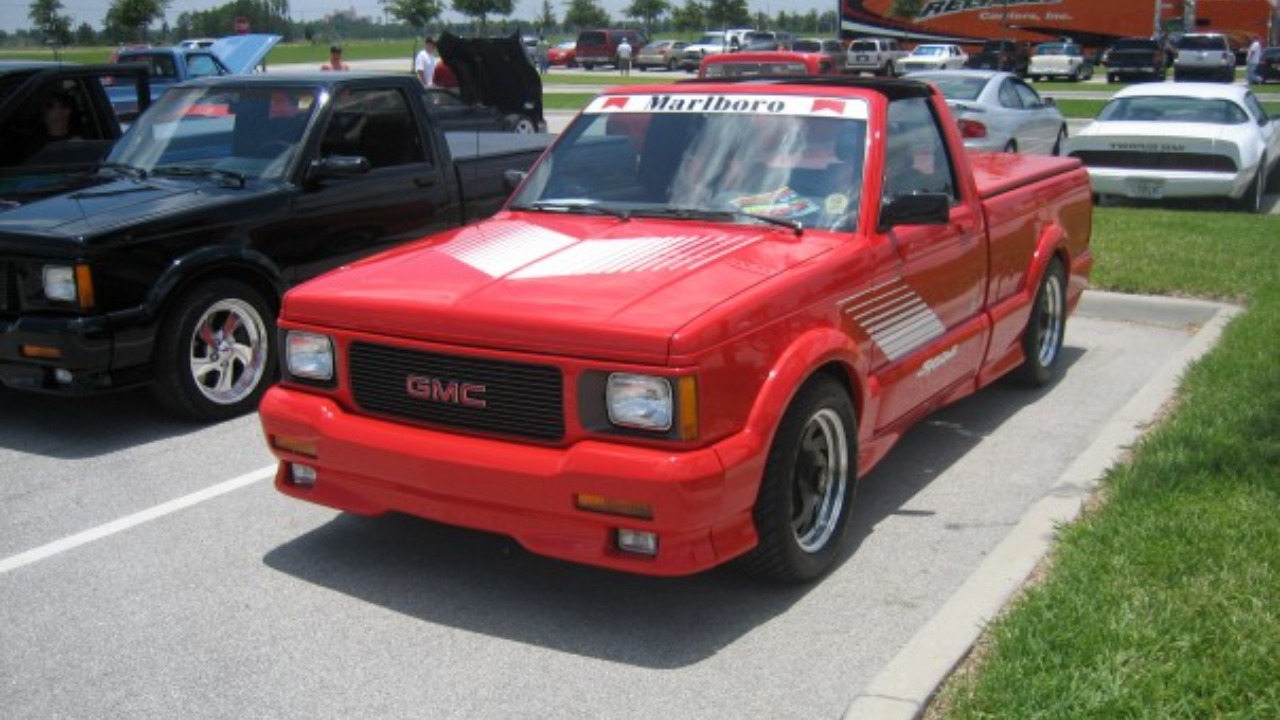
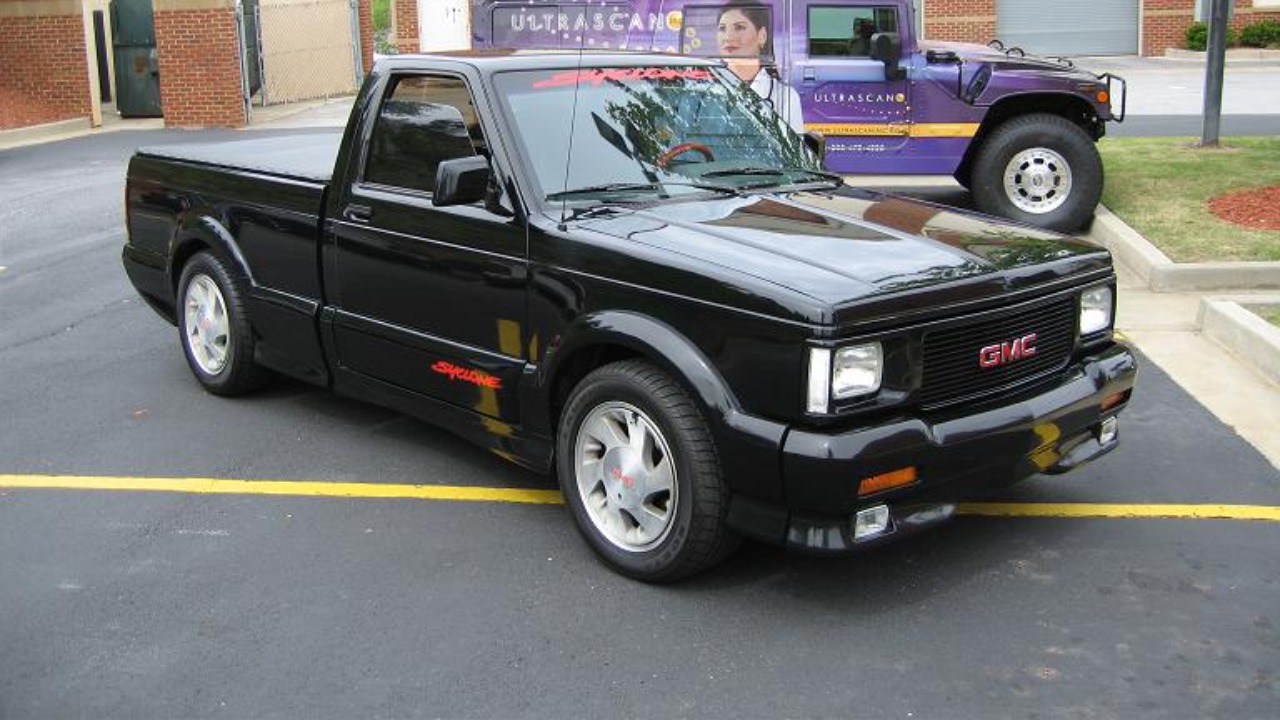
The 1991 GMC Syclone did not just nudge pickup performance forward, it detonated the curve. In an era when trucks were still expected to tow, haul, and maybe rumble a little at stoplights, this compact black missile arrived with sports-car acceleration and all-wheel-drive grip that embarrassed exotics. More than three decades later, its numbers still look audacious, and its influence still shapes how I think about fast trucks.
What fascinates me is how deliberately GMC bent the rules. By starting with a humble compact, then layering in turbo power, sophisticated driveline hardware, and sports-sedan suspension tuning, the company created a machine that forced magazines, rivals, and buyers to rethink what a pickup could be. The Syclone did not just go quicker, it rewrote the math that defined “performance” in a segment built on payload charts and tow ratings.
From work truck to weapon
On paper, the Syclone began as a simple parts-bin idea. GMC’s S-15 compact pickup was being renamed the Sonoma for 1991, but the high performance version broke away with the Syclone name and a very different mission. Engineers took the compact chassis and turned it into a short-wheelbase street fighter, with a cabin dressed in bucket seats and red piping that signaled this was no fleet special. Under the hood, they injected roughly 120 extra horses into the familiar 4.3 liter V6, then paired it with a bespoke drivetrain developed specifically for the Syclone so the truck could actually put that power down.
That transformation is even more striking when you see one in motion. In his own Jay Leno’s Garage segment, Jay Leno walks around his 1991 Cyclone, pointing out how the lowered stance, body-color cladding, and subtle badging make it look more like a stealthy sports coupe than a utility vehicle. A separate look at the 1991 GMC Syclone on GMC’s muscle truck lineage ties it directly to the later Jimmy based SUV version, the 1992–1993 GMC Typhoon, underscoring how this compact pickup became the launchpad for a whole family of factory hot rods.
The numbers that broke everyone’s brain
What really shattered expectations were the figures. Contemporary Magazines reported mid four second zero to 60 times and quarter miles in the 13s, performance that let the Syclone outrun the mighty Corvette ZR 1 and several European exotics. Later testing has echoed those results, with one modern review noting that the GMC Cyclone, that is Cyclone with an S, still sprints from naught to 60 in 4.6 seconds, a figure that keeps it in the conversation with current sports cars. Another retrospective describes how it could rocket from 0 to 60 miles per hour in only 5.3 seconds, still startling for a boxy pickup.
The weight and traction story helps explain those numbers. Detailed specs put The Syclone at 3,599 pounds, while The Typhoon weighed 3,822 pounds, a not insignificant difference that helped the pickup feel even more urgent. A deep dive into the Syclone’s sleeper status notes that this compact truck could line up against a Ferrari 348ts, an insane supercar worth six figures, and still come out ahead, with the Syclone (GMC Syclone) cemented as a What level of giant killer. When I look at those stats today, they still feel like a misprint for something that wears a bed and a tailgate.
Ferrari slayer, not farmhand
The moment that locked the Syclone into legend came when the car was pitted directly against Italian royalty. In September, Car and Driver lined up the turbo truck with a Ferrari 348 TS and its 3.4-liter V 8, and the Syclone came out on top in a drag race that instantly rewired how enthusiasts viewed pickups. Another account of that showdown notes that Part of the GMC Syclone beating a Ferrari 348 in that September 1991 issue became central to its claim to fame, a story that has been retold in every discussion of the truck since. Watching a modern Review of the GMC Syclone titled Faster Than Ferrari, I can feel how that single comparison still defines the way people talk about it.
Of course, the Syclone paid a price for that straight line focus. Its bed could barely haul 500 pounds, and its tow rating was just 2,000 pounds, according to Road & Track, numbers that would embarrass a base work truck. A Facebook clip from Donut Media, framed around how trucks are starting to get out of hand, points out that while The Lightning and the 1990 454 SS were considered Fast for their time, there was another truck from this era that simply operated on a different level. That “other truck” is the Syclone, and its willingness to sacrifice traditional utility for outrageous acceleration is exactly what made it so disruptive.
The hardware that made it possible
Underneath the marketing bravado, the Syclone’s engineering was quietly sophisticated. GMC decided to create the Syclone in the early 1990s using its Sonoma pickup as the basis, then layered on technology that had rarely been seen on a truck before, including a turbocharged V6, performance tuned suspension, and a full time all wheel drive system that turned it into a point and shoot weapon on wet pavement. One detailed look at how GMC started a performance truck revolution with the Syclone emphasizes how radical that combination was in the early 1990s, when most pickups still rode on leaf springs and open differentials. Another retrospective on the Syclone and Typhoon notes that Yet, the Syclone only came in black, Well, save for two exceptions, and that There were two special edition 1991 Syclo trucks that broke that rule, a reminder that even the paint strategy was tightly controlled to fit the sinister hardware underneath.
The chassis details show how far GMC went to make the numbers work. Bilstein gas shocks were mounted at each corner, and the truck rolled on meaty P245/50VR 16 Bilstein tuned Firestone Firehawks wrapped around turbine aluminum wheels, a setup far closer to a sports sedan than a farm rig. The drivetrain made efficient use of the turbo V6’s power with a THM 700R4 automatic that kept the engine on boost, and a Borg Warner transfer case that shuffled torque to all four wheels with minimal wheel spin, just like an Audi Quattro, as one THM and Borg focused analysis explains. Another breakdown of the truck’s specs notes that it came equipped with a BorgWarner AWD transfer case that split torque 35 percent to the front wheels and 65 percent to the rear, giving it a rear biased feel that still clawed for grip, a detail highlighted in a However thorough weekly treasure feature.
The legacy in today’s overpowered trucks
Looking back now, it is clear that the Syclone lit a fuse that is still burning. A modern overview of GMC’s factory sleepers points out that what really cemented the Syclone (GMC Syclone) as a legend was not just its 0 to 60 sprint, but the way it quietly previewed a world where trucks would be judged on lap times and launch control as much as on payload, a theme that runs through the Syclone and Typhoon story. Another historical rundown of the 1991–1993 Syclone and Typhoon notes that when the Syclone was introduced, its price tag and performance were not absurd so much as shocking, and that a period GMC ad for the truck leaned into that shock value, a detail captured in a broader Yet and Well annotated history.
When I watch a modern video that opens by declaring there has never been, nor will there ever be, another pickup this good looking, then calls it this good, I am reminded how much of the Syclone’s appeal is emotional as well as numerical, a sentiment captured in a Sep walkaround that still gushes over its stance. Another recent clip titled The 1991 GMC Syclone is a 90’s American Legend, Quickest, underlines that this is the GMC Cyclone that still feels every bit as wild today, reinforcing how the truck’s blend of stealth styling and brutal acceleration has aged into cult status. When I line up all of those perspectives, from period tests to modern nostalgia, the pattern is clear: the Syclone did not just go fast for a truck, it changed what fast meant in the truck world, and we are still living with the consequences every time a new performance pickup hits the showroom.
More from Fast Lane Only: