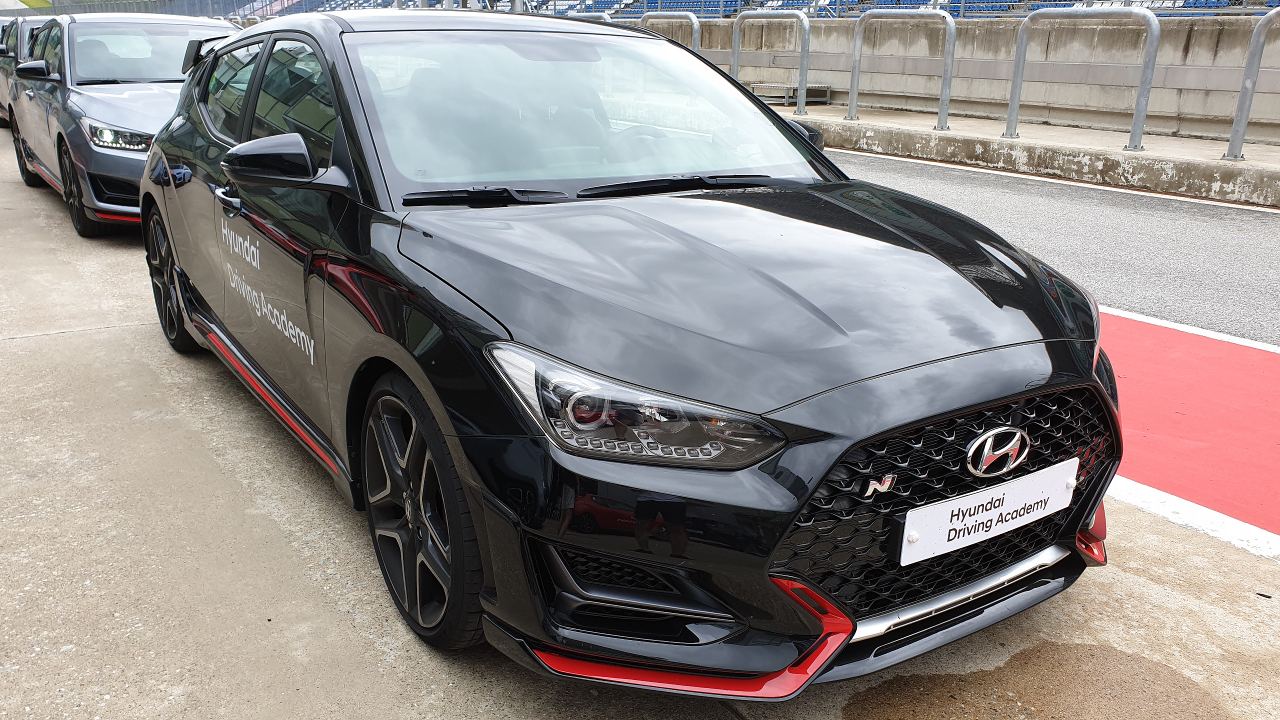
The 2019 Hyundai Veloster N arrived as a compact hatchback with outsized expectations riding on its shoulders. Hyundai had spent decades building a reputation on value and long warranties, not on lap times or exhaust crackles, yet this car was tasked with convincing skeptical enthusiasts that the brand could build a serious performance machine. By combining track-ready hardware, motorsport visibility, and a surprisingly aggressive attitude toward established rivals, the Veloster N reshaped how I, and many others, talked about Hyundai.
From bargain brand to performance contender
Hyundai’s journey to the Veloster N started long before the first car hit U.S. showrooms. When Hyundai first entered the U.S. market in the early 1990s, it leaned heavily on low prices and generous equipment, a strategy that cemented the company as a value player rather than a performance leader. Over the following decades, Hyundai methodically added “building blocks” such as better powertrains, improved chassis tuning, and more refined interiors, laying the groundwork for a future in which a hot hatch could credibly wear its badge. Reports on the brand’s early U.S. presence describe this evolution as a steady progression rather than a sudden pivot, which made the arrival of a dedicated performance division feel like a logical next step rather than a gimmick.
The creation of Hyundai’s N division formalized that ambition. Hyundai inaugurated its own performance arm with a clear mandate to develop high-performance vehicles that could be engineered and proven on demanding circuits such as the Nürburgring. Internal voices described the Veloster N as the first N-branded performance product for the U.S., a capstone to nearly 30 years of incremental improvement. By the time the Veloster N was announced, Hyundai N engineers had already been testing a newly developed 2.0‑liter turbocharged inline‑4 and refining it for front‑wheel‑drive duty, signaling that this was not a lightly warmed-over commuter but a ground-up effort to compete with established hot hatches.
The hardware that made skeptics pay attention
The Veloster N’s spec sheet was the first sign that Hyundai was serious about changing minds. Powering the front wheels was Hyundai N’s newly developed 2.0‑liter turbocharged inline‑4, tuned to deliver strong output and paired with a chassis set up for enthusiastic driving rather than comfort alone. Early drives highlighted how the engine’s torque, quoted at 260 lb‑ft in some evaluations, combined with a limited-slip differential and performance tires to give the car real pace on both road and track. Reviewers who had long associated the brand with economy cars suddenly found themselves talking about steering feel, brake consistency, and corner exit traction in a Hyundai, a shift that would have been hard to imagine in the company’s early U.S. years.
Pricing strategy reinforced that message. Hyundai representatives indicated that the base price for the 2019 Hyundai Veloster N hatchback would land in the mid‑$20,000 range, with exact figures initially held back but clearly positioned below many European rivals. That placed the car squarely in reach of younger enthusiasts while still offering serious performance hardware, including adaptive suspension and robust brakes. By undercutting competitors on price while matching them on capability, Hyundai reframed the conversation: the Veloster N was no longer just a “good for the money” option, it was a car that could be chosen on merit even if budgets allowed for more expensive badges.
Motorsport as a credibility shortcut

Hyundai did not rely on road tests alone to validate its new performance identity. The company moved quickly to put the Veloster N into organized racing, a decision that gave the car instant credibility among enthusiasts who judge brands by their presence on the grid. Bryan Herta Autosport committed to race the new Veloster N in the IMSA MICHELIN Pilot Challenge series, integrating the hatchback into a competitive environment where reliability, speed, and engineering support are tested in public. That program built on Hyundai Motor America’s decision to add the Veloster N TCR to its customer motorsports lineup, again operated by Bryan Herta Autosport, which already had a championship-winning record.
Those racing efforts did more than generate highlight reels. They created a feedback loop between track and showroom, reinforcing the idea that the Veloster N’s aggressive styling and exhaust note were backed by genuine engineering depth. When a car competes in categories like TCR and the IMSA MICHELIN Pilot Challenge, fans see the same basic shape and nameplate that sits in dealerships, which subtly elevates the road car’s status. For a brand that had historically been absent from high-profile performance series, the sight of a Veloster on a starting grid signaled that Hyundai was willing to be judged by the same standards as long-established European and Japanese rivals.
A hot hatch that picked fights with the establishment
The Veloster N did not just show up to the hot hatch party, it arrived ready to challenge the segment’s icons. Commentary around the car’s launch highlighted how Hyundai’s performance leadership openly compared the Veloster N to the Volkswagen GTI, long considered the benchmark in this class. In the process of praising the new Hyundai, one executive took aim at the Volkswagen GTI, sparking what was described as a war of words between the two brands. That rhetorical aggression was significant, because it signaled that Hyundai no longer saw itself as a junior player politely asking for attention, but as a competitor confident enough to call out the category leader by name.
Independent recognition quickly backed up that bravado. The Veloster N earned a prestigious 2020 Performance Car of the Year award from a major enthusiast outlet, with Hyundai’s N product development leadership publicly expressing pride in the honor. The award specifically cited the Veloster’s driving character and value, reinforcing the idea that Hyundai had built a car capable of impressing some of the toughest critics in the business. Around the same time, the brand continued to experiment with even more extreme versions, including an even harder-cored Veloster N concept shown at SEMA, which underscored Hyundai’s willingness to push the platform further for track-focused customers. Together, the accolades and the show cars helped cement the Veloster N as a legitimate member of the hot hatch elite rather than a one-off curiosity.
Short life, long shadow
Despite its impact on brand perception, the Veloster N’s time in showrooms was relatively brief. By the start of 2022, the broader Veloster lineup had been discontinued in the USA, leaving only the N model on sale. Reports from enthusiast communities noted that Hyundai killed all Veloster models except for N for the 2022 model year, a decision that effectively turned the car into a niche performance offering rather than a volume seller. Eventually, even that final variant disappeared, with the Veloster nameplate phased out entirely as Hyundai shifted its focus to other segments and new performance products.
Hyundai attributed the Veloster’s phase-out to declining sales and the rise of other performance-centric models, particularly electrified vehicles. The company’s multi-award-winning Ioniq 5N has since become a new performance flagship, prompting speculation about future electric rivals from brands like Volkswagen and whether an electric Golf R could challenge Hyundai’s latest weapon. In that context, the Veloster N looks like a crucial stepping stone: a car that proved Hyundai could build a credible hot hatch, win on track, and earn the respect of enthusiasts, even if the specific model did not survive. Its short production run did not erase its influence, which can be seen in the confidence with which Hyundai now develops and markets high-performance vehicles across both combustion and electric platforms.
More from Fast Lane Only: