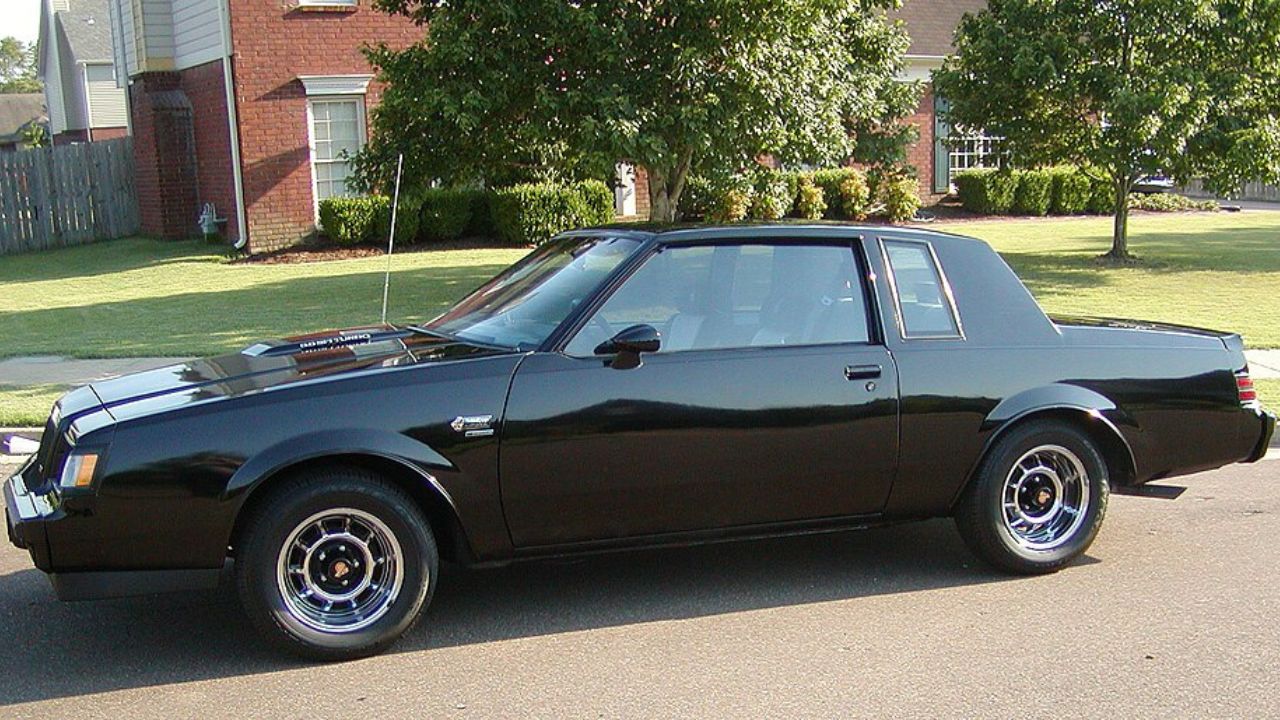
The Buick Grand National was never supposed to be a muscle car icon. Built during an era when American performance was supposedly fading, it arrived in dark, understated form and quietly rewrote expectations for what a turbocharged V6 sedan could do. Decades later, the Buick Grand National has shifted from overlooked oddball to one of the most aggressively rising collector cars in the modern market.
What happened
In the mid-1980s, Buick took an unusual approach to performance. Instead of relying on big-displacement V8 power like traditional muscle cars, engineers refined a turbocharged 3.8-liter V6 platform that could deliver surprising output while meeting tightening emissions standards.
By the time the Grand National reached its final and most iconic form in 1986–1987, the formula had become clear: boost, torque, and stealth. Officially rated at around 235 horsepower in its peak factory tune, the car’s real-world performance often felt stronger thanks to conservative factory ratings and abundant low-end torque from the turbocharged setup.
The design matched the personality. No bright trim, no chrome flash, no exaggerated styling—just an all-black coupe that looked more like a government fleet car than a street performance machine. That intentional anonymity became part of its identity.
In period testing, the Grand National shocked competitors. Against V8-powered muscle cars of the era, it delivered rapid acceleration and strong mid-range pull, often outperforming heavier rivals in real-world conditions. The later Buick GNX pushed the concept even further, turning the platform into one of the fastest American production cars of its decade.
At the time, however, the Grand National did not immediately become a collector darling. The 1980s performance market was still rebuilding its identity, and many buyers prioritized V8 displacement and traditional muscle car heritage. As a result, the Grand National remained somewhat underappreciated compared to earlier classics.
Why it matters
The current surge in collector demand is driven by a combination of nostalgia, rarity, and changing performance values.
First, the Grand National represents a turning point in American engineering philosophy. It proved that turbocharging could compete directly with large-displacement V8 engines. Today, when turbocharged performance dominates nearly every segment, the Grand National feels like an early blueprint for modern powertrains.
Second, its rarity has become more important over time. Production numbers were relatively low, and many surviving cars were driven hard, modified, or neglected during years when they were still inexpensive used vehicles. Clean, unmodified examples are increasingly scarce, especially GNX models, which were produced in extremely limited numbers.
Third, the cultural perception of the car has flipped. Once seen as a “mid-80s curiosity,” it is now viewed as one of the last true analog turbo performance cars. Enthusiasts increasingly appreciate its simplicity: rear-wheel drive, no modern electronic intervention, and a power delivery that feels raw compared to today’s heavily managed turbo systems.
The rise of turbocharged performance across modern platforms has also helped reframe the Grand National’s importance. Cars like today’s high-performance sedans and sports coupes owe part of their performance philosophy to early experiments like the Grand National, where boost became a primary performance tool rather than a niche technology.
What to watch next
Market trends show the Buick Grand National continuing to separate from other 1980s performance cars. While many vehicles from the era remain relatively affordable, the Grand National is increasingly treated as a blue-chip collectible, especially low-mile, original examples.
Condition is now the biggest factor driving value. Modified cars—once the norm—are less desirable to collectors focused on originality. Factory-correct paint, interiors, and drivetrain components significantly affect pricing, and documentation is becoming just as important as mechanical condition.
The Buick GNX sits at the top of the hierarchy, often commanding premium prices due to its extremely limited production and factory-enhanced performance package. These cars are increasingly treated as museum-level pieces rather than driving machines.
Looking ahead, the Grand National’s trajectory appears closely tied to the broader appreciation of 1980s performance cars. As enthusiasts seek vehicles that still feel mechanical, simple, and turbocharged without modern electronic filters, the Grand National stands out as one of the defining examples.
What once looked like a dark, understated coupe from an uncertain performance era has become something very different: one of the most respected and aggressively sought-after American performance cars of its decade.
More from Fast Lane Only