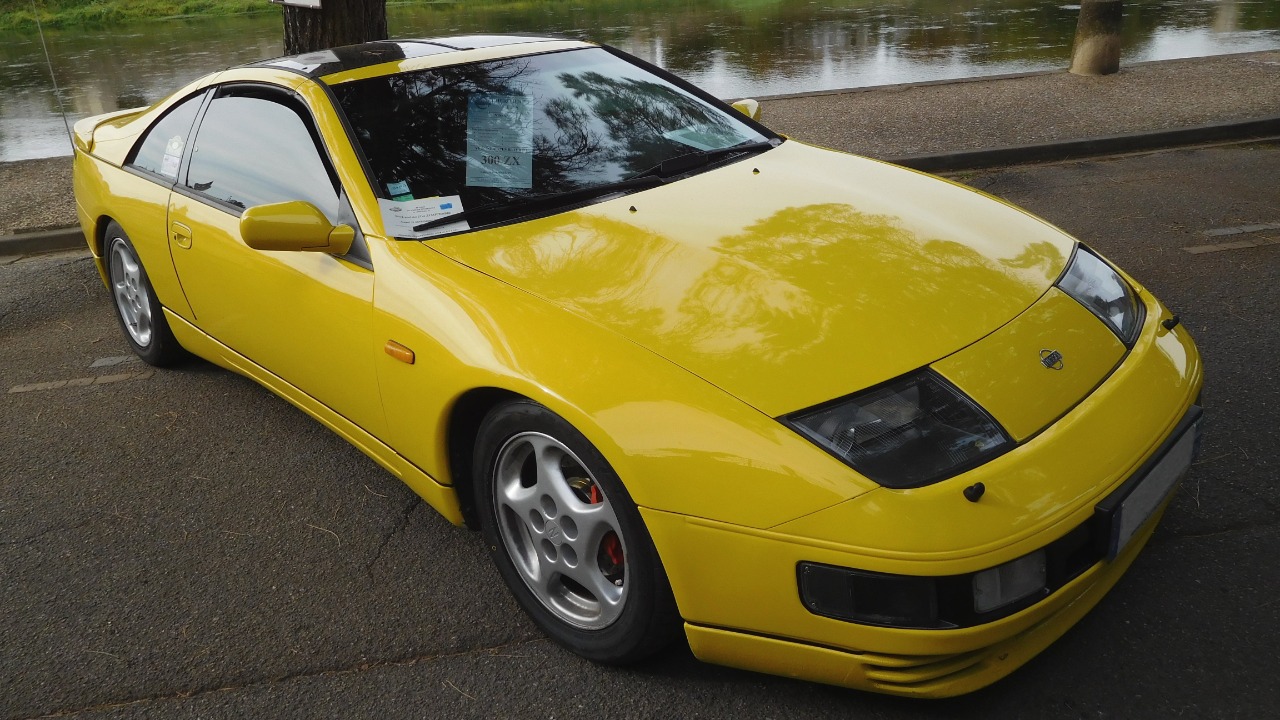
The Nissan 300ZX Twin Turbo didn’t just represent Japan’s performance ambition in the 1990s—it helped define it. At a time when sports cars were transitioning toward digital controls and refined grand touring behavior, Nissan delivered a machine that blended cutting-edge engineering with serious straight-line speed. Decades later, the Nissan 300ZX remains one of the most recognizable icons of the era.
What happened
When Nissan introduced the Z32-generation 300ZX in the late 1980s, it marked a dramatic leap from its predecessor. The new platform was lower, wider, and significantly more advanced, built around a 3.0-liter V6 that came in naturally aspirated and twin-turbocharged forms.
The standout model was the Nissan 300ZX Twin Turbo, which used parallel turbochargers to deliver strong mid-range torque and high-end power in a relatively compact package. In factory specification, it produced around 300 horsepower in later revisions, a figure that placed it firmly in competition with European sports cars of the time.
What made the 300ZX especially notable was its engineering complexity. It featured multi-link suspension front and rear, available four-wheel steering (HICAS), and a driver-focused cockpit with a digital instrument cluster in many trims. This was Nissan’s attempt to combine performance with technological sophistication in a way that few rivals matched at the time.
On the road, the car delivered a unique driving experience. Turbo boost arrived smoothly rather than abruptly, giving the engine a strong but controlled surge of acceleration. Unlike more raw turbocharged cars of the era, the 300ZX felt stable at speed and capable of long-distance cruising, positioning it between a sports car and a grand tourer.
Period comparisons often placed it against vehicles like the Porsche 968 and early Chevrolet Corvette C4 models. In many performance metrics, the 300ZX Twin Turbo held its own, especially in acceleration and high-speed stability, which helped solidify its reputation as a serious global performance contender.
Why it matters
The 300ZX Twin Turbo became iconic because it captured a rare balance: advanced technology without losing performance character. In the early 1990s, many sports cars were either raw and analog or comfortable and refined. The 300ZX managed to be both.
It also represented the peak of Japan’s early-1990s performance engineering confidence. Alongside other legendary models like the Toyota Supra Mark IV and Mazda RX-7, the 300ZX showed that Japanese automakers could compete directly with Europe’s established performance brands using turbocharging, advanced suspension systems, and aerodynamic design.
The styling played a major role in its appeal. The Z32’s smooth, low-slung body with hidden headlights and sculpted fenders gave it a futuristic appearance that still feels distinctive today. It didn’t rely on aggressive angles or oversized wings; instead, it used proportion and surface design to communicate speed.
Its reputation was also shaped by tuning culture. The twin-turbo VG30DETT engine responded well to modifications, making it a favorite among enthusiasts who wanted to extract more power through boost upgrades, exhaust changes, and ECU tuning. This flexibility helped extend the car’s relevance long after its showroom life ended.
Over time, the 300ZX became more than just a sports car—it became a symbol of a specific moment in automotive history when manufacturers were pushing the boundaries of what internal combustion engines could achieve before stricter regulations and heavier platforms reshaped the industry.
What to watch next
Today, the Nissan 300ZX Twin Turbo is firmly established as a collectible performance car. Interest has increased steadily as enthusiasts revisit 1990s Japanese performance icons, especially models that still offer analog driving characteristics compared to modern vehicles.
Condition and originality are now key drivers of value. Unmodified examples with intact twin-turbo systems, clean interiors, and documented maintenance histories are increasingly rare. Many surviving cars were heavily modified during the tuner boom of the late 1990s and early 2000s, which reduces the number of factory-correct examples.
The broader Z32 platform continues to benefit from its dual identity: a comfortable grand tourer and a capable performance machine. This versatility makes it appealing not only to collectors but also to drivers who still want to experience a 1990s turbocharged sports car in usable form.
Looking forward, the 300ZX Twin Turbo’s legacy is likely to strengthen as modern sports cars become more complex and electronically mediated. The Z32 stands as a reminder of a transitional era—when turbocharging, digital instrumentation, and aerodynamic design were converging, but driving was still fundamentally mechanical.
For enthusiasts, that combination is exactly why the 300ZX remains an icon: it delivers performance with personality, technology with character, and speed with a distinctly 1990s identity that cannot be easily replicated today.
More from Fast Lane Only