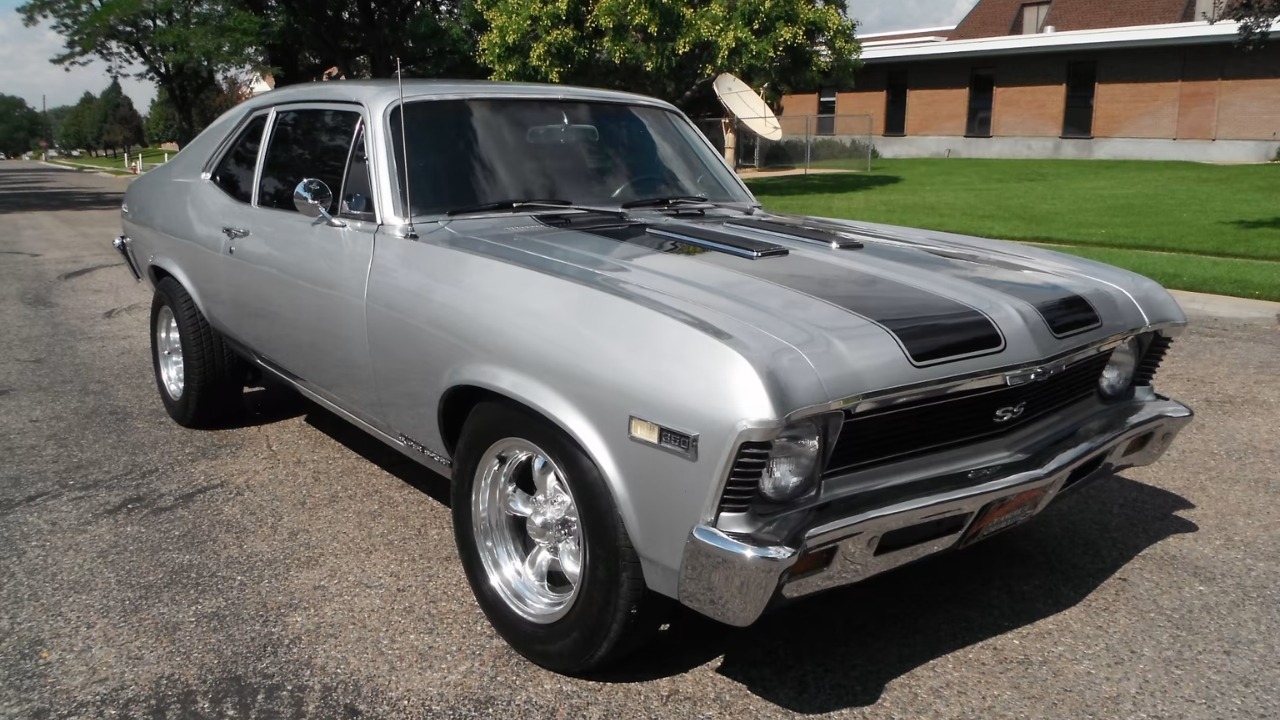
The 1968 Chevrolet Nova SS earned a reputation that far exceeded its compact size, turning an unassuming economy platform into one of Detroit’s most respected sleeper performance cars. It blended lightweight engineering with serious V8 power, creating a formula that still attracts muscle car collectors and street racing enthusiasts today.
From Economy Compact to Street-Ready Muscle Machine
At first glance, the 1968 Chevrolet Nova SS looked like a modest compact built for practicality rather than performance. But under the surface, it carried one of the most effective transformations of the muscle car era. Chevrolet took a simple rear-wheel-drive platform and turned it into a lightweight performance weapon that could embarrass much larger cars of its time.
The appeal begins with its proportions. The Nova was small, low, and relatively simple compared to full-size muscle cars, which immediately gave it an advantage in weight distribution and agility. When equipped as the Super Sport variant, the Chevrolet Nova SS (1968) became something very different from its economy-car roots—it became a factory-built sleeper with real street credibility.
This transformation reflected a broader Chevrolet philosophy during the late 1960s: performance did not always require size. Sometimes, the most dangerous car on the road was the one nobody expected to be fast.
The Small-Block Formula That Changed Everything
The foundation of the Nova SS’s reputation came from its engine choices. While base models used modest inline-sixes or small V8s, the SS package opened the door to serious small-block and big-block Chevrolet engines. This flexibility is what made the car such a standout in its segment.
In lighter configurations, the Nova SS used small-block V8s that delivered strong acceleration without overwhelming the chassis. But the real legend came when buyers ordered the available big-block option, including the infamous 396 cubic-inch engine. In that configuration, the Nova SS stopped being a compact cruiser and became a straight-line performance threat.
What made this combination so effective was not just raw horsepower—it was the weight-to-power ratio. The Nova SS was significantly lighter than many of its muscle car rivals, meaning even modest horsepower figures translated into explosive real-world acceleration. On street tires, it felt sharper, quicker, and more immediate than many larger, heavier performance coupes.
This is where the Nova SS built its identity: not as the most powerful car, but as one of the most efficient at turning power into motion.
The Sleeper Effect: Why Underestimation Became Its Strength
One of the defining characteristics of the Nova SS was its ability to surprise people. Unlike flashy muscle cars with aggressive styling cues, the Nova retained a relatively conservative appearance. It did not always announce its performance potential visually, which created what enthusiasts call the “sleeper effect.”
This meant that drivers often underestimated it at stoplights or on the street. That underestimation became part of its legend. When the throttle opened and the car surged forward, it created a psychological impact that more obvious performance cars could not replicate.
In modern collector culture, this trait has become even more valuable. The idea of a factory-built sleeper is rare today, where most performance cars are visually aggressive and highly styled. The Nova SS represents a different philosophy—one where speed was hidden beneath simplicity.
This understated personality is a key reason why the 1968 Chevrolet Nova SS still has a loyal following among enthusiasts who value subtlety over spectacle.
Lightweight Engineering and Real-World Performance
Another major factor behind the Nova SS’s enduring popularity is its lightweight construction. Compared to full-size muscle cars of the same era, the Nova was significantly lighter, which improved every aspect of performance—from acceleration to braking and cornering.
This gave it an advantage not only in straight-line speed but also in real-world driving conditions. While many muscle cars of the late 1960s were built primarily for drag strip performance, the Nova SS felt more balanced on everyday roads.
Drivers often describe the car as “tight” and responsive for its era. Steering feedback was direct, and the chassis responded predictably under load. It was not a modern sports car by any means, but compared to heavier contemporaries, it felt surprisingly agile.
This balance is what helped it stand out. It was not just fast in a straight line—it was usable, predictable, and enjoyable in a wider range of driving conditions than many competitors.
The Big-Block Era and Its Cultural Impact
The introduction of big-block options elevated the Nova SS from a quick compact into a serious performance contender. With engines like the 396 V8, the car entered the same conversation as larger muscle cars from Pontiac, Dodge, and Ford.
This era was defined by escalation. Manufacturers were constantly increasing displacement and horsepower figures, and the Nova SS became one of the most efficient participants in that race. It did not rely on sheer size to compete—it relied on packaging efficiency.
This is also where the Nova SS began to build its cultural identity. Street racing culture in the late 1960s and early 1970s embraced cars that could outperform expectations. The Nova SS fit perfectly into that environment, where reputation mattered as much as specification sheets.
Over time, stories of small Novas outperforming larger muscle cars became part of its mythology. Whether fully accurate or exaggerated through enthusiast culture, those stories helped cement its status as a respected underdog.
The Nova SS in Modern Collector Culture
Today, the 1968 Chevrolet Nova SS occupies a unique space in the collector market. It is not as expensive as ultra-rare muscle cars, but it commands strong respect among enthusiasts who understand its engineering philosophy.
Collectors value originality, especially unmodified examples with factory big-block configurations. The simplicity of the platform also makes it attractive for restoration and preservation, since it does not rely on overly complex systems compared to later performance vehicles.
In modern terms, the Nova SS is often described as an “entry-level classic muscle car,” but that label undersells its importance. It represents a turning point in Chevrolet’s performance strategy, where compact cars were no longer limited to economy roles.
For many collectors, owning a Nova SS is less about status and more about connection to a specific era of automotive thinking—one where innovation was measured in weight reduction, engine swaps, and mechanical simplicity.
Why the Legacy Still Holds Strong Today
The lasting appeal of the 1968 Chevrolet Nova SS comes down to a combination of factors that are increasingly rare in modern performance cars. It is lightweight, mechanically straightforward, visually understated, and capable of serious performance when properly equipped.
In a modern automotive landscape dominated by digital systems and heavily regulated power delivery, the Nova SS feels refreshingly direct. It represents a time when driving skill mattered more than software calibration, and when performance could be achieved through engineering simplicity rather than complexity.
The Chevrolet Nova SS (1968) continues to attract new generations of enthusiasts for exactly that reason. It is not just a classic—it is a reminder that performance does not always need to be loud, heavy, or complicated.
Instead, it can be light, simple, and unexpectedly fast.
More from Fast Lane Only
- Unboxing the WWII Jeep in a Crate
- 15 rare Chevys collectors are quietly buying
- 10 underrated V8s still worth hunting down
- Police notice this before you even roll window down
*Research for this article included AI assistance, with all final content reviewed by human editors