The 1969 Cadillac Sedan DeVille arrived at the height of Detroit’s confidence, when American luxury meant size, silence, and a V8 that could move a small apartment building. It was not just a comfortable car; it was a rolling statement about status, technology, and what success looked like on U.S. roads at the end of the 1960s. More than half a century later, that model year still captures a moment when Cadillac set the tone for how a premium sedan should feel, sound, and even behave in traffic.
From today’s era of downsized engines and minimalist cabins, the 1969 DeVille can seem almost surreal. Yet its long hood, formal roofline, and indulgent interior help explain why the nameplate became shorthand for American opulence, and why collectors still treat late‑sixties Cadillacs as the benchmark for traditional full‑size luxury.
A Turning Point in Cadillac’s Flagship Line
By 1969, Cadillac had spent decades building its identity around big, powerful, rear‑wheel‑drive sedans with generous chrome and intricate interiors. The Sedan DeVille occupied the sweet spot of that lineup, positioned below the Fleetwood Brougham but above more modest domestic sedans that shared its basic footprint. It delivered nearly Fleetwood levels of comfort without the chauffeur connotations, making it a favorite for self‑driven executives and affluent families.
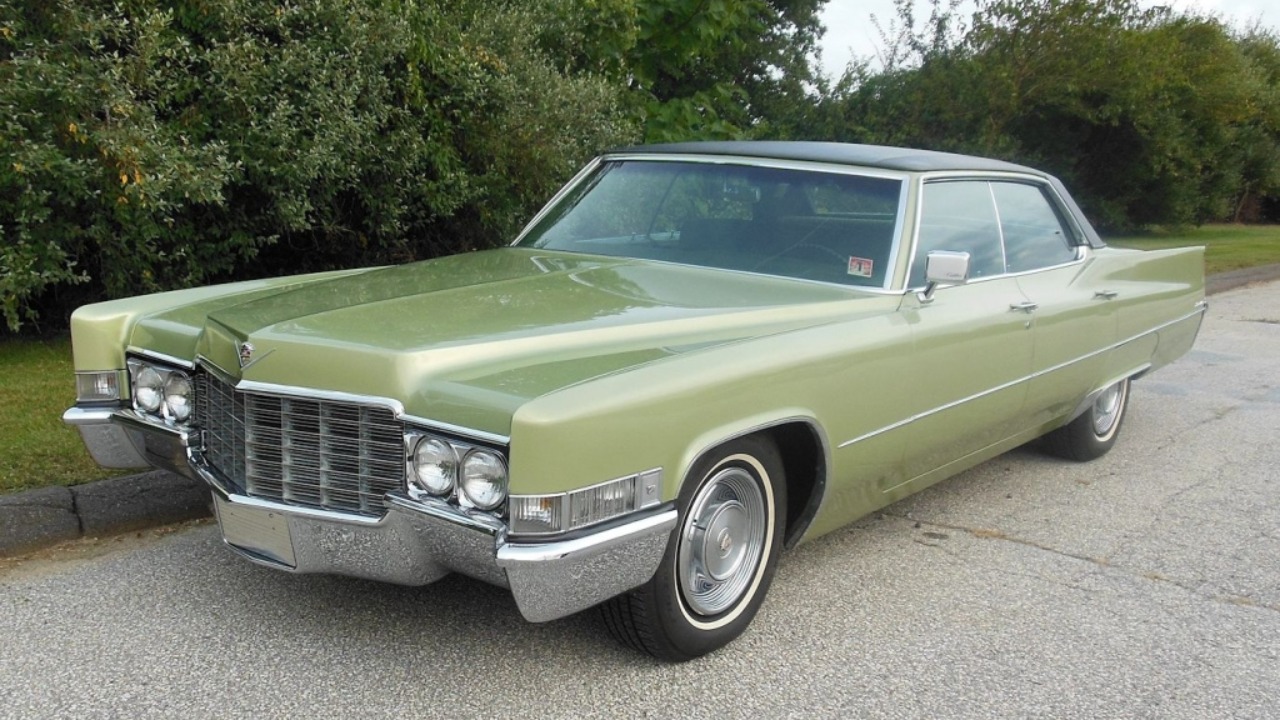
This model sat on a vast wheelbase and stretched well over 18 feet, with slab sides that emphasized its length rather than hiding it. Cadillac designers had already begun moving away from the wildest tailfins of the late 1950s, yet the car still carried vertical lamps and crisp body creases that tied it to the brand’s flamboyant past. The proportions were calculated to project authority in a parking lot or in a rearview mirror, and they did so with ease.
Under the hood, the DeVille relied on a massive V8, an approach that defined American luxury in that era. Big‑block engines with abundant torque allowed manufacturers to promise effortless passing power and near‑silent highway cruising, a formula that helped create a long list of large V8 luxury sedans across several brands. Cadillac’s execution stood out because it paired that mechanical excess with a carefully tuned suspension and thick sound insulation, so the driver felt only a distant murmur from the powertrain even when the car was working hard.
Design Language That Broadcast Status
The exterior of the 1969 Sedan DeVille leaned into visual cues that American buyers associated with prestige. A long, nearly level hood led into a formal roofline, with a decklid that ended abruptly rather than tapering into fins. The look suggested a tailored suit rather than a costume, which made sense in a decade when Cadillac wanted to keep its flamboyant reputation but also compete for more conservative buyers who might otherwise consider European sedans.
Brightwork framed the windows and rocker panels, and the grille carried a pattern that read as jewelry from a distance. The front bumper wrapped around the corners, integrating the headlamps into a single horizontal band. This gave the DeVille a wide, planted stance that visually separated it from smaller domestic models that shared some body dimensions but not the same presence.
Inside, the cabin doubled down on that message. Bench seats were broad and deeply cushioned, often trimmed in soft leather or high‑grade cloth, and the dashboard featured chrome‑accented controls that felt substantial to the touch. Cadillac had spent years refining this formula, and later cars such as the 1978 Sedan DeVille d’Elegance would continue the pattern of plush seats, thick carpets, and quiet operation that enthusiasts still describe as true classic comfort. The 1969 model helped lock in that template.
Details mattered. Door panels carried wood‑tone inlays, armrests were wide enough to feel like furniture, and the steering wheel rim was thick for the time. Even the trunk was trimmed and finished to a standard that many mainstream sedans did not attempt. The message was consistent: every surface a passenger touched should feel more expensive than what they had at home.
Technology as a Luxury Feature
Luxury in 1969 was not only about materials. It also meant access to features that most drivers had never seen. The Sedan DeVille offered power windows, power seats, automatic climate control, and a stereo system that could fill the vast cabin with sound. For many buyers, this was their first experience with a car that could adjust its own temperature or move the seat at the touch of a switch.
Cadillac used this equipment to reinforce the idea that its cars were more advanced than domestic rivals. The automatic transmission shifted with minimal drama, and the power steering required only fingertip effort, which made the large sedan feel manageable even in tight parking lots. The DeVille also prioritized ride quality, with a suspension tuned to glide over broken pavement and isolate occupants from vibration.
This approach contrasted sharply with European luxury brands, which tended to emphasize firm handling and high‑speed stability. In the United States, the ability to float over long stretches of interstate mattered more than carving mountain passes. The 1969 DeVille delivered on that expectation, and in doing so, it defined what many Americans came to expect from a premium sedan for decades.
Part of a Larger Cadillac Story
The 1969 Sedan DeVille did not exist in isolation. It was one chapter in a long narrative that stretched from the extravagant fins of the late 1950s to the more squared‑off designs of the late 1970s. Earlier cars such as the 1959 Coupe DeVille, famous for its towering tailfins and jet‑age styling, had already cemented Cadillac’s reputation as a symbol of success. Enthusiasts still celebrate the way a well‑preserved 1959 example can emerge from decades of storage and immediately stand out as a piece of rolling sculpture, as seen when a California owner uncovered a pristine Coupe DeVille after twenty years in hiding.
By 1969, Cadillac had toned down the visual drama but retained the sense of occasion. The Sedan DeVille represented a mature phase of the brand’s identity, where engineering refinement and interior comfort carried as much weight as exterior flair. Buyers who wanted the wildest styling could still find it in older models, while those who valued quiet authority gravitated toward the latest DeVille.
As the 1970s progressed, Cadillac would continue to evolve the formula with models that kept the full‑size footprint but added new trim levels and even more elaborate interiors. The continuity between these cars matters, because it shows how the 1969 model sat at a pivot point: modern enough to feel current in its time, yet traditional enough to satisfy customers who had grown up admiring the fins and chrome of the previous decade.
The Cadillac versus Lincoln Battle
Any discussion of late‑sixties American luxury has to acknowledge the rivalry between Cadillac and Lincoln. Both brands aimed at the same affluent buyers, and both used large, rear‑wheel‑drive sedans to project prestige. The contest was as much about image as it was about engineering, and each company watched the other’s product planning closely.
Lincoln’s Continental offered its own version of full‑size comfort, with slab‑sided styling and a reputation for quiet cruising. Yet Cadillac often enjoyed higher sales and a stronger association with success, in part because the DeVille line gave buyers a clear step into the brand without forcing them into a limousine‑like flagship. Analysts who have examined the Cadillac versus Lincoln rivalry point to brand perception as a key factor, and the 1969 Sedan DeVille played a central role in that perception by serving as the aspirational car that many Americans saw in their neighborhoods and on television.
The DeVille’s balance of size, comfort, and price made it a more approachable dream than the rarefied Fleetwood or the chauffeur‑oriented limousines. It allowed Cadillac to dominate the visible middle of the luxury market, which in turn reinforced the idea that Cadillac defined the segment and others responded to it.
Why the 1969 DeVille Still Resonates
Modern collectors and enthusiasts often single out the late‑sixties DeVilles as some of the most satisfying classic Cadillacs to own and drive. They combine the drama of big‑car proportions with more refined road manners than earlier fin‑era models, and they benefit from parts availability that reflects Cadillac’s high production volumes at the time.
There is also a cultural dimension. The 1969 Sedan DeVille appears in period photographs, films, and advertising that depict corporate success, suburban growth, and the rise of the American highway vacation. Families loaded these cars with luggage and drove across multiple states without worrying about comfort. That image of the car as a rolling living room has become part of its legend.
From a design perspective, the car captures a moment just before federal regulations and fuel crises began to reshape the industry. Bumpers had not yet grown into massive safety beams, and engines had not yet been detuned to meet emissions standards at the expense of power. The 1969 DeVille therefore represents a kind of peak for traditional American luxury: large, powerful, quiet, and unapologetically focused on comfort.
Influence on Later Luxury Sedans
The template that Cadillac refined with the 1969 Sedan DeVille influenced not only its own future products but also how other manufacturers approached the idea of a flagship sedan. The emphasis on isolation, power, and interior space carried into the 1970s and 1980s, even as cars gradually shrank in response to fuel prices and regulatory pressure.
Other American brands adopted similar strategies, offering big V8s, soft suspensions, and plush cabins in their top models. Some of these later cars would eventually become known as affordable luxury classics, accessible to enthusiasts who wanted the feel of an old‑school premium sedan without paying top‑tier collector prices. The 1969 DeVille stands near the top of that pyramid, both because of its historical timing and because it embodies the traits that made those later cars appealing.
Even as European and Japanese brands gained ground with more compact, performance‑oriented luxury sedans, the memory of the DeVille’s comfort and presence lingered. Many American buyers continued to judge ride quality and cabin quietness against the standard that Cadillac had set, which helped keep those priorities alive in the domestic market.
Survivors, Restorations, and the Collector Market
Surviving examples of the 1969 Sedan DeVille now occupy an interesting niche. They are old enough to qualify as true classics, yet new enough to offer highway performance and braking that does not feel entirely out of step with modern traffic. Restorers appreciate the car’s body‑on‑frame construction and relatively straightforward mechanical layout, which make major repairs more approachable than on some unibody contemporaries.
Well‑preserved cars often attract attention at local shows, where their sheer size and presence set them apart from smaller coupes and sports cars. Owners frequently emphasize the reaction from passengers who experience the DeVille’s interior for the first time, especially younger riders who have grown up with compact crossovers and minimalist dashboards.
More from Fast Lane Only
- Unboxing the WWII Jeep in a Crate
- 15 rare Chevys collectors are quietly buying
- 10 underrated V8s still worth hunting down
- Police notice this before you even roll window down
*Research for this article included AI assistance, with all final content reviewed by human editors.