The 1956 Ford Thunderbird arrived at a moment when American drivers wanted sports car flair without giving up comfort, and it delivered a rare mix of style, performance, and everyday usability. With its reshaped tail, removable hardtop, and upgraded V8 options, the second-year Thunderbird sharpened the original formula into a more mature personal car. Nearly seventy years later, it still represents a turning point when Detroit proved that a glamorous two-seater could also be practical and refined.
From Two-Seater Experiment to Refined Personal Car
Ford launched the Thunderbird in the mid 1950s as a stylish two-seat response to European-inspired sports cars, but the company never intended it to be a stripped, track-focused machine. The model was conceived instead as a personal luxury car, with V8 power, an automatic transmission option, and comfort features that appealed to buyers who wanted speed and style without sacrificing convenience. The 1956 model year built on that idea, adjusting the original design to improve both performance and usability.
The broader Thunderbird line quickly grew into a long-running series that stretched across multiple generations, body styles, and mechanical layouts. Over time, the badge covered everything from early two-seat roadsters to larger four-seat cruisers and later retro-themed coupes, a history that can be traced through detailed model breakdowns of the Ford Thunderbird. Within that long story, the 1956 car stands out as the moment when Ford refined the first-generation concept before radically changing direction the following year.
Design Tweaks That Changed the Car’s Character
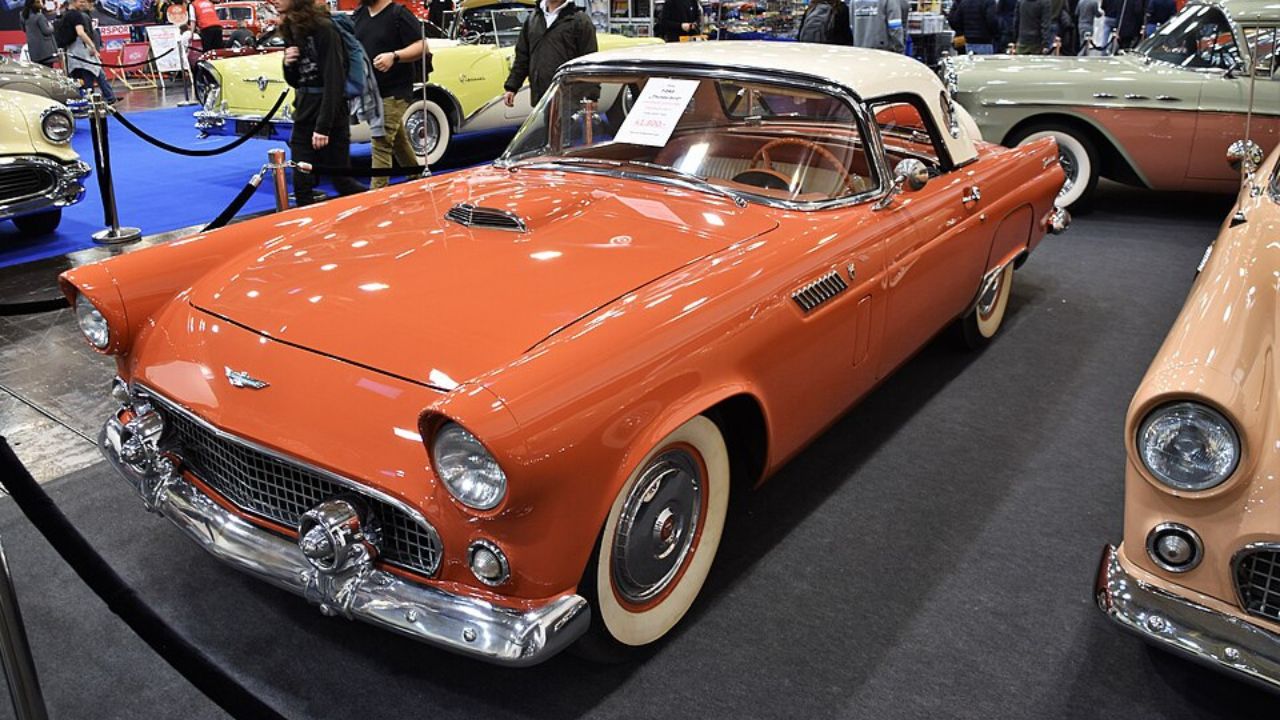
The 1955 Thunderbird already carried a clean, low-slung body with a long hood and short rear deck, but the 1956 update made several targeted changes that altered both appearance and function. The most obvious change came at the tail, where Ford added external rear fender-mounted spare tire storage, often called a continental kit. Moving the spare out of the trunk lengthened the profile and gave the car a more upscale, custom look that fit the growing personal luxury image.
Practicality shaped the cabin too. The Thunderbird remained a two-seater, which preserved its sporty proportions, yet the interior focused on comfort, with full carpeting, a padded dashboard, and a comprehensive gauge cluster. Buyers could choose a removable hardtop or a soft top, and the 1956 model introduced porthole windows in the hardtop on many cars, which improved side visibility and gave the roofline a distinctive signature. The combination of low roof, long hood, and neatly sculpted rear fenders created a silhouette that still reads as unmistakably mid century American.
Performance: V8 Power with Civilized Road Manners
Under the hood, the 1956 Thunderbird continued to rely on Ford’s overhead valve V8, which provided strong torque and smooth power delivery. Buyers could pair the engine with manual or automatic transmissions, and the powertrain was tuned to provide brisk acceleration rather than razor-edge racing performance. That approach matched the car’s mission as a fast, comfortable cruiser that could cover long distances with ease.
Chassis tuning followed the same philosophy. The Thunderbird used a conventional body-on-frame layout with independent front suspension and a live rear axle, a setup that favored durability and ride comfort. Steering and brakes were designed for predictable behavior on American highways, not for tight European circuits. Yet the relatively compact size and two-seat layout gave the car a more agile feel than larger contemporaries, so it occupied a middle ground between pure sports car and full-size luxury coupe.
Balancing Style and Everyday Usability
The real achievement of the 1956 Thunderbird lay in its ability to blend visual drama with real-world practicality. The continental kit and porthole hardtop turned the car into a rolling piece of design, while the engineering updates made it easier to live with. Relocating the spare tire freed trunk space for luggage, which mattered to buyers who actually used the car for weekend trips. The removable hardtop allowed owners to enjoy open-air motoring in good weather and closed-roof comfort when temperatures dropped.
Inside, the Thunderbird felt more like a well-appointed personal lounge than a stripped sports cockpit. Features such as power windows, power seats, and optional air conditioning signaled that this was a car for drivers who valued convenience as much as speed. That mix of luxury and performance helped the Thunderbird appeal to a broader audience than a typical roadster, pulling in buyers who might have otherwise chosen a full-size sedan or a more traditional coupe.
A Style Icon on Screen and in Pop Culture
The Thunderbird’s blend of glamour and usability made it a natural fit for film and television. Directors and set designers often chose Thunderbirds to signal taste, success, or romantic adventure, and the car’s compact proportions photographed well from almost any angle. Over the decades, various Thunderbird generations appeared in movies ranging from dramas to comedies, with the early two-seat cars often cast as the stylish choice for leading characters.
Lists of the car’s most memorable appearances highlight how different eras of Hollywood leaned on the Thunderbird’s image, from early two-seaters to later four-seat convertibles, building a reputation that extended beyond the showroom into popular culture. These iconic movie appearances reinforced the idea that a Thunderbird signaled individuality and flair, a perception rooted in the visual impact of models like the 1956 car.
Customization and the Hot Rod Influence
Although Ford positioned the Thunderbird as a refined personal car, the model also attracted customizers and hot rodders who saw the two-seat body as an ideal canvas. The 1956 version, with its distinctive rear treatment and clean front end, lent itself to subtle modifications that enhanced its original lines without overwhelming them. Builders experimented with lowered stances, custom paint, shaved trim, and updated wheels, often keeping the car’s essential profile intact.
One documented example of a customized 1956 Thunderbird showcases an East Coast interpretation that layers modern components onto the classic shell. This particular build features updated suspension, contemporary wheels, and a reworked interior, yet it preserves the signature silhouette and key design cues of the original car, as detailed in a feature on an East Coast style Thunderbird. Projects like this highlight how the 1956 design can accommodate performance upgrades and personal touches while still reading as authentically mid 1950s.
How the 1956 Model Differs from 1955 and 1957
To understand why enthusiasts single out the 1956 Thunderbird, it helps to compare it with the cars that bookend it. The 1955 model introduced the basic shape and two-seat layout, but it lacked some of the refinements that came later. The 1957 car, in contrast, adopted a more dramatic tail with larger fins and different rear treatment, signaling a move toward the styling trends that would dominate the late 1950s.
The 1956 version occupies a middle position, both chronologically and stylistically. It retains the clean purity of the 1955, while integrating the continental spare and porthole hardtop that many people now associate with the first-generation Thunderbird. At the same time, it avoids the more flamboyant fins of the 1957, so it feels slightly more restrained. This balance makes the 1956 car particularly attractive to collectors who want the classic two-seat look with the most recognizable details of the early Thunderbird era.
Collector Appeal and Market Perception
In the collector market, the 1956 Thunderbird benefits from its status as a one-year configuration that refined the original concept without yet transitioning to the four-seat layout that arrived later. Buyers often seek cars that combine distinctive styling features with practical drivability, and the 1956 model checks both boxes. The car’s mechanical components share much with other Ford products of the period, which simplifies maintenance and parts sourcing compared with some low-volume sports cars of the same era.
Originality and specification play a major role in value. Cars with factory-correct continental kits, porthole hardtops, and period-correct colors tend to attract strong interest. At the same time, tasteful restomods that update brakes, suspension, and powertrains without erasing the car’s visual identity also command attention, especially among buyers who plan to drive their cars regularly rather than preserve them as static showpieces.
Driving Experience in a Modern Context
On modern roads, a well-sorted 1956 Thunderbird offers a driving experience that feels more relaxed than a contemporary sports car but more engaging than a large 1950s sedan. The V8 provides ample torque for highway merging and passing, and the relatively short wheelbase gives the car a responsive feel in traffic. Sound insulation and seating comfort reflect the car’s luxury orientation, so long drives remain comfortable at moderate speeds.
Compared with modern performance cars, braking distances and cornering limits are modest, which encourages a different rhythm. Drivers tend to settle into a steady cruise, enjoying the view over the long hood and the sense of occasion that comes from piloting a mid century icon. The removable hardtop or soft top adds another layer of flexibility, allowing owners to tailor the experience to weather and mood.
Why the 1956 Thunderbird Still Matters
The 1956 Thunderbird matters today because it captures a specific American idea of personal mobility: a car that belongs to its driver as an expression of taste, not just as transportation. It predates the muscle car era and the later boom in personal luxury coupes, yet it foreshadows both by combining strong performance, stylish design, and a focus on the individual rather than the family. In that sense, it represents a bridge between early postwar sports cars and the more comfort-oriented performance machines that followed.
Designers and product planners still study cars like the 1956 Thunderbird when they think about how to mix emotion and practicality. The lesson is that drivers respond to vehicles that look special yet fit into daily life. The Thunderbird’s success showed that a two-seat car could thrive in the American market if it offered comfort, convenience, and a sense of occasion, not just raw speed.
What Enthusiasts Are Watching Next
Enthusiasts who care about the 1956 Thunderbird are watching several trends. One involves the balance between preservation and modernization. As more cars receive upgraded drivetrains, disc brakes, and modern electronics, purists and restomod fans continue to debate how far modifications can go before a Thunderbird loses its character. The example of carefully updated builds suggests that sympathetic changes can extend the car’s usable life while keeping its essence intact.
Another area of attention is generational interest. As younger collectors enter the hobby, they bring different expectations about performance, technology, and usability. Some are drawn to the 1956 Thunderbird precisely because it offers a manageable size, distinctive style, and a driving experience that feels connected yet not overwhelming. Clubs, online communities, and specialist shops play a role in introducing this generation to the car’s history and helping them keep these vehicles on the road.
Finally, the ongoing visibility of Thunderbirds in media, from classic films to modern references, continues to shape public perception. Each time a first-generation Thunderbird appears on screen or at a major event, it reinforces the idea that this car represents more than a nostalgic artifact. For many enthusiasts, the 1956 model remains the clearest expression of that idea, a machine that balanced style and performance in a way that still feels relevant long after its original moment.
More from Fast Lane Only
- Unboxing the WWII Jeep in a Crate
- 15 rare Chevys collectors are quietly buying
- 10 underrated V8s still worth hunting down
- Police notice this before you even roll window down
*Research for this article included AI assistance, with all final content reviewed by human editors.