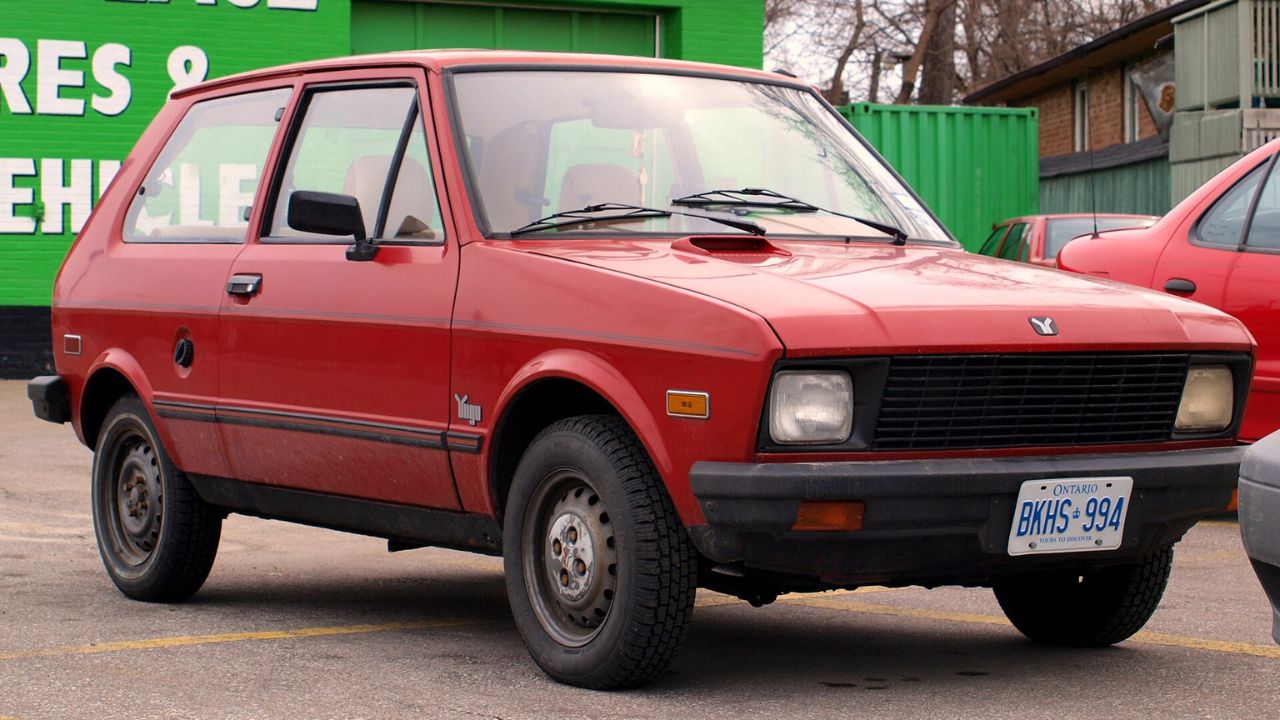
Few cars have become the punchline of as many jokes as the Yugo GV. For decades, it has been remembered as one of the least successful cars ever sold in America, often overshadowing the reasons it existed in the first place. Yet when the 1986 Yugo GV arrived on U.S. shores, it wasn’t intended to compete with luxury sedans or sports cars.
Its mission was much simpler: provide the cheapest new car Americans could buy.
That ambitious goal brought enormous attention—and expectations that no bargain-priced economy car could realistically satisfy.
The Car That Promised Affordable Transportation
Imported from what was then Yugoslavia, the Yugo GV was based on the Zastava Koral, itself derived from the mechanical foundations of the Fiat 127. American entrepreneur Malcolm Bricklin believed there was still room in the market for a basic, inexpensive car at a time when new vehicle prices continued to climb.
When the Yugo debuted in the United States, its sticker price of under $4,000 made headlines. For first-time buyers, college students, and families on tight budgets, it offered an opportunity to own a brand-new car instead of shopping the used market.
That affordability became its biggest selling point.
Basic by Design
The Yugo GV never pretended to be luxurious.
Its compact body, simple dashboard, cloth seats, and manual windows reflected its purpose as affordable transportation. Features that were optional—or unavailable altogether—helped keep costs low, allowing the GV to undercut nearly every competitor on price.
Power came from a modest 1.1-liter four-cylinder engine paired with a four-speed manual transmission. Performance was adequate for city driving, though highway acceleration required patience.
Everything about the Yugo emphasized simplicity over sophistication.
When Expectations Grew Too High
The Yugo’s biggest challenge wasn’t what it was—it was what people expected it to be.
Media coverage surrounding its incredibly low price generated tremendous curiosity. Many buyers hoped it would deliver the reliability of Japanese imports while costing thousands less.
Unfortunately, inconsistent build quality, frequent mechanical issues, and a limited dealer network quickly damaged its reputation. Even owners who understood they had purchased an inexpensive economy car often found themselves frustrated by problems that affected everyday usability.
Before long, the Yugo became a symbol of automotive disappointment.
More Complicated Than Its Reputation
Despite the jokes, the Yugo’s story isn’t entirely one of failure.
Many owners appreciated its fuel economy, low purchase price, and ease of maintenance. Parts were relatively simple, and mechanically inclined drivers often found the car straightforward to repair.
Its shortcomings were real, but so was its role in making new-car ownership accessible to buyers who otherwise couldn’t afford it.
Viewed through that lens, the Yugo becomes less of a disaster and more of an ambitious attempt to fill a unique niche.
A Collector’s Conversation Piece
Today, surviving Yugos are surprisingly uncommon.
Many were driven until they wore out, leaving relatively few well-preserved examples behind. As a result, clean 1986 GV models have become unexpected collector cars—not because they were engineering masterpieces, but because they tell an unforgettable story about automotive history.
At classic car gatherings, a Yugo often attracts as much attention as far more expensive vehicles. It reminds enthusiasts that not every memorable car earned its place through speed, luxury, or innovation.
Sometimes a car becomes legendary simply because of the conversations it sparks.
More Than the Punchline
The 1986 Yugo GV will likely always carry the reputation that followed it during its years on the American market. Yet reducing it to a punchline overlooks the circumstances that made it so intriguing.
It arrived with the difficult task of delivering brand-new transportation at an almost unbelievable price, and that promise inevitably created expectations no ultra-budget car could fully satisfy. While it fell short in important ways, the Yugo remains an unforgettable chapter in automotive history—a reminder that sometimes the boldest ideas leave the biggest impressions, even when they don’t succeed as planned.
More from Fast Lane Only