When people think of classic Volkswagen models, the Beetle, Bus, and Karmann Ghia usually come to mind. They all shared one defining trait: an air-cooled engine mounted in the rear. For decades, that engineering formula defined the Volkswagen brand.
Then came the K70.
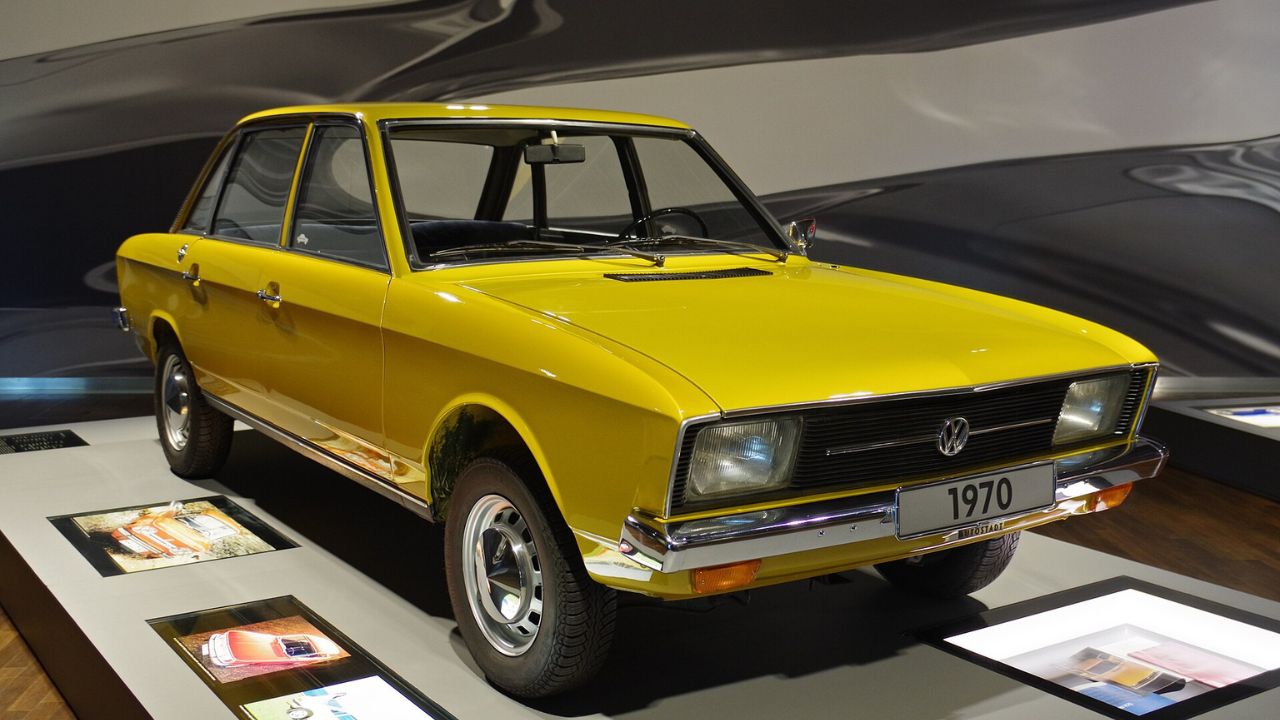
Introduced for the 1971 model year, the Volkswagen K70 broke nearly every rule the company had followed for years. It featured a front-mounted, water-cooled engine, front-wheel drive, and modern sedan styling that looked nothing like the rest of Volkswagen’s lineup. It was such a dramatic departure that many buyers didn’t know what to make of it.
The K70 may not have been a sales sensation, but it marked a turning point in Volkswagen’s evolution.
A Car That Wasn’t Originally a Volkswagen
The K70’s story began long before it wore a Volkswagen badge.
It was originally developed by NSU Motorenwerke as a replacement for the aging NSU Prinz. Before the car reached production, however, Volkswagen acquired NSU through its merger with Auto Union in 1969, forming what would eventually become Audi NSU Auto Union.
Rather than canceling the nearly finished project, Volkswagen decided to introduce the K70 under its own name.
The result was a sedan that looked and felt unlike anything else in the company’s showrooms.
Breaking with Tradition
The K70 represented a complete shift in engineering philosophy.
Instead of the familiar rear-mounted air-cooled engine, it featured a water-cooled inline-four mounted up front and driving the front wheels. This layout improved cabin space, luggage capacity, and handling while providing better heating and cooling for passengers.
Its clean, squared-off styling reflected the practical European design trends of the early 1970s. Large windows created excellent visibility, while the roomy interior comfortably accommodated five adults.
For buyers seeking practicality over nostalgia, the K70 offered a refreshing alternative.
Designed for Everyday Driving
The K70 wasn’t built to be a sports sedan.
Its focus was comfort, predictable handling, and everyday usability. Independent suspension at all four corners contributed to a composed ride, while front-wheel drive provided confident traction in wet and slippery conditions.
Several versions of the inline-four engine were available, delivering respectable performance for family transportation without sacrificing fuel economy.
Compared with Volkswagen’s rear-engined models, the K70 felt remarkably modern behind the wheel.
The Beginning of Volkswagen’s Future
Although buyers initially viewed the K70 as something of an oddball, its engineering pointed directly toward Volkswagen’s future.
The company soon embraced water-cooled, front-engine, front-wheel-drive vehicles across its lineup. Models like the Passat, Golf, and Scirocco would build on the same philosophy, eventually replacing Volkswagen’s long-running air-cooled designs.
In hindsight, the K70 served as an important bridge between two very different eras.
It introduced customers to the technologies that would define Volkswagen for decades to come.
An Overlooked Pioneer
The K70 never achieved the worldwide popularity of the Beetle or Golf, and relatively few examples survive today.
Its limited production numbers and unusual history have made it an intriguing collector’s car, particularly among Volkswagen enthusiasts who appreciate the brand’s lesser-known models.
Because it occupies such a unique place in the company’s history, the K70 often attracts attention precisely because it doesn’t resemble the Volkswagens most people expect to see.
The Bridge Between Two Eras
The 1971 Volkswagen K70 wasn’t just another family sedan—it represented a bold shift in Volkswagen’s identity. By embracing front-wheel drive and water-cooled engineering, it challenged decades of company tradition and paved the way for a new generation of vehicles.
While it remains one of Volkswagen’s least familiar classics, its influence can still be seen across the brand’s modern lineup. The K70 proved that sometimes a company’s strangest car is also one of its most important.
More from Fast Lane Only