The 2019 Bugatti Chiron Super Sport 300+ was not built to shave a tenth off a lap time or to win a marketing slogan. It was created to push a production-based car through a wall of air that had humbled generations of engineers, and to do it in a way that could be verified, repeated and sold to customers. When the car finally surged past the 300 mile per hour mark, it turned an abstract engineering obsession into a very real, very loud piece of history.
I see that run less as a stunt and more as a line in the sand. By turning a prototype achievement into a limited road car, Bugatti tried to freeze a moment in time, to capture the instant when combustion power, aerodynamics and human nerve all aligned at the outer edge of what a road‑going machine can do.
The 300 mph barrier that would not fall
For years, the idea of a street‑legal car hitting 300 miles per hour sat in the same mental drawer as supersonic airliners and flying taxis, technically imaginable but stubbornly out of reach. The physics are brutal: as speed climbs, aerodynamic drag rises faster than linearly, so every extra mile per hour demands a disproportionate jump in power, stability and tire strength. When a modified Bugatti Chiron derivative finally recorded a verified 304.773 mph, it was not just another top‑speed number, it was a clean break from everything that had come before, a moment when a production‑based machine crossed into territory usually reserved for aircraft, and that is why the figure still carries such weight in enthusiast circles.
Bugatti did not stumble into that milestone by accident. The company took a pre‑production version of what would become the Chiron Super Sport 300+, stretched and honed it, then sent it down a high‑speed test track where the record run was logged at a speed of 304.773 mph. That effort turned a theoretical “300” target into a concrete, TÜV‑verified number, and it set the stage for a road‑going special that would carry the achievement out of the proving ground and into private collections.
From prototype obsession to road‑legal statement
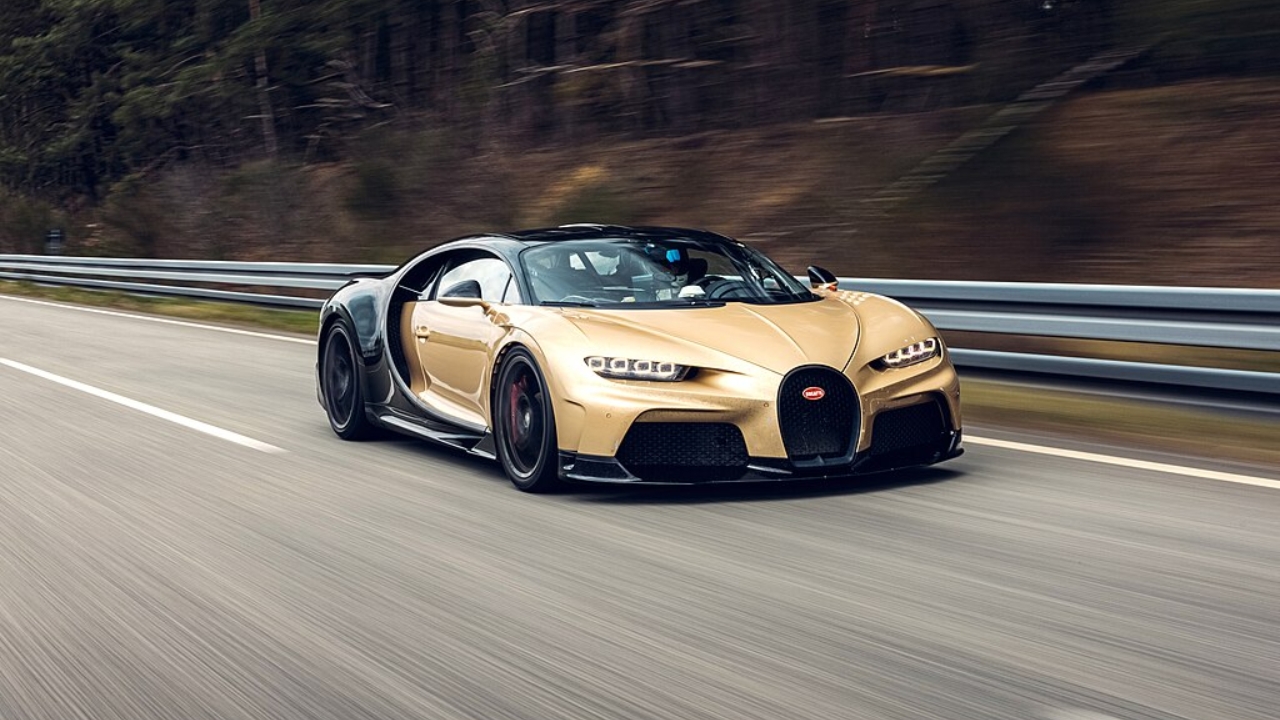
What fascinates me most is how Bugatti translated a single, extreme run into a car that customers could actually buy and register. The company did not simply badge the record car and call it a day, it created the Chiron Super Sport 300+, a special edition limited to 30 units that visually and mechanically echoed the prototype while still meeting the expectations of ultra‑wealthy owners. In other words, the brand tried to bottle the atmosphere of that high‑speed pass and pour it into a road‑legal package that could sit in a Monaco garage as comfortably as it sat on a German test track.
Bugatti framed the Chiron Super Sport 300+ as a kind of anniversary present to itself, a way to celebrate being the first to push a production‑based hypercar beyond the magic “300” figure. The car’s elongated tail, distinctive black and orange finish and meticulous detailing were all designed to remind buyers that this was the fastest Bugatti, a machine born directly from the record‑setting program and limited to 30 units rather than a mass‑produced variant.
Engineering a car to live at aircraft speeds
Turning a Chiron into something that could live near 300 mph required more than a power bump, it demanded a rethinking of how the car sliced through the air and stayed planted on the tarmac. The record‑run machine used a lengthened rear section, a reworked diffuser and a stripped‑back body to reduce drag while still generating enough stability that the driver could keep the car straight as the world blurred around him. That black and orange prototype was not a styling exercise, it was a rolling experiment in how to make a 2‑tonne hypercar behave like a guided missile without crossing into full race‑car territory.
Reports on the run describe how the black and orange prototype was carefully prepared as a hardcore version of the Chiron hypercar, with its bodywork and chassis tuned specifically for the unique aerodynamic effect that builds as a car approaches 300 mph. That focus on airflow and stability, rather than just raw horsepower, is what allowed the driver to thread the needle between lift and drag, and it is the same philosophy that carried over into the production Chiron Super Sport 300+ that followed.
Why this record mattered to Bugatti’s identity
Speed records are never just about numbers, they are about identity, and Bugatti treated the 300 mph chase as a way to define what the brand stands for in the modern era. When the company’s leadership talked about the run, they framed it as the end of a “hypercar race war” to be the first to that figure, a way of saying that the contest was over and that Bugatti had planted its flag. In that light, the Chiron Super Sport 300+ becomes less a car and more a statement that the marque still leads the conversation whenever the topic turns to outright velocity.
One account of the achievement even described how Bugatti Blazes Past 300 mph and is “The First To Ever Do It,” echoing the pride that surrounded the project inside the company. Another source notes that Bugatti is already looking toward a future intertwined with Rimac, but also stresses that the brand has been “shaped by speed,” a phrase that captures why the 300 mph run was treated as a capstone for the combustion‑era Chiron rather than just another marketing bullet point.
Legacy, rivals and the limits of physics
Once a barrier falls, the conversation quickly shifts to what comes next, and the Chiron Super Sport 300+ is no exception. Dealers and commentators have pointed out that They have surpassed the magic number that no production car had been able to reach, and that the record has become a reference point for anyone trying to sell or compare exotic machinery. At the same time, the run has sparked debates about what counts as a “production” record, how many cars need to be built, and whether a one‑way speed should carry the same weight as a two‑way average, arguments that underline just how disruptive the 304.773 mph figure really was.
Even with those debates, the Chiron Super Sport 300+ still sits at the center of discussions about the world’s fastest road cars. One detailed breakdown notes that The Fastest Production Car In The World title, in that analysis, “The Award Goes To The Bugatti Chiron,” specifically the Bugatti Chiron Super Sport that traces its lineage directly back to the 300 mph program. Another account of the record emphasizes how a modified Chiron prototype hit 304.77 mph, with the velocity verified by Germany’s Technical Inspection Association, and credits “Andy and the” team behind the wheel and in the pits for turning a theoretical limit into a measured reality. Taken together, those perspectives show why the 2019 Bugatti Chiron Super Sport 300+ did not just chase history, it caught it, documented it and then parked it in a handful of very lucky garages.
More from Fast Lane Only: