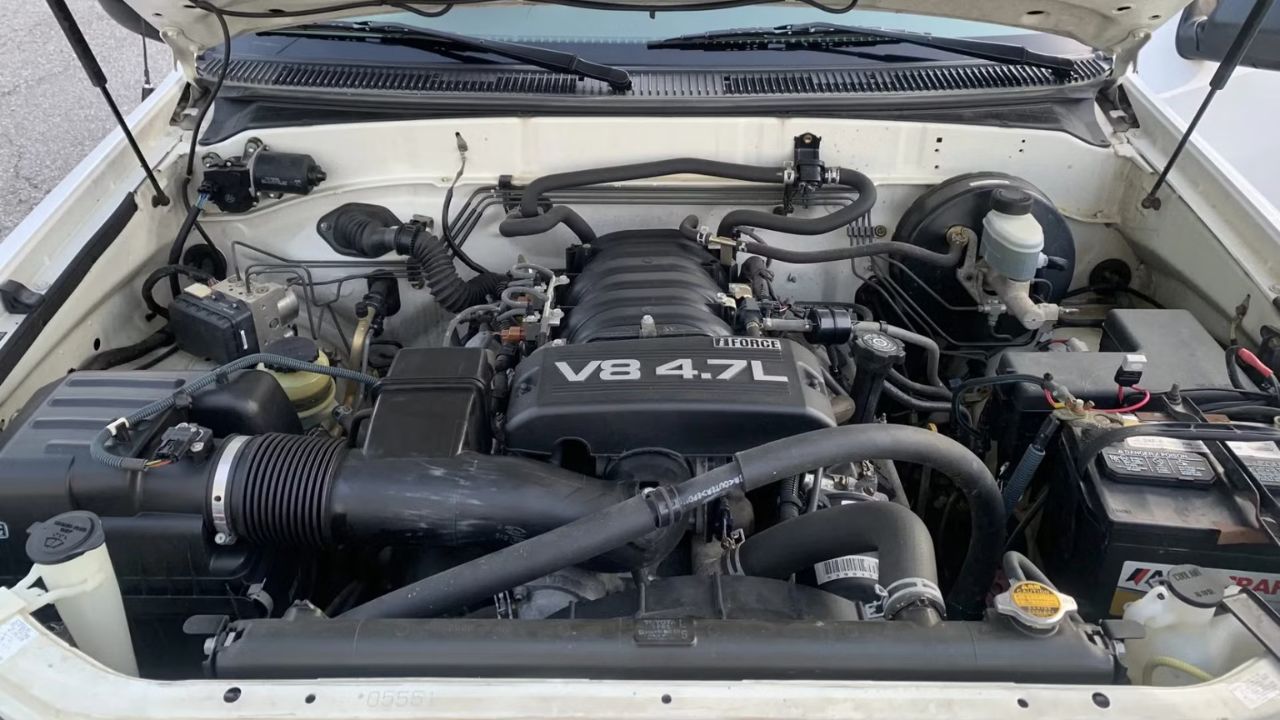
The 2UZ-FE V8 was never the flashiest engine in Toyota’s lineup, yet it quietly built a reputation that owners trust more than any spec sheet. In high-mileage Land Cruisers, Lexus LX models, Tundras, and Sequoias, this 4.7‑liter workhorse has become shorthand for an SUV or truck that can cross 250,000 miles and keep going. That status did not arrive by accident; it came from conservative engineering, real-world abuse, and a used market that still pays a premium for vehicles built around it.
What happened
When Toyota launched the 2UZ-FE in the late 1990s, the company aimed at heavy-duty use rather than headline-grabbing performance. The engine used a 4.7‑liter V8 layout with a cast-iron block and aluminum heads, paired with relatively modest compression and conservative tuning. In early applications such as the Land Cruiser 100 Series and first-generation Lexus LX 470, it was calibrated more for durability and smoothness than outright power.
That same V8 later found its way into full-size SUVs and pickups that would become long-haul staples. The first-generation Toyota Sequoia, sold from 2001 through 2007, relied on the 2UZ-FE as its primary powerplant. Used buyers still seek out those Sequoias specifically for their V8, and pricing data for the 2001 to 2007 model years shows that clean, higher-mileage examples hold more value than many rivals of the same age, a pattern tied directly to the perceived longevity of the engine that powers them, as seen in used Sequoia market analysis.
Owners did not just keep these vehicles for school runs. Across North America, 2UZ-FE powered SUVs and trucks took on towing, off-road travel, and commercial work. Reports of Tundras and Land Cruisers surpassing 250,000 miles without major engine work became common, and several documented trucks have gone far beyond that threshold. Coverage of Toyota models that routinely reach or exceed 250,000 miles lists the 4.7‑liter V8 among the engines that help push owners into that high-mileage territory, with examples of Land Cruisers and Tundras that cross the quarter-million mark while still serving as daily drivers in high-mileage Toyota roundups.
In the truck world, the 2UZ-FE’s reputation has been amplified by extreme cases. One frequently cited example involves a Toyota pickup that accumulated an extraordinary odometer reading while retaining its original V8. Reports on the highest-mileage Toyota trucks highlight a Tundra that logged more than 1,000,000 miles with its 4.7‑liter engine still running, a story that cemented the V8’s status among enthusiasts and appears in coverage of the highest-mileage Toyota examples.
As those stories circulated, online communities of Land Cruiser and Lexus LX owners began to treat the 2UZ-FE as a long-term asset. Buyers actively search for well-maintained examples with documented service, even if the odometer shows 200,000 miles or more. The engine’s track record under harsh conditions, including heavy towing and off-road overlanding, has turned it into a reference point for what a durable SUV powertrain should look like.
Why it matters
The legend around the 2UZ-FE matters because it challenges the usual assumptions about vehicle age and mileage. In most segments, a 15‑year‑old SUV with 200,000 miles is treated as a disposable asset, valued only for its remaining months of service. With Toyota’s 4.7‑liter V8, the calculation is different. Owners and used buyers treat that mileage as the halfway point rather than the end of the story, which changes how they spend, maintain, and drive these vehicles.
Several factors explain why the engine inspires that confidence. The cast-iron block adds weight but resists wear, distortion, and overheating damage better than many aluminum alternatives. Conservative output figures mean the engine rarely operates near its structural limits, which reduces stress on internal components. Timing belt service intervals are well documented, and when owners follow them, the V8 tends to avoid catastrophic failures that might sideline other high-mileage engines.
That mechanical conservatism shows up in real-world data. Long-term owners report that major internal repairs are rare before 300,000 miles if oil changes and cooling system maintenance are kept on schedule. In many cases, ancillary components such as starters, alternators, and suspension parts fail long before the engine itself. This pattern aligns with broader reporting on Toyota trucks and SUVs that regularly surpass 250,000 miles, where the limiting factors tend to be rust or transmission wear rather than engine failure, as reflected in the documented experiences of high-mileage Toyota owners in the same high-mileage Toyota coverage.
For used buyers, that reliability has financial consequences. The first-generation Sequoia is a clear example. Despite its age, pricing guides and market analyses show that 2001 to 2007 Sequoias with the 4.7‑liter V8 command higher asking prices than many domestic rivals of similar vintage and mileage. Analysts tie that resilience in value to the engine’s reputation, noting that shoppers often prioritize a clean maintenance history on the 2UZ-FE over lower mileage on less proven powertrains in competing SUVs, a trend documented in used Sequoia evaluations.
The same logic shapes how owners plan their vehicle lifecycles. A contractor who buys a used Tundra with 180,000 miles on its 4.7‑liter V8 can reasonably expect years of additional service if the truck has been maintained. That expectation encourages investment in preventative work such as timing belt replacement, suspension refreshes, and rust mitigation, because the underlying engine is seen as a safe bet. For families running older Land Cruisers and Lexus LX 470s, the V8 becomes a justification for keeping a fully paid-off SUV rather than trading into a newer, debt-financed model.
Beyond individual wallets, the 2UZ-FE’s track record influences how enthusiasts and industry observers think about sustainability. Extending the useful life of a heavy SUV or truck reduces the frequency of new-vehicle production, which carries its own environmental footprint. While these V8s are not fuel efficient by modern standards, their ability to stay on the road for decades shifts part of the emissions conversation from tailpipe output alone to total lifecycle impact. A vehicle that lasts 400,000 miles without major engine replacement spreads the embedded manufacturing emissions of that powertrain over a much longer period.
The engine’s status also shapes brand perception. Toyota’s marketing often leans on durability, but the 2UZ-FE provides tangible proof that supports the slogan. Stories of million-mile Tundras and 300,000‑mile Land Cruisers give the company a credibility that purely theoretical engineering claims cannot match. That credibility, in turn, helps sell newer trucks and SUVs that no longer use the 4.7‑liter V8 but trade on its legacy.
What to watch next
The 2UZ-FE is no longer in production, which raises a key question for high-mileage SUV owners and shoppers: what comes after it. Toyota has shifted toward more efficient powertrains, including smaller displacement V6 engines and hybrid systems, in both its trucks and SUVs. These newer engines promise better fuel economy and lower emissions, but they have not yet accumulated the same decades-long track record under heavy use that made the 4.7‑liter V8 famous.
One area to watch is how the used market treats the successors to 2UZ-FE powered models. As newer Tundras, Sequoias, and Land Cruisers age into the 150,000 to 250,000‑mile range, buyers will start to compare their real-world reliability directly against the older V8. If those newer powertrains can match or exceed the longevity of the 4.7‑liter, the premium currently attached to 2UZ-FE vehicles may begin to flatten. If they fall short, the older V8 trucks and SUVs could become even more prized, particularly in regions where rust is less of a concern.
Another factor is parts support. As the fleet of 2UZ-FE equipped vehicles ages, owners will rely on a mix of original components and aftermarket suppliers to keep their engines running. So far, support remains strong, with timing belt kits, water pumps, ignition components, and sensors widely available. Over time, the availability and quality of those parts will play a role in how many of these engines can realistically reach 400,000 miles or more without major intervention.
More from Fast Lane Only