

Zündapp’s KS 750 sidecar outfit sent power to two wheels, not one. A shaft from the gearbox drove the rear wheel and the sidecar wheel together through a differential, and the rider could lock that differential with a lever when the ground turned soft.
That arrangement made a heavy three-wheeler behave a little like a small all-wheel-drive vehicle. It also suited the job the German army had in mind. The outfit was meant to cope with desert sand, Russian winters and mountain tracks.
The design came out of a strict wartime brief. Even so, the drivetrain is what set it apart, because the army wanted three soldiers’ worth of payload carried over soft ground.
The brief that shaped the KS 750 sidecar outfit
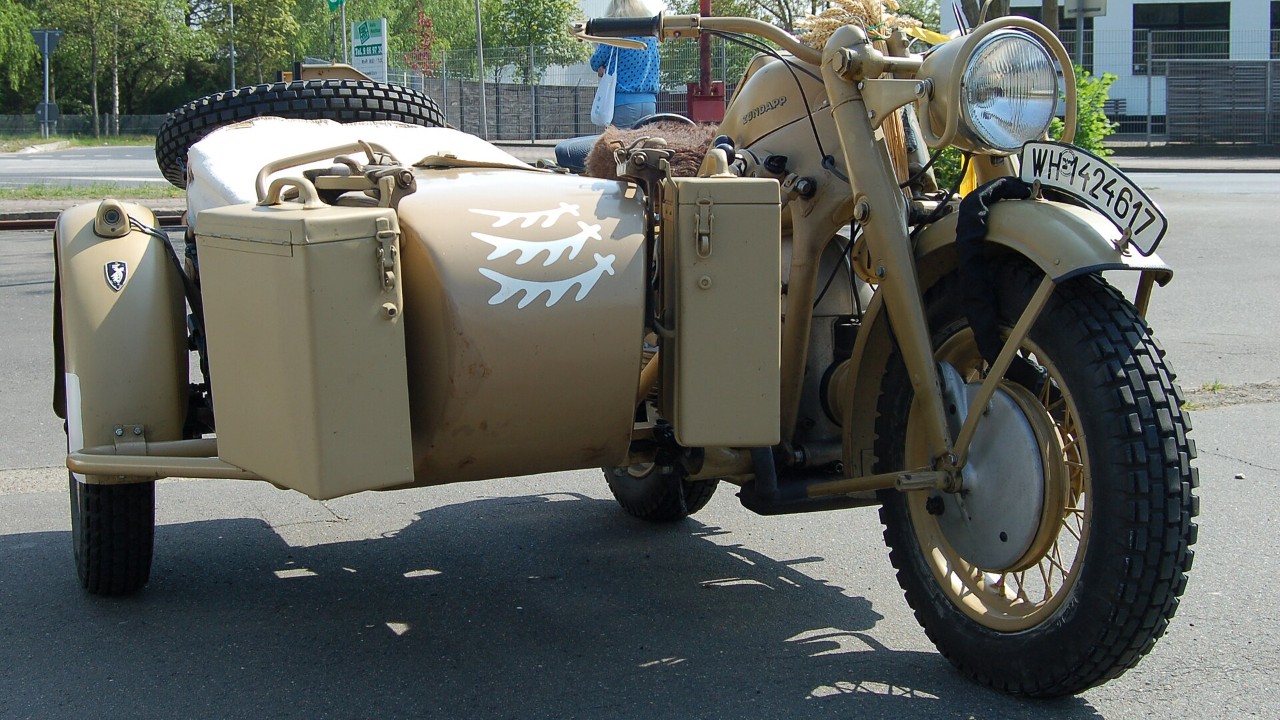
The army wrote its wish list in 1937. According to Motorcycle Classics’ profile of a 1942 Zündapp KS750, it wanted a 500-kg payload, equal to three fully equipped soldiers. It also asked for an 80-km/h cruising speed, a 95-km/h top speed and at least 150 mm of ground clearance.
There was a slow-speed demand, too. The machine had to crawl at about 3 mph, so it wouldn’t run over marching troops. In addition, the brief called for 5.00 x 16-inch tires, and the ground clearance had to leave room for snow chains. Cost, Motorcycle Classics says, was not a constraint.
Zündapp’s prototypes went through testing alongside BMW’s R75 in 1939. The army judged the Zündapp design superior, the magazine says. It then asked BMW to build the Zündapp under license, but BMW refused at first.
Instead, BMW kept its own R75 and borrowed from its rival. Motorcycle Classics says the R75 adopted the Zündapp-designed rear-wheel drive, hydraulic brake system and wheels. As a result, the two machines ended up sharing many standardized parts. That’s why the driven sidecar wheel and its differential lock appear on both bikes.
A flat twin built for rough ground
Power came from an overhead-valve, air-cooled flat twin. Motorcycle Classics lists it at 751cc and 26 hp at 4,000 rpm. It also notes that the cylinders were tilted up 5 degrees for extra ground clearance.
Rider Magazine’s retrospective on the KS750 gives the bore and stroke as 86 mm by 75 mm. It also describes a Solex carburetor with a cold-weather air-warming tube and three “tornado” air cleaners. In other words, Zündapp built the engine for dust, sand and freezing air as much as for power.
Rider says the finished outfit weighed about half a ton before anyone loaded fuel or ammunition. Moving that much weight across mud explains why the sidecar wheel needed drive.
Range mattered as much as traction. Rider says the 23-liter tank was good for more than 200 miles. Motorcycle Classics, meanwhile, quotes about 60 mph flat out and 36 mpg.
How the KS 750 sidecar wheel got its power
On most sidecar outfits, the sidecar wheel just rolls along. On the KS 750, Rider says, the driven sidecar wheel was there for traction. Rider also describes an open driveshaft running down the right side of the machine.
Between the two driven wheels sat a differential. Rider calls it a limited-slip unit that could be locked for tandem drive. Meanwhile, Motorcycle Classics says that with the differential unlocked, about 70% of the power went to the motorcycle’s rear wheel and the rest went to the sidecar.
That split matters because the two wheels travel different distances in a turn. With the differential free, the outfit could still corner on a road. At the same time, the sidecar wheel added pull whenever the rear tire started to spin.
Locking the differential
When the going got really bad, the rider could lock the two wheels together. Rider says a lever beneath the rider’s right side switched the differential between limited-slip and full lock.
Locked, both wheels turned at the same speed. That helped in mud or sand, but Rider notes it made cornering difficult. Motorcycle Classics goes further. It says the lock was meant only for off-road use, and that on pavement the outfit would handle erratically.
The gearbox added more flexibility. Rider describes a hand shifter on the right side of the tank plus a separate lever for reverse gearing. Motorcycle Classics also mentions a low and high range. The two sources count the total gears differently, so we’ve left the number out.
Production and what happened after the war
The first KS750 with a Steib sidecar left Zündapp’s Nürnberg factory in 1941, Rider says. Zündapp built roughly 18,000 before bombing halted production in late 1944. Motorcycle Classics gives a similar picture, with a spec-sheet figure of 18,695.
Paint changed with the theater. Early outfits were dark gray, the Luftwaffe used charcoal, and Afrika Korps machines wore desert beige, Motorcycle Classics says. After 1943, every KS 750 left the factory in dark yellow.
Many of them stayed in service long after 1945. According to Rider, a lot of KS750s ended up in Eastern Europe and kept working there until the Berlin Wall fell in 1989. Western collectors then traded used Volkswagens for them.
More from Fast Lane Only


