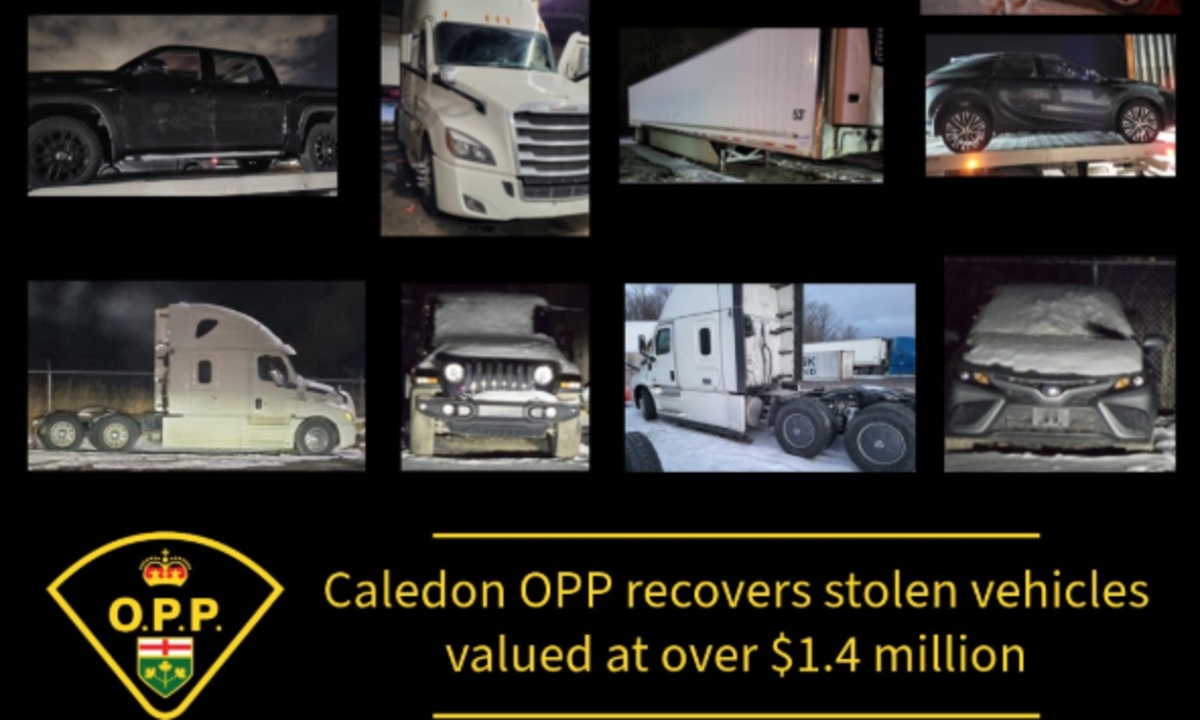
In less than the time it takes to brew a pot of coffee, thieves in Ontario quietly removed a fleet of exotic vehicles worth about $1.4 million from a dealership lot and vanished into the dark. The heist, which saw eight high performance cars driven away in under ten minutes, has intensified concern about how quickly organized groups can strip a business of its most valuable assets. It also fits into a broader pattern of luxury car thefts across the province that is testing both police resources and dealer security strategies.
Eight cars, eight minutes, $1.4 M gone
Investigators say the Ontario theft unfolded with almost clinical efficiency, with eight vehicles taken in roughly the same number of minutes and a total loss pegged at about $1.4 M. Surveillance footage described in coverage of the incident shows a small group of suspects moving with purpose, entering the lot, locating specific high value models, and then driving them away in rapid succession. Among the vehicles listed in reports are a Ferrari 812 G and a Porsche 911 G, both identified as halo products that would be instantly recognizable to any enthusiast and highly desirable to criminal buyers.
The choice of targets underscores how carefully the thieves appear to have planned the operation. The Ferrari 812 GTS and Porsche 911 GT3 are not only expensive, they are rare enough that legitimate resale channels would be limited, which suggests the cars may already have been earmarked for export or for dismantling into parts. Reporting on the case notes that the group completed the theft in roughly eight Minutes, a span so short that staff did not realize anything was wrong until long after the last car had left the property. That compressed timeline, combined with the focus on top tier models, has led police to treat the incident as the work of an experienced crew rather than opportunistic joyriders.
A province on edge after repeated luxury heists
The Ontario supercar theft did not occur in isolation. Earlier this year, Police in Canada were already searching for suspects after roughly $2 million in luxury vehicles disappeared from a dealership in Oakville, a community west of Toronto. In that case, Eight high end cars were taken from the same lot in a single overnight window, with investigators in Ontario again pointing to a coordinated group that appeared to know exactly where to find keys and how to bypass barriers. Video from the Oakville scene shows multiple vehicles being driven off the property in quick succession, echoing the speed and confidence seen in the $1.4 M heist.
Local authorities in Halton, which includes Oakville, have described the Oakville theft as a brazen operation that unfolded before anyone on site could intervene. Security Video captured the suspects moving through the dealership and then exiting with a string of luxury vehicles, including models that would typically be kept in secure indoor displays. Coverage of the Oakville case notes that police believe the thieves may have had access to keys or detailed knowledge of where they were stored, a detail that resonates with the Ontario supercar theft where the suspects also appeared to move directly to specific vehicles without hesitation.
How thieves are outpacing dealership security
The Ontario heists highlight a growing gap between the value of vehicles on dealer lots and the level of protection many sites can realistically maintain. In both the $1.4 M supercar theft and the Oakville incident, suspects were able to enter the property, locate keys or ignition systems, and drive away in multiple cars before alarms or staff responses could meaningfully slow them down. Reporting on the Oakville case describes thieves using simple tools such as crowbars to pry open access points, then exploiting the fact that once inside, many vehicles could be started and moved with minimal additional effort.
Experts interviewed in coverage of the $1.4 M theft point out that high end models like the Ferrari 812 GTS and Porsche 911 GT3 are often stored together for display, which can unintentionally create a single, concentrated target for organized groups. Once thieves gain entry to that area, they can move from car to car with little obstruction, especially if keys are kept nearby for sales staff convenience. The speed of the Ontario operation, with eight Cars removed in roughly eight Minutes, suggests the suspects had either conducted prior surveillance or obtained inside information about the layout and security routines, a pattern that aligns with what Police in Canada have suggested in other Ontario luxury thefts.
Why supercars are such attractive targets
The specific models taken in the Ontario heist help explain why organized groups are willing to take significant risks for a few minutes of access. A Ferrari 812 GTS and a Porsche 911 GT3 sit at the top of their respective lineups, with price tags and performance figures that make them aspirational purchases even for affluent buyers. Reporting on the case notes that in total, eight high value cars were removed, a mix that likely included multiple exotics whose combined worth reached the $1.4 M mark. For thieves, that concentration of value in a small number of vehicles means a single successful raid can rival the profits of many lower level property crimes.
Coverage of the Ontario theft has also drawn on commentary from enthusiasts such as Hank, described as a lifelong gearhead with a particular love for classic American muscle cars and 1960s Mopars. While Hank focuses on older performance models, his analysis of criminal incentives is relevant to modern supercars. He notes that thieves prefer easy targets, and that a dealership lot filled with high end vehicles, limited overnight staff, and predictable routines can be far more attractive than trying to steal a single car from a private driveway. When that lot includes rare machines like the Ferrari and Porsche models taken in Ontario, the potential payoff for a few minutes of risk becomes even more compelling.
Mounting pressure on police and the industry
For law enforcement, the Ontario supercar theft and the Oakville case have become emblematic of a broader challenge in tracking and recovering high value vehicles that can be moved across borders or stripped for parts in a matter of hours. Police in Canada have publicly acknowledged the difficulty of pursuing crews that operate quickly, leave few traces, and may have links to international networks that specialize in moving stolen cars out of Ontario. In the Oakville investigation, Halton officers have appealed for tips and have circulated Video clips of the suspects and vehicles, hoping that the distinctive appearance of some models will generate leads.
Dealerships, meanwhile, are under pressure to rethink how they protect inventory that can be worth tens of millions of dollars across a single property. Reporting on the Oakville theft notes that Nearly $2 million in vehicles disappeared in one incident, a figure that, combined with the $1.4 M Ontario heist, illustrates how quickly losses can mount. Industry voices have begun to call for more robust overnight staffing, better key management, and layered physical barriers that make it harder to simply drive cars off the lot. Yet as long as groups can execute operations like the eight car, eight Minute theft without immediate detection, the balance of advantage appears to rest with the thieves, leaving both police and dealers racing to catch up.
More from Fast Lane Only