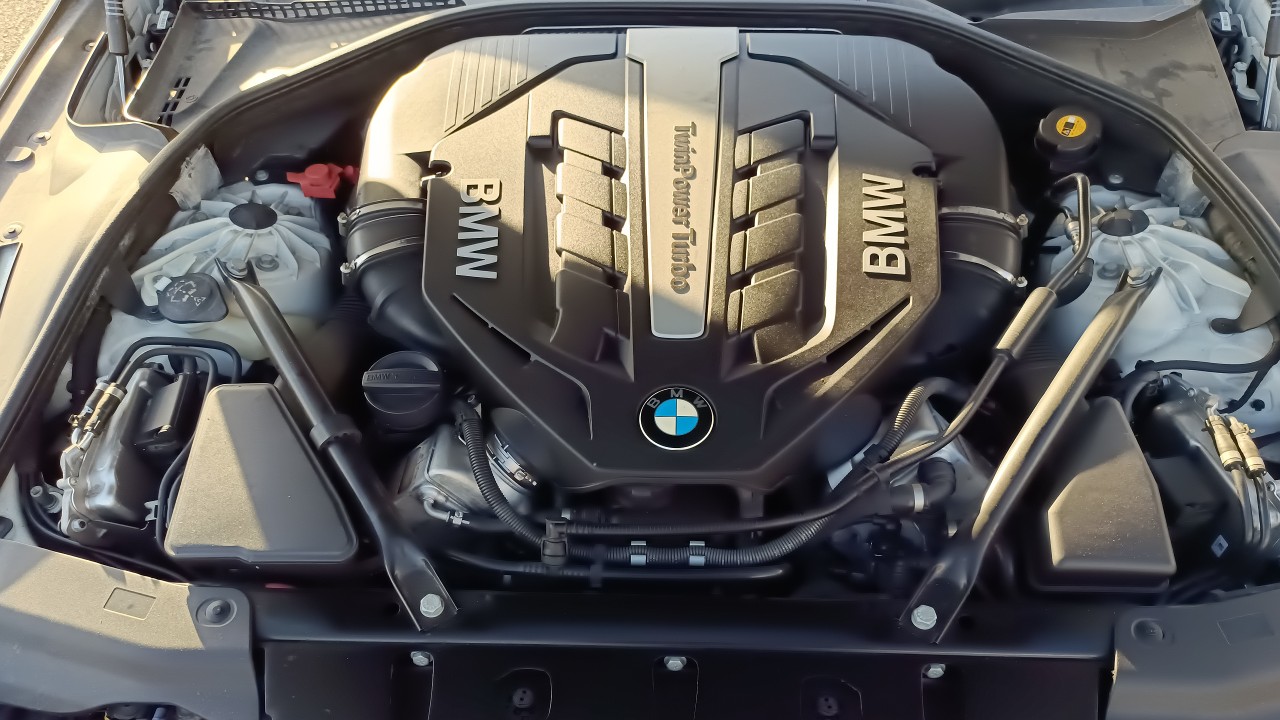
While much of the industry prepares to shrink engines or abandon them altogether, BMW is publicly arguing that large combustion powerplants still have a future under Euro 7. The company is working to keep its V8 and even V12 engines alive by reengineering them to satisfy tougher emissions rules without sacrificing the character that made them desirable in the first place. That stance sets BMW apart from rivals that are rapidly downsizing, and it raises a pointed question about how far regulation can go before it fundamentally reshapes performance cars.
BMW’s contrarian bet on big engines
As Euro 7 edges closer, many manufacturers are treating it as the final chapter for large displacement engines, yet BMW is moving in the opposite direction. The company has signaled that its high output combustion units will not be quietly retired, but instead adapted so they can continue in markets governed by Euro 7 as well as in regions with looser rules. Social media posts highlighting that, while competitors are downsizing, BMW is still showcasing big engines under Euro 7 scrutiny underline how deliberately the brand is positioning itself as a holdout for traditional performance.
That contrarian posture is not just marketing language, it is backed by engineering commitments. According to BMW’s own messaging, the firm is investing in combustion development so that its larger engines can comply with Euro 7 without massive cost spikes that would make them unviable. One widely shared update noted that BMW is proving big engines are not finished in Europe, even as stricter Euro 7 regulations approach, and that the company believes it can meet the standard without “massive investment” that would price these cars out of reach. In a landscape where downsizing is often framed as inevitable, BMW is effectively arguing that technology, not cylinder count, should decide what survives.
Inline-six and V8: the core of BMW M’s future
At the heart of BMW’s strategy is a clear pledge to keep its signature inline-six and V8 engines in service. BMW M boss Frank van Meel has confirmed that the M division’s inline-six and V8 will be engineered to satisfy Euro 7 rules with no loss of performance, and that there is no four-cylinder M5 on the horizon. That statement is significant, because it directly rejects the idea that future M flagships must downsize to four cylinders with hybrid assistance in order to survive, a path some rivals have already taken.
Frank van Meel has also described how BMW intends to achieve this balance between regulation and performance. He has pointed to detailed work on combustion and exhaust management, including strategies to avoid excessive temperature build up, as key to making the engines cleaner without dulling their response. Separate reporting on BMW’s broader powertrain plans reinforces that message, noting that the company expects its iconic inline-six and V8 to continue under Euro 7 and that it is not planning a wholesale shift to smaller engines in its performance portfolio. In other words, BMW M is treating Euro 7 as a technical challenge to be solved, not a signal to abandon the engines that define the brand.
V8s beyond Europe and the business case for keeping them
BMW’s insistence on preserving its V8s is not limited to Europe, and the business logic is straightforward. The company has confirmed that V8 engines are “here to stay,” particularly in markets such as the United States and the Middle East, where demand for high power, long range and effortless torque remains strong. In those regions, customers still associate a V8 with status and refinement, and the regulatory environment is less aggressive than Euro 7, which gives BMW more room to sell such engines in volume.
That global demand helps justify the engineering work required to keep V8s compliant in stricter jurisdictions. Reporting on BMW’s long term combustion strategy notes that the brand expects to continue offering V8 powered models in markets with strong appetite, while using the same core engine families, tuned for emissions, in Euro 7 territories. Another analysis has suggested that Germans could soon be watching Americans drive BMWs with V8s and wishing they could enjoy the same thing, a reminder that regulation is fragmenting the global market. For BMW, maintaining a robust V8 program is both a way to satisfy key customers and a hedge against a future in which some regions move faster toward full electrification than others.
V12 survival through Rolls-Royce
If keeping V8s alive under Euro 7 is ambitious, preserving a V12 borders on defiant, yet BMW is doing exactly that through Rolls-Royce. Company messaging shared in mid January made clear that the V12 is not being consigned to history, but will continue in Rolls-Royce products that justify its complexity and cost. One widely circulated post framed it as “Long Live the V12,” explaining that BMW has decided the rumored death of big displacement engines has been exaggerated and that the twelve cylinder will remain part of the Rolls-Royce lineup.
Additional reporting has underlined that point, stating that BMW is keeping V12s alive and that the engine will not yet go the way of the dodo, because it still powers Rolls-Royce models built by BMW. Another source noted that Rolls and Royce products will continue to feature the twelve cylinder powerhouse, even as stricter regulations close in. The logic is clear: the V12 is now a low volume, ultra luxury proposition, reserved for cars where customers expect the smoothest possible power delivery and are willing to pay for the engineering needed to make such an engine compliant.
How BMW plans to satisfy Euro 7 without neutering performance
BMW’s confidence that its V8s and V12s can coexist with Euro 7 rests on a specific technical approach rather than vague optimism. The company has emphasized “exhaust optimization” as a central tool, focusing on how gases are treated and managed after combustion so that pollutants are reduced before they ever reach the tailpipe. In one detailed explanation, BMW described how it is working on exhaust layouts and aftertreatment systems that keep regulators satisfied without resorting to what it jokingly compared to an automotive “juice cleanse,” a nod to the fear that emissions hardware might sap character from the engines.
That focus on exhaust and thermal management aligns with Frank van Meel’s comments about avoiding temperature build up, and with broader statements that BMW can meet Euro 7 without massive investment that would make big engines uneconomic. Social media posts tied to the company’s Euro 7 preparations have stressed that stricter regulations are widely regarded as the end of the road for large engines, yet BMW is using targeted engineering changes to keep them viable. The strategy suggests that, at least for now, the brand believes it can thread the needle between regulatory pressure and the expectations of customers who still want an inline-six, a V8 or even a V12 under the hood.
More from Fast Lane Only