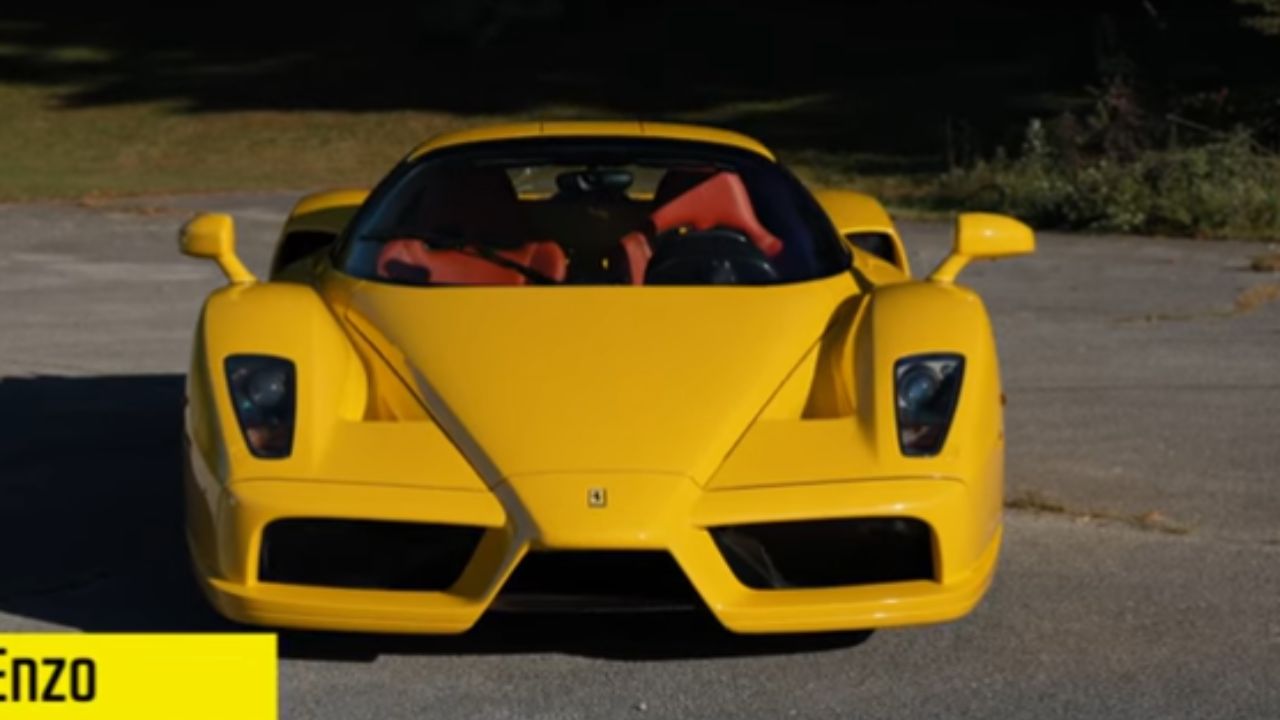
The $18 million sale of a 2003 Ferrari Enzo has done more than set a headline-grabbing record. It has redrawn the pricing map for modern Ferraris and signaled that the market is suddenly willing to treat early-2000s halo cars with the same reverence as blue-chip classics. If you collect, trade, or simply track these cars, you are now operating in a different world.
Instead of a one-off anomaly, the Enzo’s result slots into a broader surge in Ferrari values that is reshaping what you can expect to pay, and what you might be able to sell for, in the next auction cycle. The numbers coming out of Mecum’s Florida block, and from the wider list of the year’s priciest cars, suggest you are watching the start of a repricing, not the end of one.
The $18 million Enzo that reset expectations
You have probably seen the clip by now: a 2003 Ferrari Enzo crossing the block at Mecum and hammering at a staggering $18 million. The sale, shared widely by accounts such as SCR SPIKE CAR, did not just edge past the previous benchmark, it effectively tripled it. Earlier reporting on This Enzo notes that the new figure represents a near three-time increase on the record set by a comparable car in Monterey in 2023, and crucially, this time there was no charity component or special one-off provenance to inflate the price.
That context matters for you as a buyer or seller, because it strips away the usual excuses that auction watchers lean on when a number looks too wild to repeat. This Enzo was not a factory one-off or a celebrity-owned oddity, it was a highly original, low-mileage example from the remarkable Ferrari collection of Phil Bachman, a name that carries weight in concours circles. When a car like that sells for $18 million in a standard commercial setting, you are looking at a new reference point that other Enzo owners, and their auctioneers, will not hesitate to cite.
How Mecum Kissimmee turned into a Ferrari price laboratory
If you zoom out from that single Enzo, the broader Mecum Kissimmee picture tells you why this sale should not be dismissed as an outlier. At the Mecum Kissimmee Sale, Ferraris dominated the top of the sheet, with the auction’s leading results all wearing the prancing horse. The event became a de facto stress test for how much liquidity exists at the very top of the modern and vintage Ferrari market, and bidders answered with paddles raised.
Reporting on the Highlights from Mecum Kissimmee underscores just how concentrated that demand was. The top 10 Ferraris alone accounted for $124 m in sales, with total Ferrari proceeds cited at $124 million, and the headline vintage lot, a 1962 Ferrari 250 GTO, changing hands for a figure in the $30 million range. When a single marque can generate that kind of volume in one venue, you are looking at a market that is not just healthy but aggressively repricing its benchmarks.
From 250 GTO royalty to modern icons
For years, you could safely assume that the most explosive numbers in the Ferrari world would come from 1960s royalty like the 250 GTO. That pattern still holds at the very top, as the same Ferrari coverage notes a 1962 Ferrari 250 GTO selling for a headline figure and reinforces the enduring pull of the GTO nameplate. The 250 G designation remains shorthand for the kind of scarcity and racing pedigree that underpins the classic end of the market.
Yet when you look at the broader list of the year’s priciest cars, you see modern Ferraris muscling into territory once reserved for 1960s icons. The Jan survey of the Most Expensive Cars 2026 Sold at Public Auction shows contemporary halo models like the LaFerrari Aperta sharing space with the 250 GTO on the leaderboard. When you see a yellow LaFerrari Aperta and a 1962 Ferrari GTO mentioned in the same breath, it tells you that the market is starting to treat modern limited-series cars as peers rather than junior partners.
The Bachman effect and the power of provenance
To understand why this particular Enzo and its stablemates hit such stratospheric numbers, you need to look at the name attached to the titles. The late Phil Bachman spent decades assembling a Ferrari collection that was as obsessive about color and originality as it was about model selection. Many of his cars were delivered in unusual hues, kept in near-delivery condition, and shown sparingly, which meant that when they finally surfaced, you were not just bidding on a model, you were bidding on a story.
The scale of that story came into focus in a video recap of the sale, where commentators marvel at the Bachman Ferraris generating figures in the 140 m to 150 m range, with one voice emphasizing that 140 million 150 million in the current climate is “as good as it gets.” When you combine that kind of provenance with already coveted models like the F50 and Enzo, you create a multiplier effect that you, as a bidder, have to price in. The Jan rundown of the Ten Most Expensive at Public Auction in 2026 highlights the Bachman 1995 Ferrari F50 among the year’s top results, reinforcing how a single collection can tilt the entire market’s perception of what modern Ferraris are worth.
What the spike means for you in the next auction cycle
When a modern Ferrari like the Enzo suddenly trades at $18 million, you are not just watching a record, you are watching the reference grid for the whole segment shift. Private sale analysis of vintage Ferraris notes that This Enzo, despite being a private deal with no charity angle, still managed to nearly triple the previous benchmark, which suggests that the appetite for top-tier examples is not confined to the auction room. If you are holding an Enzo, F50, or LaFerrari, you now have hard evidence that the ceiling is higher than anyone assumed three years ago.
For buyers, the message is equally clear. The combination of a blockbuster Mecum Kissimmee run, where Ferraris delivered $124 m in top-line results, and a Jan leaderboard of Sold cars dominated by Maranello’s finest, tells you that waiting for a “correction” in modern Ferrari pricing may be wishful thinking. Instead, you should expect auction estimates for Enzos, F50s, and LaFerraris to be recalibrated upward, with consignors pointing to the 250 GTO and 250 G lineage to argue that today’s modern icons are simply following the same trajectory, only on a compressed timeline.
More from Fast Lane Only