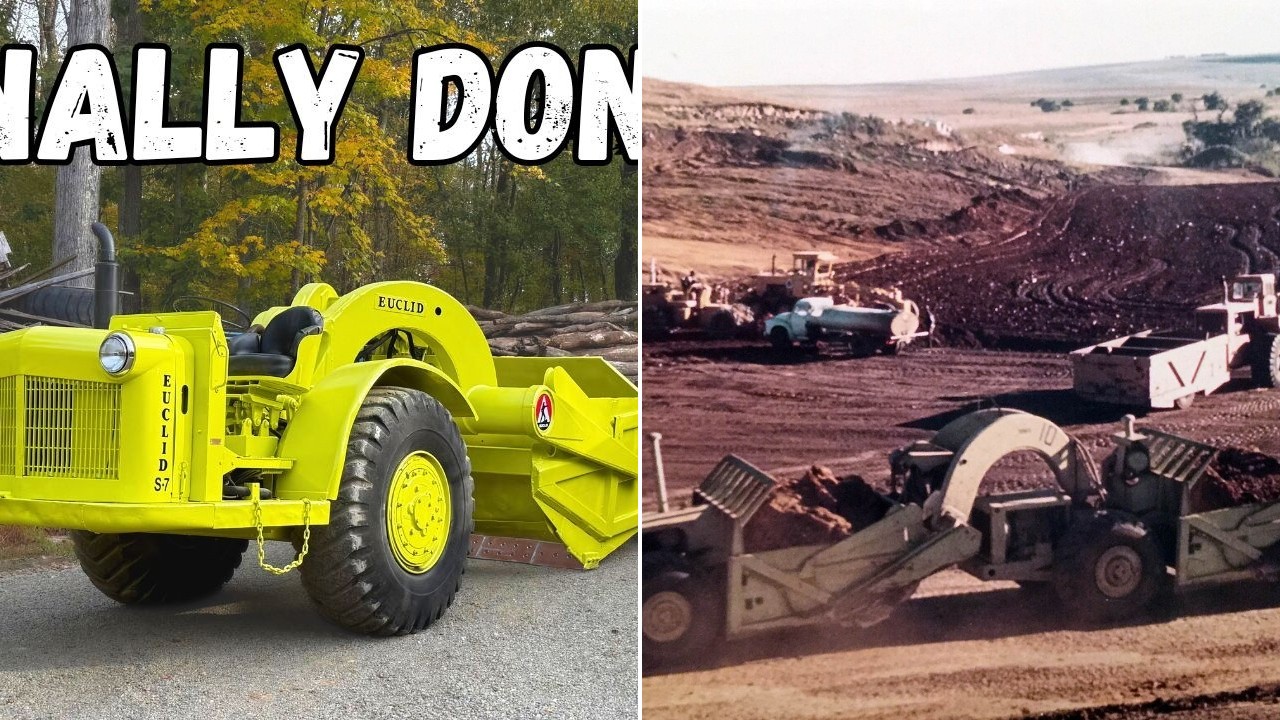
Restoring old earthmoving equipment takes patience, because parts for it simply don’t exist anymore. A heavy-equipment restorer who posts as @DieselCreek spent months on a 1950s Euclid scraper with his helper Kim. In the last part, they build a new driveshaft, repaint the front and bolt on new cutting edges, then take it to a steam show and fill its bowl with dirt.
First, he explains the problem with the old driveline. Its universal joints are obsolete, he says, and he can’t find replacements anywhere.
A Driveshaft Built From Scratch
“Me and Kim, neither one of us, I believe, have ever built a drive shaft before,” he says at 4:43.
So they buy modern joints and a slip joint, trim the tube and true it up on the lathe. Then they mark both ends with paint so the yokes stay in phase. Along the way, their shop press bends sideways, so Kim turns the part to push it square.
After that, he welds each joint in four offset sections to stop the shaft from warping. Because the finished shaft won’t fit in one piece, they assemble one joint in place.
The old joints also had grooves worn into them by the bearings. Later, a friend named Sam machines spacer rings so the yokes clear the mounting plates.
Paint, Headlights And Decals
Meanwhile, the front gets more putty and a lot more sanding. Then they spray it green, pull the tape while the paint is wet and fit the headlights.
“This has been the better part of six or seven months now in the making,” he says at 22:20.
He also brings back a body line down the middle of the hood where dents had flattened it. When one decal goes on crooked, he jokes that it is the “leaning tower” of the machine.
The Euclid Scraper Goes To Work
Next, four custom-made cutting edges bolt on without trimming, even though he worried about his measurements.
Finally, they haul it to the dozer pit at the National Pike Steam Show. By the end, dirt spills over the sides of the bowl. “This thing works awesome,” he says at 44:58.
Still, he is clear about its limits. He says it loads about three-quarters of a bowl on its own, because these machines were built to be pushed by a dozer for a full load.
Before the cutting edges go on, they open the bowl to reach the moldboard. At the show, Kim films while he runs the machine through a logged area.
Odds And Ends Still To Fix
He says the hydraulic valve for the ejector leaks oil, and so does a new air relay valve for the brakes, which he suspects picked up blasting media.
Meanwhile, a steam show member gave him the missing center gauge, which turned out to be a tachometer. He also still needs a small single-trumpet air horn for the grille, and he plans to be back at the show in May and August.
What To Plan For When Restoring Vintage Equipment
His project shows where the time really goes:
- Expect to make parts, because many old components can’t be bought anymore.
- Mark parts before you cut or press them, so they go back in the right position.
- Weld in short, offset passes to keep long parts from warping.
- Test the machine under real work, then make a list of the leaks that show up.
What Comes Next
He isn’t quite finished. A hydraulic valve and a brake air valve still leak, and he plans to send the gauges to a restorer. For now, the machine’s next outing is a parade at the same steam show.
More from Fast Lane Only