Sometimes the best part of a barn find isn’t the car. A Minnesota builder named Christopher Runge went to buy a barn-find Porsche in 2010 and came home with the seller’s metal-shaping tools as well. Now he and his son Finn hand-build aluminum sports cars, as they showed in a shop tour posted by @Hagerty.
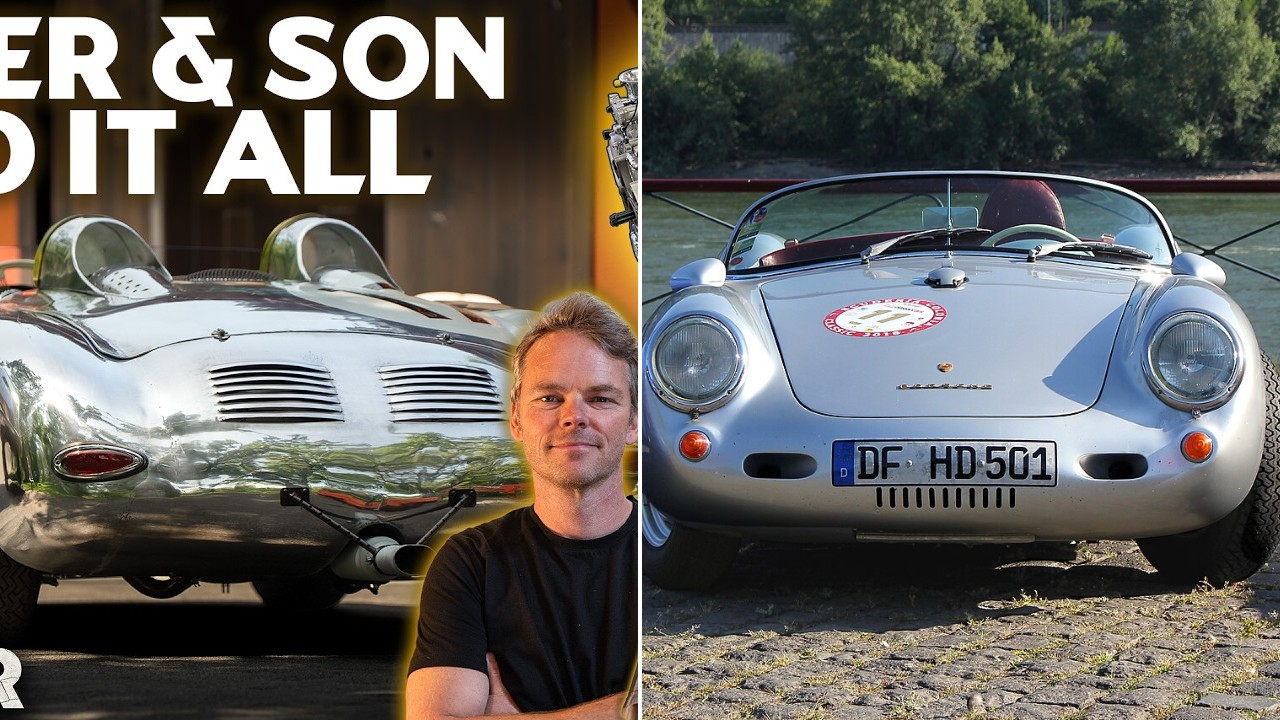
Host Tom Cotter visits the Runges near Alexandria, Minnesota. Christopher tells him that the 1967 Porsche 912 came from South Dakota, where the seller’s barns were full of her late husband’s things.
From A Barn Full Of Tools To Car No. 17
After that trip, he taught himself to shape metal from books and a DVD. Then he built his first car on a Formula Vee race car that he says cost about $3,500.
“I had the body on and the car moving in 12 months,” he says at 6:40.
Today, he says, they are “just finishing number 17.” He still shapes panels by hand on an English wheel and builds wooden bucks to form them over.
He says he had long admired small post-war racers built by hand, and the tools gave him a way to try. So he set up an English wheel at the family farm and spent about a year researching a chassis.
How Father And Son Build Aluminum Sports Cars
Meanwhile, Finn brings the new tools. He uses CAD, 3D scanning and full-size 3D-printed mockups to test how parts fit. In a second shop, a stretch-forming machine shapes a seat in about an hour, while Christopher says it takes him two and a half to three days by hand.
The car in the shop began as an unfinished chassis from the late Ted Dunham. Now it has a 911-based engine cut down to four cylinders, which Christopher says makes about 220 hp in a car of about 1,300 pounds.
Christopher also says many clients are more like art collectors. Finn has even 3D-scanned a customer in his driving position, so the car fits him exactly.
A Flat-Eight Of Their Own
However, the biggest surprise is a full-size 3D-printed model of a flat-eight engine that they are developing with an engineering firm in the U.K.
“It’s been about 2 and 1/2 years on this project,” he says at 32:39. Finn says the printed model has more than 80 pieces, and Christopher says three pre-production engines are underway.
According to Christopher, the first goal was simply to see if a flat-eight could fit where a 911’s engine goes. He says it will power their own cars, and they plan to offer it to other builders too.
What To Ask When A Barn Find Comes With Extras
His start shows why it pays to look past the car itself:
- Ask what else is for sale, because tools and parts can be worth as much as the car.
- Start with a cheap, simple project to learn a new skill before taking on a big one.
- Mix old methods and new tools, since each can save time on different jobs.
- Expect a first project to take a year or more, and keep going anyway.
What Comes Next
Car No. 17 is about to go to its owner, and the first long block of the flat-eight is nearing completion. Eventually, Christopher says, he would like to put the new engine into a car the pair designed around it.
More from Fast Lane Only