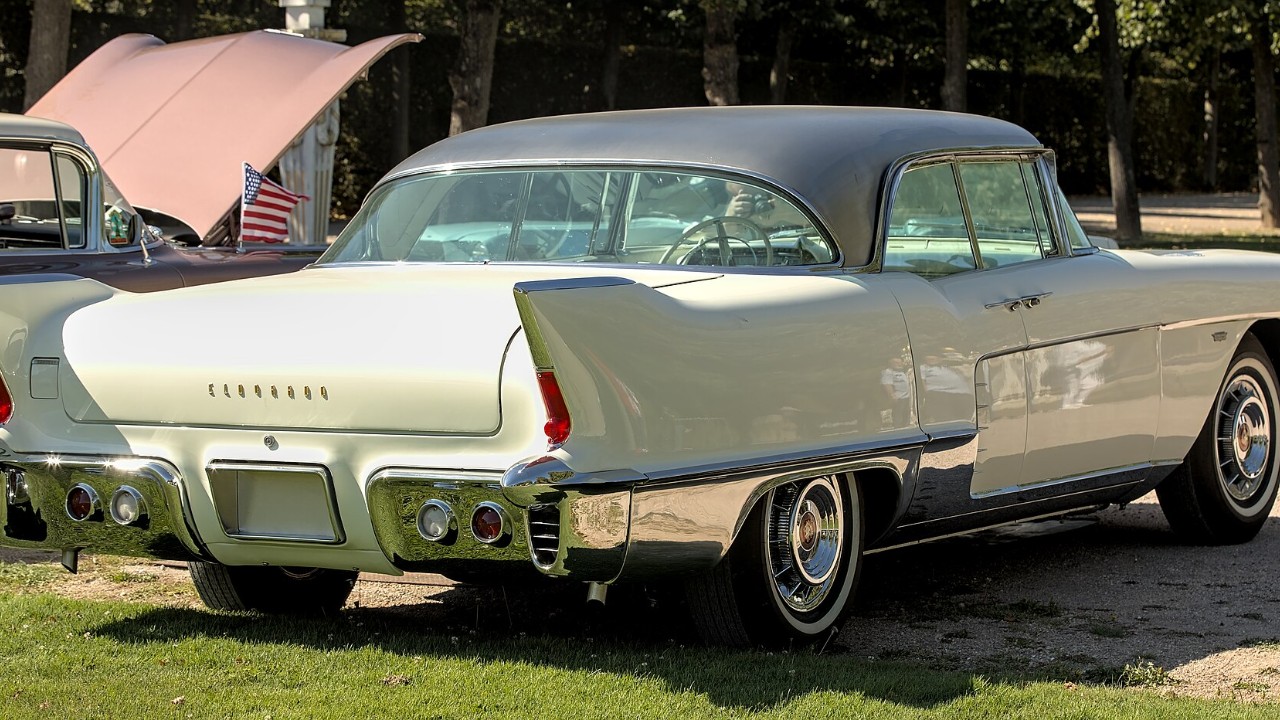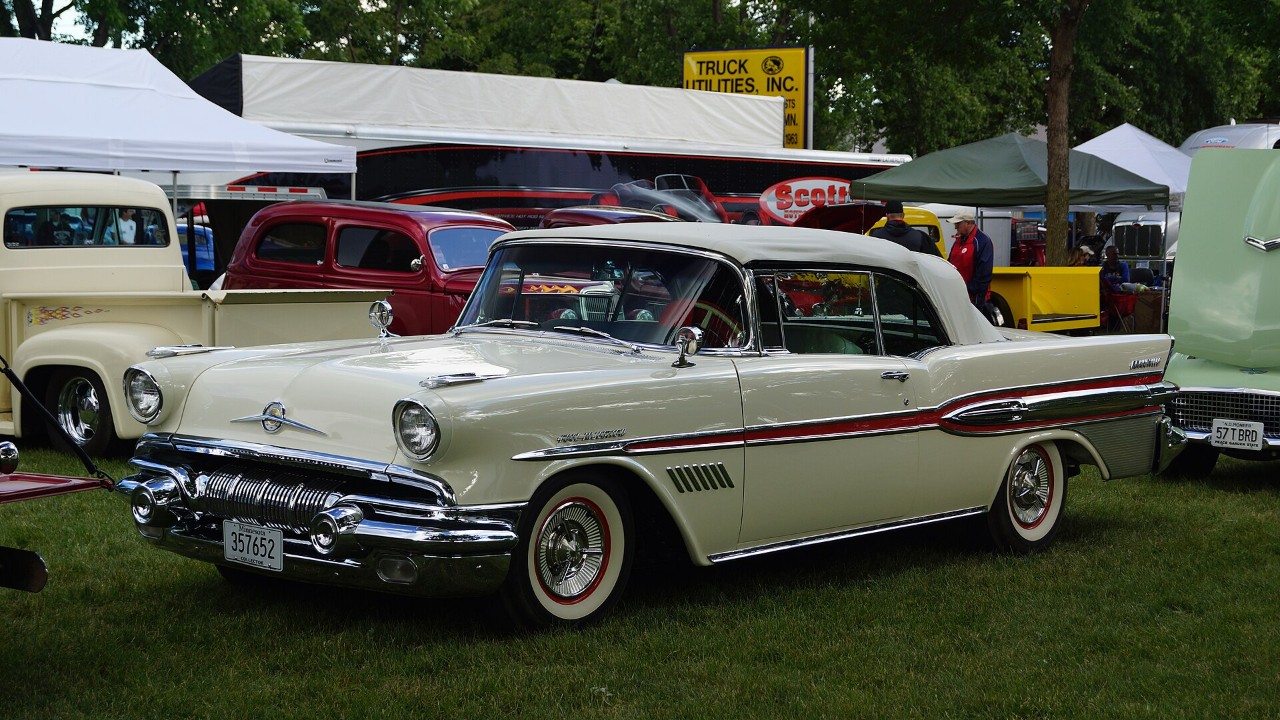
Pontiac built only 630 Bonnevilles for 1957, and every one was a fuel-injected convertible. The 1957 Pontiac Bonneville came one way, with nearly every option already fitted. It also cost $2,677 more than a Star Chief convertible.
Pontiac did not build it for volume. Instead, the factory built one for each of its dealers, so every showroom had one to show. That made it a rare car from the very first day.
Here is how the first Bonneville came together, what sat under its hood and what Pontiac did with the name next. The details come from RM Sotheby’s, Conceptcarz and Greg Wapling’s car spotter’s guide, all linked below.
One 1957 Pontiac Bonneville for each dealer
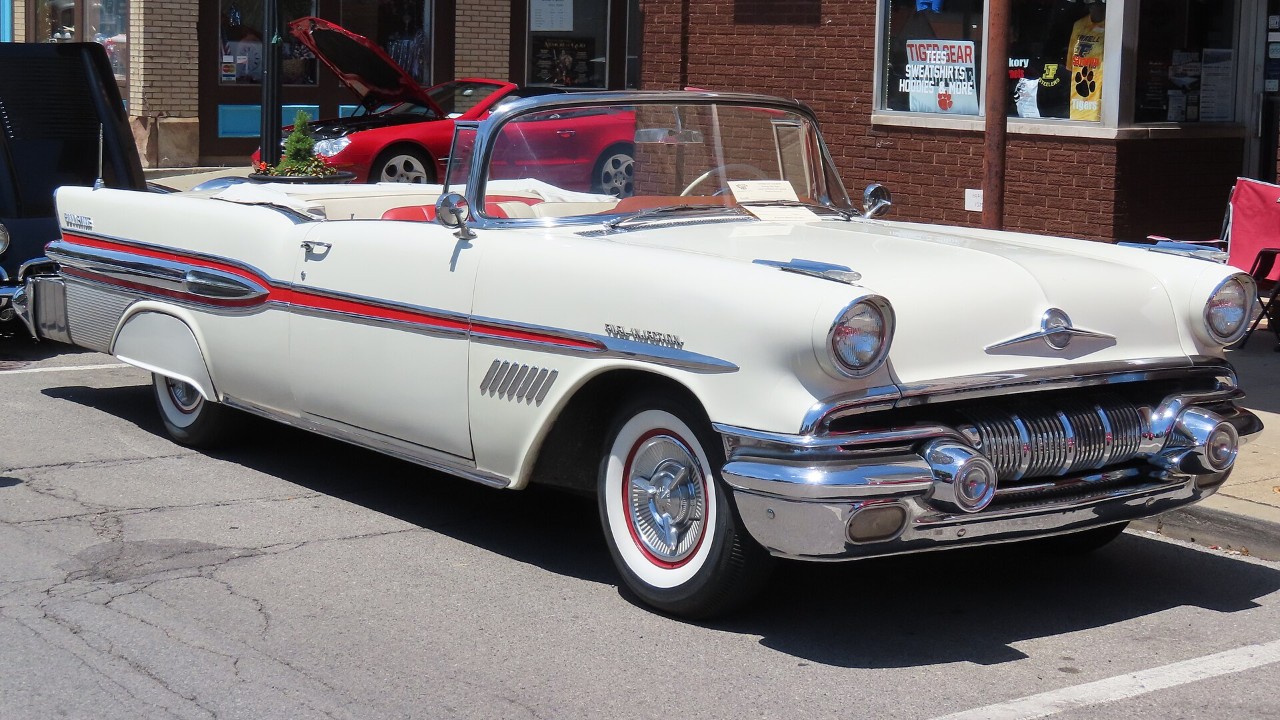
Conceptcarz says Pontiac built “630 Bonneville Convertibles for 1957, one for each of its 630 dealers.” In its own history of the car, RM Sotheby’s also gives 630, one per dealer in the United States. RM adds that Pontiac built two prototypes as well.
The car made its debut on January 11, 1957, according to Greg Wapling’s spotter’s guide. At that point, it was not yet a model line of its own. Instead, Conceptcarz places it in the Custom Star Chief sub-series for 1957.
The two prototypes differed inside. Hagerty’s valuation guide says they reportedly had four bucket seats, while production cars used two bench seats. Hagerty also gives the 630 figure and the two prototypes, matching RM.
As for the name, it came from Utah. Conceptcarz says Pontiac borrowed it from the Bonneville Salt Flats, the site of early auto contests and land-speed records.
The man behind the first Bonneville
The Bonneville arrived just after a change at the top. Conceptcarz says Semon “Bunkie” Knudsen became general manager of Pontiac in July 1956. He was then the youngest general manager of any GM division, the site adds.
Knudsen wanted a younger image for the brand. Conceptcarz quotes his reasoning: “You can sell a young car to old people, but you can’t sell an old car to young people.” Likewise, the Wapling guide credits Knudsen with the car’s performance focus.
Fuel injection on a 347 V8
Under the hood, every 1957 Bonneville had the same engine. RM Sotheby’s describes it as a “Rochester fuel-injected 347-cubic-inch V-8” with a 10.25:1 compression ratio. Pontiac offered it only with fuel injection, the Wapling guide confirms.
Specifically, the injection system was mechanical. Conceptcarz calls it a continuous-flow unit engineered by Harold Barr and Zora Arkus-Duntov.
The horsepower figure is harder to pin down. According to Conceptcarz, Pontiac never released an official rating and said only that the engine made “in excess of 300 horsepower.” RM Sotheby’s gives 315 hp. Meanwhile, Conceptcarz also mentions 310 and 317 in other passages. So the safest figure is the one Pontiac used: over 300 horsepower.
Fuel injection set the car apart from the rest of the 1957 Pontiac line, where a carburetor did the job. A carburetor draws fuel into the air by suction as it flows into the engine. By contrast, an injection system meters the fuel and sprays it in.
Then power reached the rear wheels through an automatic. RM lists a Strato-Flight Hydra-Matic three-speed automatic, and Hagerty also lists a three-speed automatic. Conceptcarz, for its part, lists Hydra-Matic as standard.
What $5,782 bought in 1957
The Bonneville cost $5,782 in 1957, according to RM Sotheby’s. By comparison, an ordinary Star Chief convertible cost $3,105, RM says. Both Conceptcarz and the Wapling guide put the gap at $2,677.
For that money, almost everything came standard. RM lists power steering, brakes, windows, top, antenna and seats. It also lists Pontiac’s top radio, leather upholstery, a padded dash, an automatic headlight dimmer and special wheel covers. In addition, Conceptcarz adds an underseat heater and names the radio as the Wonderbar and the dimmer as the Autronic-Eye.
That left very little to choose. In fact, the Wapling guide says only two options existed: air conditioning and an outside-mounted Continental kit spare tire.
Spotting one also takes a closer look. The Wapling guide says most cars were white with red “flashes,” while a few had custom colors. It also points to the tri-blade wheel covers as a feature of the car. Hagerty adds that Bonneville badging identifies the 1957 convertibles.
The 1957 Pontiac Bonneville’s quick second act
The limited first year did not last. For 1958, Pontiac made the Bonneville its own series, both RM Sotheby’s and Conceptcarz say. Conceptcarz adds that a two-door Sport Coupe joined the line, and that a Bonneville paced the Indianapolis 500 that year.
Volume rose fast, too. According to RM Sotheby’s, Pontiac built almost five times as many Bonneville convertibles for 1958 as it did for 1957.
More from Fast Lane Only
- Unboxing the WWII Jeep in a Crate
- 15 rare Chevys collectors are quietly buying
- 10 underrated V8s still worth hunting down
- Police notice this before you even roll window down
This article was created with the help of AI and was reviewed and edited by Fast Lane Only editors before publication.